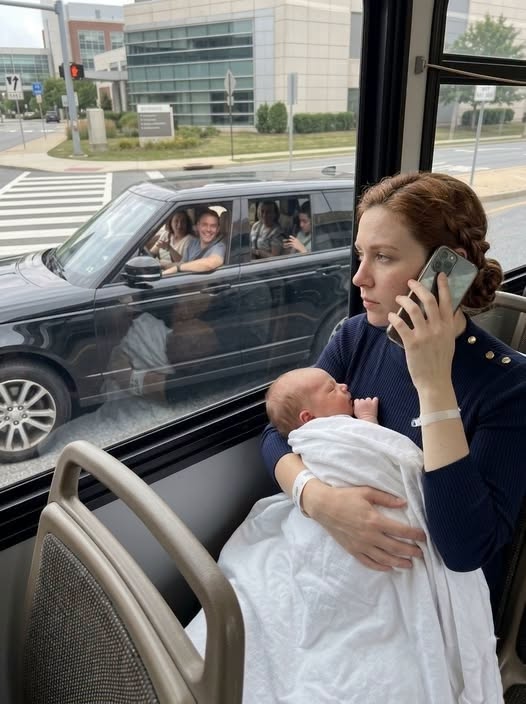
PART 1: Fifty Dollars and a Bus Fare
“This should be enough for the bus. Hurry home. My mother is waiting for us at lunch.”
I stood beneath the glass entrance canopy of St. Catherine’s Medical Center in Boston, staring at the crumpled fifty-dollar bill and loose change my husband had just placed in my hand.
Our son was five days old.
I had been discharged less than fifteen minutes earlier after an emergency C-section, and every movement sent a burning pain across my abdomen.
For a moment, I thought I must have misunderstood him.
“Jason, what do you mean by the bus?”
My voice sounded weak, even to me.
“I can barely walk.”
Jason Mercer, my husband of two years, sighed as though my recovery were an inconvenience I had arranged specifically to ruin his afternoon.
“Please don’t start, Claire. Vanessa was walking around three days after she had Madison. She didn’t turn it into a medical crisis.”
Vanessa was his younger sister, a woman whose own postpartum recovery had included a private nurse, catered meals, and six weeks at her mother’s lake house.
Jason glanced toward the street.
“It’s not rush hour. You’ll get a seat.”
Our newborn son, Owen, slept against my chest, wrapped in a soft white blanket. Jason did not look at him.
He did not offer to carry the diaper bag.
He did not ask whether I could climb the steps of a city bus.
Behind him, parked at the curb, was the black luxury SUV my father had given me before our wedding. Jason drove it almost every day because, according to him, it created “the right impression” when he met investors.
I had imagined a very different homecoming.
I thought Jason might open the passenger door, help me settle Owen safely, and tell me I had done well.
I did not need flowers or speeches.
I needed basic kindness.
“What about the SUV?” I asked.
Jason adjusted the cuffs of his expensive shirt.
“I need it. My parents and Vanessa are meeting me for lunch. I made reservations on Newbury Street, and I’m not canceling because you’ve decided to be fragile.”
The words left me unable to answer.
At that moment, Jason’s family emerged from the hospital lobby.
His mother, Elaine, wore a cream wool coat and enough perfume to announce her arrival before she spoke. His father, Robert, walked beside her, studying his phone. Vanessa followed in designer boots, already complaining that they would lose their table.
“Oh, good, you’re finally discharged,” she said. “Jason, we need to leave.”
She looked briefly at Owen, raised one eyebrow, and continued toward the SUV.
No one asked how I felt.
No one asked whether the baby needed anything.
A discharge nurse brought out the diaper bag. Jason took it from her, tossed it onto the back seat, and then turned toward me.
“There’s leftover pasta in the refrigerator,” he said. “Heat that up when you get home. And don’t keep calling. I want one afternoon with my family without another emergency.”
The coins pressed into my palm.
Part of me wanted to scream. Another part wanted to beg him to reconsider.
Then Owen made a quiet sound against my chest.
I tightened my arms around him and said nothing.
Jason climbed behind the wheel. Elaine took the front passenger seat while Vanessa and Robert settled in the back.
The SUV pulled away.
Through the tinted glass, I saw Jason laughing at something his sister had said.
I could not remember the last time he had smiled at me that way.
A city bus arrived with a hiss of brakes.
Climbing aboard felt nearly impossible. Each metal step pulled against my incision. I held Owen close with one arm and gripped the railing with the other.
The driver looked at my pale face and the newborn beneath my shawl.
“You all right, ma’am?”
“I just need to sit down.”
He lowered the bus and waited until I reached the nearest seat.
“Take your time.”
That small courtesy from a stranger nearly broke me.
As the bus traveled through Boston, the last two years replayed in my mind.
Jason did not know who I truly was.
He believed my father owned a midsize construction company in western Massachusetts and had invested wisely over the years. I had allowed him to believe that because I wanted a marriage untouched by my family’s influence.
My maiden name was Claire Harrington.
My father, Richard Harrington, was the founder and chairman of Harrington Infrastructure Group, a privately held conglomerate involved in ports, rail systems, energy projects, and commercial development across North America.
I was his only child.
Financial magazines occasionally estimated the family’s worth, but my father never confirmed the figures. His influence mattered more than any published number.
I had hidden the scale of that world from Jason because I wanted to know whether someone could love Claire without calculating the value of the Harrington name.
In the beginning, he seemed to.
He was attentive, funny, and ambitious. He made pancakes on Sunday mornings and listened when I spoke. He claimed he admired my quiet life and my refusal to use family connections.
Then his software company began attracting serious investors.
The more successful Mercer Systems appeared to become, the less kindness Jason showed at home.
He began criticizing my clothes and dismissing my opinions. Elaine referred to me as a dependent burden, even though I had contributed most of the money used during the company’s first year.
Vanessa joked that I had been fortunate to marry a man destined for the technology elite.
What none of them understood was that the investment firms supporting Jason had taken his calls because they knew I was Richard Harrington’s daughter.
The banks extended generous credit because they assumed Harrington Infrastructure would never allow a company connected to the family to fail.
Jason believed his charm had opened those doors.
My surname had been standing behind him the entire time.
Popular Posts
→- 1
- 2
- 3
- 4




Recently Viewed
Stories you read recently will appear here.





