I didn’t argue.
I didn’t scream.
I didn’t throw anything.
I simply picked my little girl up and walked out.
My husband ran after me shouting, “Where are you taking her?”
I turned around, looked him directly in the eyes, and gave him the six words that ended our marriage.
“Somewhere your mother cannot hurt her.”
Donald stopped moving.
For one second, he looked almost shocked.
Then his face hardened.
But at that moment, I still had no idea what he had really been planning behind my back.
I had no idea that what happened in that hallway wasn’t the beginning of our family falling apart.
It was the moment I finally noticed that it already had.
That afternoon had started like every other weekday.
I left work a little after five, exhausted from staring at spreadsheets and answering customer complaints all day.
I worked for a regional insurance company, processing claims and handling policy disputes. It wasn’t glamorous. My desk was in a gray cubicle beneath fluorescent lights, and most days I came home with a headache from looking at two computer monitors for eight hours.
My salary wasn’t impressive.
Donald never let me forget that.
He worked in sales and earned significantly more than I did when commissions were good. Some months he made nearly twice what I brought home.
Whenever we argued about money, he reminded me that he paid the larger share of the mortgage.
His mother reminded me too.
“You should be grateful,” Nancy would say. “Some women would give anything to marry into stability.”
I never understood exactly what kind of stability she thought Donald had given me.
We had a mortgage.
Two aging cars.
Credit card debt.
A refrigerator that made a rattling sound every night around two in the morning.
A bathroom faucet that had leaked for six months because Donald kept saying he would fix it “next weekend.”
We were comfortable enough, but we weren’t wealthy.
Still, Nancy behaved as if her son had rescued me from starvation.
According to her, I had entered their family “with nothing but a suitcase and an empty stomach.”
The first time she said it, I laughed because I assumed she was joking.
The fifth time, I stopped laughing.
By the twentieth time, I simply pretended I hadn’t heard her.
That was what I had become good at.
Ignoring.
Ignoring Nancy’s comments.
Ignoring Donald’s silence when his mother insulted me.
Ignoring the way she corrected everything I did with Carolyn.
Ignoring the uncomfortable feeling in my stomach whenever she offered to babysit.
I told myself I was being sensitive.
Nancy was old-fashioned.
Nancy was strict.
Nancy came from a different generation.
Nancy loved Carolyn in her own way.
Those were the excuses Donald gave me.
Eventually, they became the excuses I gave myself.
I had met Donald when I was twenty-six.
He was charming then.
Funny.
Confident.
The kind of man who remembered your coffee order after hearing it once.
He opened doors.
Called when he said he would.
Brought flowers to my office.
He loved telling people that when he first saw me, he knew immediately that I was different.
Nancy disliked me almost as quickly.
Our first dinner together should have warned me.
She asked where my father worked.
I told her he had died years earlier.
She barely paused before asking what my mother did.
“She works at a laundromat,” I said.
Nancy smiled.
Not kindly.
“Oh.”
One tiny word.
But I understood it perfectly.
Donald squeezed my hand underneath the table.
I thought that meant he understood too.
Later, in the car, I said, “Your mother doesn’t like me.”
He laughed.
“She doesn’t like anyone at first.”
“She asked if my mother finished high school.”
“That’s just Mom.”
That sentence would become the soundtrack of our marriage.
That’s just Mom.
When Nancy criticized the apartment I rented before marriage, that was just Mom.
When she told me my wedding dress looked “surprisingly elegant for someone with my budget,” that was just Mom.
When she rearranged my kitchen cabinets while I was at work, that was just Mom.
When she told Carolyn at age three that crying was something “weak children did,” that was just Mom.
And every time I swallowed my anger, I told myself I was protecting my marriage.
After Carolyn was born, things became worse.
Nancy had opinions about everything.
Breastfeeding.
Formula.
Nap schedules.
Preschool.
Shoes.
Haircuts.
Bedtime.
What Carolyn ate.
How often Carolyn laughed.
How loudly she spoke.
Whether she said please quickly enough.
Nancy treated childhood like military training.
Donald called it structure.
I called it exhausting.
Still, there were moments when Nancy could be affectionate.
She bought Carolyn birthday presents.
She knitted her a blanket.
She sometimes picked her up from kindergarten.
Those moments confused me.
They made me question my instincts.
Maybe I was judging Nancy too harshly.
Maybe she really did love Carolyn.
Maybe love simply looked different in her generation.
I clung to those thoughts because the alternative was frightening.
The alternative meant admitting that the woman Donald trusted around our child might not be safe.
That afternoon, Nancy had picked Carolyn up from kindergarten because Donald had an appointment and I had been asked to stay late at work.
I reached our apartment shortly after five-thirty.
The front door was unlocked.
Before I even stepped fully inside, I heard Nancy’s voice.
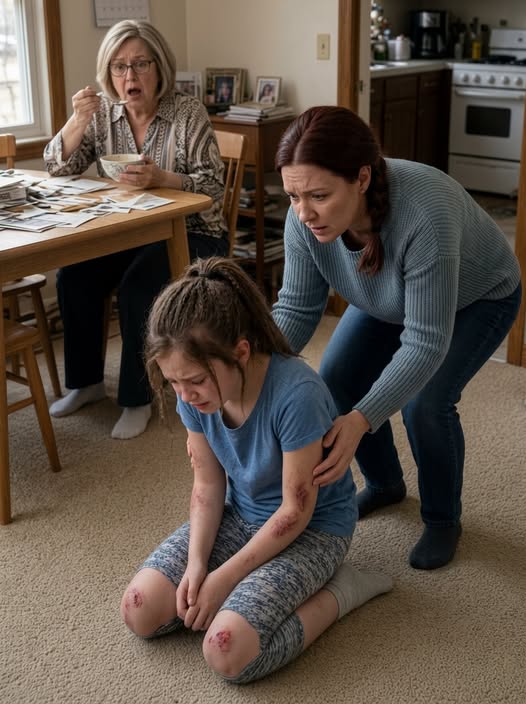
“Your daughter has been kneeling there for forty minutes, and she still hasn’t learned!”
I stopped in the doorway.
At first, I didn’t understand what she meant.
Then I looked down the hallway.
Carolyn was kneeling on the tile.
Still wearing her kindergarten uniform.
Blue skirt.
White blouse.
One pink hair clip hanging crookedly above her ear.
Her little backpack had been thrown beside the shoe cabinet.
Her hands were twisted tightly into the fabric of her skirt.
Her shoulders shook whenever she breathed.
And her knees—
I will never forget her knees.
The skin was scraped raw.
Popular Posts
→- 1
- 2
- 3
- 4




Recently Viewed
Stories you read recently will appear here.





