My hand was on the back-seat door when I heard my mother step outside and call my name.
I had my 6-year-old son in my arms, and only minutes earlier, the same woman calling after me had taken my phone out of my hand when I tried to call 911.
That was the part I could not get past.
Not the arguing. Not my sister’s expression. Not even my father’s insistence that I was overreacting.
My mother had seen my son hurt, heard him say he could not breathe properly, and still decided the person who needed protecting was somebody else.
I kept thinking about the moment I had first looked down at him on the floor.
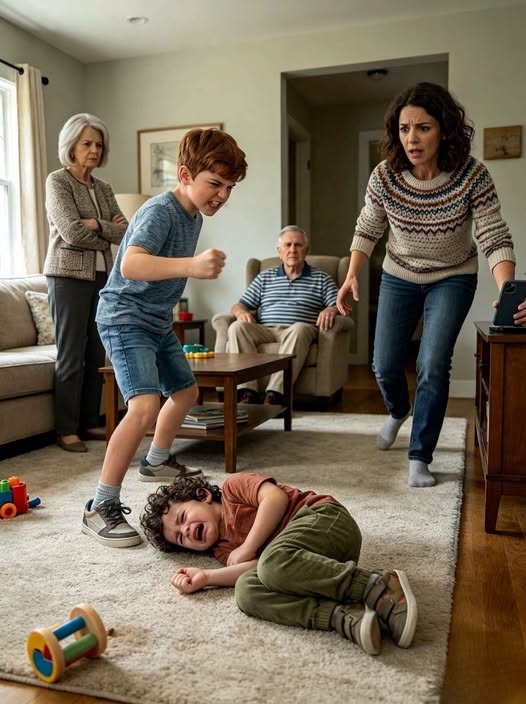
He had been beaten by his 10-year-old cousin, and he was gasping with a broken rib, one small hand pressed against his side as if he could somehow hold the pain in place.
Every attempt to move made his body tighten.
He was six.
He was scared.
He was hurting.
He was surrounded by adults who were discussing his condition as though the biggest danger in the room was my reaction to it.
When I reached for my phone to call 911, my mother snatched it away before I could make the call.
“Boys fight,” she said. “Don’t ruin your nephew’s future.”
For a second, I could barely process the sentence.
My son was on the floor struggling for breath, yet she was already thinking about consequences for the 10-year-old who had hurt him.
My father barely looked up.
“You’re overreacting.”
My sister smirked.
It was such a small expression, but I remember it because of what it said without words: they expected the family pattern to hold.
They expected me to get angry, get talked over, get accused of being dramatic, and eventually give up because everyone else had agreed that I was the difficult one.
They were prepared for shouting.
They were prepared for guilt.
They were prepared for me to defend myself.
They were not prepared for me to stop caring whether they approved.
I stared at my mother’s fingers around my phone and then looked back at my son.
His breathing was coming in thin, uneven catches, and that sound made every argument around me seem suddenly useless.
“Give me my phone.”
My mother pulled it closer against herself.
“You need to calm down first.”
There are sentences families use so often that they stop sounding like sentences and start functioning like commands.
Calm down.
Don’t make a scene.
Think about the family.
For years, those words had probably done exactly what they were designed to do: shift attention away from whatever had happened and onto the person refusing to accept it.
But my child was still on the floor.
“He needs medical help.”
My sister stood then, but she did not go toward my son.
She came toward me.
“My kid is ten. Do you understand what a police report could do to him?”
I looked at her and realized she was asking me to enter a completely different conversation from the one happening in front of us.
She wanted to discuss her son’s future.
I was looking at my son’s next breath.
“Do you understand what your kid just did to mine?”
Her mouth tightened.
She glanced toward the hallway where her son had gone, then looked back at me.
“They were fighting. Your son isn’t innocent just because he’s younger.”
That was when I understood how hard everyone in that room was working to flatten what had happened into something easier to live with.
If it was just a fight, nobody had to ask harder questions.
If both children were equally responsible, nobody had to admit that a 6-year-old was now on the floor in visible distress.
If I was overreacting, then they could make my behavior the problem instead of facing theirs.
My father let out an irritated sigh.
He sounded less like a grandfather looking at an injured child and more like a man inconvenienced by an argument that had gone on too long.
Then my son reached for my sleeve.
His fingers barely caught the fabric.
“I told Grandma,” he whispered.
I dropped down beside him.
“Told her what?”
His eyes moved toward my mother.
“That I couldn’t breathe right. Before you came.”
Everything inside me seemed to narrow around those words.
Until then, part of me had still been assuming my mother was reacting badly in the moment.
Maybe she had walked in late. Maybe she had misunderstood how serious it was. Maybe she had seen crying and assumed the worst of the pain had already passed.
But my son had told her.
Before I arrived.
He had told an adult he trusted that he was having trouble breathing after being hurt, and she had known that before she ever took my phone.
I looked at her.
She did not deny it.
She did not crouch beside him.
She did not ask him another question.
She tightened her grip on my phone and said, “He was crying. Kids say things when they’re upset.”
That sentence changed the room for me.
It meant this was not simply a disagreement about what to do after I arrived.
She had already made a decision before I walked in.
She had heard him describe a problem with his breathing, and instead of treating that information as urgent, she had decided it was emotional exaggeration.
Then, when I tried to get help myself, she physically removed the phone from my hand.
My father finally stood.
“Enough. Nobody is saying he shouldn’t get checked out. We’re saying you don’t need to turn this into some huge family disaster.”
I remember looking at him and thinking how strange those words were.
The disaster, according to him, was apparently something that might happen if I acted.
Not what had already happened to my son.
Not the injury.
Not the breathing difficulty.
Not my mother’s decision to dismiss what he told her.
Popular Posts
→- 1
- 2
- 3
- 4




Recently Viewed
Stories you read recently will appear here.





