PART 1: THE SOUND OF METAL AGAINST MY HEAD
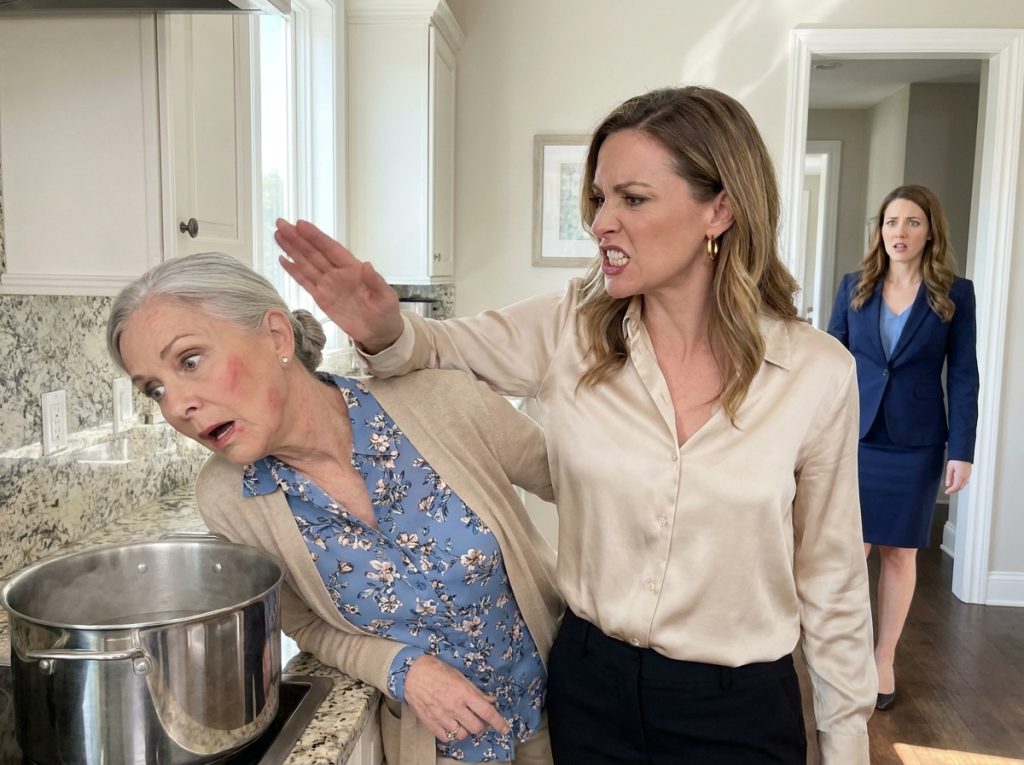
My daughter-in-law struck me across the head with a metal soup ladle because she didn’t like what I was cooking.
I was standing in my own kitchen.
Preparing chicken soup for my son.
The same soup I had made for him since he was a little boy.
One moment, I was stirring the pot.
The next, a sharp blow landed near my temple.
Pain exploded across the side of my face.
I staggered backward, gripping the kitchen counter to keep myself upright.
“You’re absolutely useless!” my daughter-in-law screamed.
I couldn’t answer.
My ears were ringing.
My vision blurred.
And for several terrifying seconds, I couldn’t understand how an ordinary afternoon had turned into something so frightening.
Then the front door opened.
My daughter walked into the hallway.
She stopped when she saw me.
Her eyes moved toward the metal ladle.
Then to my trembling hands.
Then to the side of my face.
The expression in her eyes changed instantly.
“What exactly do you think you’re doing to my mother?”
My daughter-in-law froze.
And for the first time since she had moved into my home, she looked genuinely frightened.
But what happened next would reveal a truth I had been refusing to confront for far too long.
My name is Margaret Wilson.
I was sixty-eight years old, a widow, and the mother of two grown children.
My son, Mark, was forty-one.
My daughter, Sarah, was thirty-seven.
I had raised them in the same house where I still lived.
It was a comfortable two-story home with a large kitchen, a small garden, and a wooden porch my late husband had built with his own hands.
My husband, Robert, had died six years earlier.
We had been married for forty-three years.
He was a gentle man.
Patient.
Hardworking.
And deeply devoted to our family.
When our children were young, Robert worked long hours as an electrician.
I managed the household and later worked part-time at a local school.
We weren’t wealthy.
But we had enough.
Enough food.
Enough warmth.
Enough laughter.
And enough love to make our little house feel like the safest place in the world.
Mark had always been especially attached to me.
As a child, he loved homemade chicken soup.
Whenever he was sick, disappointed, or simply exhausted, he would ask for it.
“Mom, can you make the good soup?”
I always laughed.
“Which soup is the good soup?”
He would grin.
“Yours.”
Even as a teenager, he never outgrew that habit.
After difficult exams, football games, or arguments with friends, he would sit at the kitchen table while I prepared a pot.
Sometimes he talked.
Sometimes he remained silent.
But he always seemed calmer afterward.
I loved those moments.
They reminded me that even when children grow older, the simplest expressions of care can still matter.
Sarah was different.
Independent.
Strong-willed.
And fiercely protective of the people she loved.
When she was nine, a boy at school teased Mark for wearing glasses.
Sarah marched across the playground and told him to stop.
She was three years younger than her brother.
But that never seemed to concern her.
When the principal called me, I tried to explain that fighting wasn’t the answer.
Sarah crossed her arms.
“He was being mean to Mark.”
I sighed.
“Sweetheart, you can’t solve every problem by confronting someone.”
She looked at me seriously.
“Then somebody should tell him to stop being mean.”
I remember smiling despite myself.
That was Sarah.
She never liked watching someone being mistreated.
As adults, my children followed different paths.
Sarah became a registered nurse.
She married a kind man named Daniel and lived about twenty minutes away.
Mark worked in sales.
He married a woman named Vanessa three years earlier.
At first, I was happy for him.
Vanessa was attractive, confident, and ambitious.
She seemed determined to build a successful life.
But over time, I noticed something troubling.
She rarely spoke kindly to people she believed were beneath her.
Waiters.
Cashiers.
Delivery drivers.
Even elderly neighbors.
Whenever someone made a mistake, Vanessa reacted as though they had personally insulted her.
I tried to overlook it.
I told myself she was simply impatient.
Then Mark and Vanessa began experiencing financial difficulties.
Their apartment lease ended.
Mark’s company reduced his commissions.
And Vanessa said they needed somewhere to stay while they rebuilt their savings.
I offered them the guest rooms in my house.
“Just for a few months,” Mark promised.
I smiled.
“Of course, sweetheart.”
That was nearly a year ago.
During those months, Vanessa slowly began treating my home as though it belonged to her.
She rearranged the kitchen cabinets.
Moved my photographs.
Complained about my furniture.
And criticized nearly everything I cooked.
At first, I tried to be accommodating.
Popular Posts
→- 1
- 2
- 3
- 4




Recently Viewed
Stories you read recently will appear here.





