My Daughter-in-Law Demanded I Sell My Home to Pay Her Mother’s Debts
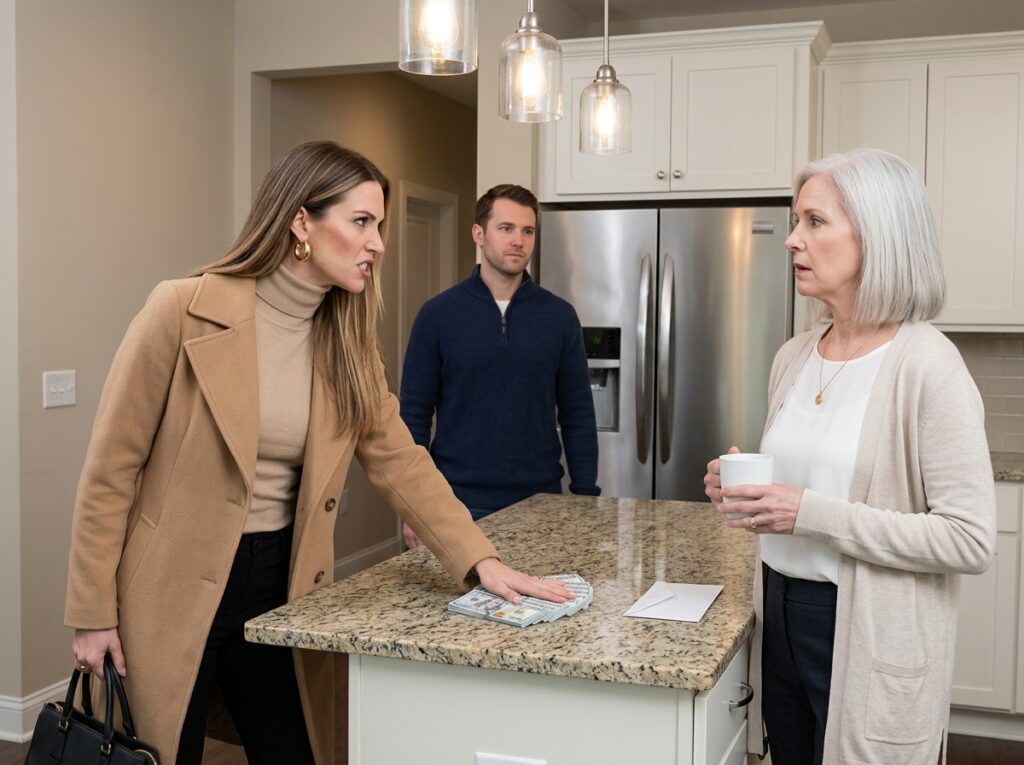
My daughter-in-law slammed a stack of bills on my kitchen counter and said, “Sell your house. My mother’s debt comes first.”
The sound made my coffee jump in the mug.
For one ridiculous second, that was what I noticed.
Not the nerve of the woman standing in my kitchen.
Not my son sitting three feet away with his head bowed.
Not the fact that the papers she had thrown down were bills belonging to a woman who had never paid one dollar toward my mortgage, my taxes, my groceries, or the life I had spent forty years building.
I noticed coffee trembling against white porcelain.
Then I looked up.
Rebecca stood on the other side of the island in a camel-colored coat she had bought the previous winter, the one with the oversized belt and gold buttons. She was still wearing her gold hoop earrings. Her cheeks were flushed from the cold outside, but there was nothing uncertain about her expression.
She looked furious.
As if I had disappointed her.
As if I had made a promise and broken it.
My son, Andrew, sat at the kitchen table.
Eyes down.
Hands clasped.
Silent.
That told me more than anything Rebecca could have said.
For two years, they had lived in my home in Naperville, Illinois.
Two years.
Andrew had lost his job at a logistics company during a restructuring. Rebecca had been working part-time from home for a marketing agency, and when their lease came up, she had cried in my living room and said they needed “a soft landing.”
Those had been her exact words.
A soft landing.
I gave them the entire upstairs.
I cleared out the guest room.
I moved boxes from the second bedroom into the basement.
I told Andrew not to worry about rent while he got back on his feet.
I covered the utilities.
I paid the property taxes.
I bought most of the groceries because every time I asked what they needed, Rebecca would say, “Whatever you’re getting is fine.”
Apparently “whatever you’re getting” included organic coffee, imported cheese, expensive sparkling water, and the almond milk she liked.
I never complained.
Not once.
I thought I was helping my son rebuild his life.
I did not realize I was teaching his wife that my home was a resource waiting to be harvested.
Rebecca pushed the bills toward me.
“My mother is drowning,” she said.
I didn’t touch them.
“Then she should talk to a financial counselor.”
Rebecca stared at me.
“Credit cards,” she said, tapping the top page. “Medical payments. The salon loan. She’s behind on the lease for the shop. She can’t keep doing this.”
“I’m sorry to hear that.”
Her eyes narrowed.
“That’s it?”
“What do you want me to say?”
“I already told you what needs to happen.”
I looked down at the papers.
Then back at her.
“You want me to sell my house.”
“Yes.”
Just like that.
No embarrassment.
No hesitation.
She stepped closer to the counter.
“This place is worth what? Nine hundred thousand? More?”
I felt something cold move through me.
Not anger.
Not yet.
Recognition.
She had looked it up.
Rebecca continued.
“You don’t need this much house. You’re one person.”
I almost smiled.
It was either smile or throw her bills back in her face.
She kept going.
“You could sell it, buy a smaller condo, and use part of the difference to help Mom. She could wipe out the worst of the debt, maybe restructure the rest, keep the salon open. You’d have less maintenance. Everyone wins.”
I laughed once.
A short, ugly sound.
“Everyone?”
Rebecca’s jaw tightened.
Behind her, Andrew shifted in his chair.
That was the first sign he was still alive.
I turned to him.
“Andrew.”
He rubbed one hand across his mouth.
“Mom…”
I waited.
He stared at the floor.
“It’s just an idea.”
“No,” I said. “An idea is discussed. This is a demand.”
Rebecca threw up both hands.
“Oh, come on.”
“No. You came into my kitchen with your mother’s bills already printed and organized. You researched the value of my house. You decided where I should move. You decided what should happen to my money.”
“I’m trying to solve a crisis.”
“Your crisis.”
“My mother is family.”
“Your mother is your family.”
“She is Andrew’s family too.”
I looked at my son.
He still couldn’t meet my eyes.
Rebecca slapped her palm against the counter.
“She is family now.”
The room went very quiet.
I had known Rebecca for seven years.
My husband, Robert, had still been alive when Andrew introduced us to her.
Robert had been polite to Rebecca, though never fooled by her. He once told me, after a Thanksgiving dinner where Rebecca complained that the serving dishes were outdated, “That girl looks at everything and immediately wonders whether it could be upgraded.”
I had scolded him then.
“Give her a chance.”
Robert had smiled.
“I am. I’m also keeping the good silver locked up.”
He died three years later.
Heart attack.
Fast and cruel.
He left me the house we had bought when Andrew was twelve, the retirement savings we had spent decades protecting, and one piece of advice I had ignored too many times.
Don’t let guilt spend money that judgment would protect.
Standing across from Rebecca that morning, I heard his voice in my head as clearly as if he were leaning against the refrigerator.
Rebecca crossed her arms.
“You live alone in a house worth almost a million dollars,” she said. “My mother is about to lose everything. It is selfish to sit on equity while family suffers.”
There it was.
Selfish.
After two years of free housing.
Two years of heat, air-conditioning, water, electricity and groceries.
Two Christmases where I had bought them expensive gifts because they were “having a difficult year.”
Two birthdays where Andrew had slipped cards across the table and said, “I’ll make it up to you when things settle down.”
Popular Posts
→- 1
- 2
- 3
- 4




Recently Viewed
Stories you read recently will appear here.





