The asphalt hummed beneath the tires of my government-issued sedan as I cleared the outbound security checkpoint of Fort Liberty. It was past 2000 hours. The North Carolina pine barrens were drowning in an ink-black dusk, the scent of damp loam and ozone heavy in the air ahead of an approaching summer storm. Behind me lay thirty years of service: three tours in the sandbox, commands across two continents, a chest full of ribbons, and the eagles of a full colonel pinned to my collar. In the military, you are trained to process chaos into actionable data. You learn that panic is merely wasted energy, that friction in the field is inevitable, and that a commander’s voice must remain an immovable anchor when everything around her is burning to the ground.
Then my personal phone vibrated against the console.
I tapped the hands-free receiver. “Colonel Vance.”
Static hissed through the speaker. A sharp, ragged gasp tore through the line, wet and stuttering.
“Mom…”
My spine stiffened. Every operational instinct honed over three decades converged into a single, razor-sharp point of adrenaline.
“Maya? Report. What’s going on?”
“Mom… please come get me.”
Five words. That was all. Not an explanation, not an address, just a breathless sob before the line went dead with the sharp, mechanical click of a severed connection.
I hit redial instantly. It went straight to automated voicemail: You have reached the personal line of Maya Vance. Please leave a message.
I didn’t leave a message. I slammed the gas pedal to the floorboard, swung the sedan across the grass median in an illegal tactical U-turn, and dialed the direct dispatch line for Cumberland County Emergency Services while simultaneously pinging my daughter’s cloud device. Nothing. The signal had been wiped.
Twenty-two minutes later, while I was tearing down Interstate 95 toward Charlotte, my encrypted line rang. It wasn’t Maya. It was Rosa Morales—former Master Sergeant, twenty-year veteran of military intelligence, and the godmother Maya had known since the day she took her first steps in base housing at Fort Bragg.
“Elena,” Rosa said, her voice stripped of pleasantries. “I picked up an emergency beacon ping routed through a secondary server Maya set up on her personal laptop three weeks ago. She’s at St. Bernard Hospital in south Charlotte. Trauma bay four. Get there now.”
“What happened, Rosa?”
“I don’t have the full picture yet,” Rosa said, the clatter of high-speed keystrokes rattling in the background. “Local dispatch logged an emergency call from an estate in the Quail Hollow district. Domestic disturbance, caller hung up. But when the ambulance arrived at St. Bernard twenty minutes ago, it wasn’t registered as a police transport. It was brought in by private security. Elena… the paperwork lists her under an intake alias. If I hadn’t had a packet-sniffer keyed to her social security hash, she would have vanished into their administrative system.”
“Whose private security?” I demanded, weaving through highway traffic at ninety-five miles an hour.
“Vance Holdings,” Rosa replied flatly. “Her in-laws.”
The emergency department at St. Bernard smelled of antiseptic floor stripper and cold iron.
I didn’t bother changing out of my operational service uniform. The heavy combat boots clicked against the linoleum with rhythmic, deliberate force. My service dress blouse was buttoned to the neck; the silver eagles on my shoulders caught the harsh fluorescent glare overhead.
A triage nurse stepped into the corridor, holding a plastic clipboard like a shield. “Ma’am, uniform or not, you can’t come back here. This is a restricted observation unit. Only immediate family—”
“I am her immediate family,” I said. My voice did not rise; it dropped half an octave into the register I used when an airstrike was off-target and subordinates needed to understand that hesitation meant casualties. “My daughter is Maya Vance. You will tell me where she is, or you will summon the chief of hospital administration and explain why a federal officer is being obstructed from investigating a felony assault against a dependent.”
The nurse swallowed hard, her eyes flicking to the brass nameplate pinned above my left pocket: COL E. VANCE. She looked at my face, read the complete absence of doubt in my posture, and stepped aside without a word. “Bed three. Behind the blue curtain.”
I pushed through the vinyl partition.
The sight struck me with the force of an improvised explosive device.
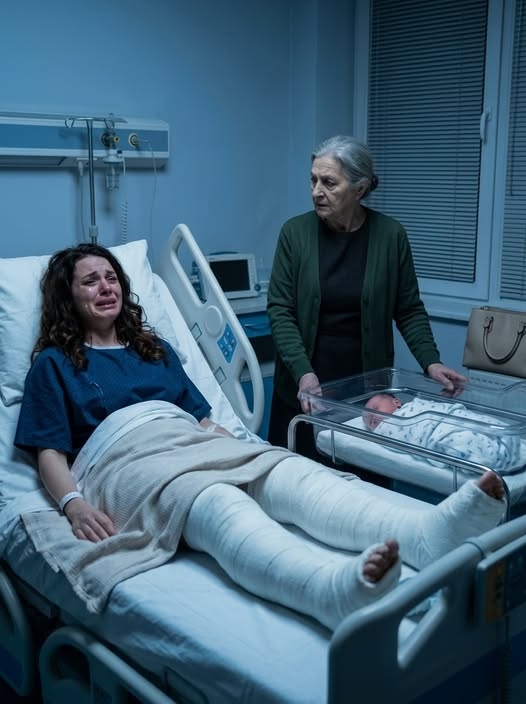
Maya was curled on her side in the center of the gurney, clutching a paper-thin hospital blanket to her chin like a shield. She looked tiny. At twenty-six, my daughter was a vibrant, sharp-witted botanical illustrator who possessed an incandescent laugh and a stubborn streak inherited entirely from me. Now, she was shaking so hard the steel guard rails of the bed rattled.
Her face was swollen. A dark, plum-colored hematoma bloomed across her left cheekbone, stretching down toward the corner of her lip, which had been split and hurriedly stitched. Her ivory designer dress—an expensive piece bought for some high-society country club function—was torn along the left shoulder seam, smudged with dark garden mulch and grease.
“Maya,” I breathed.
She flinched violently at the sound of my voice, tucking her head down before realizing who it was. The moment her bruised eyes met mine, the brittle dam broke.
“Mommy…”
It had been fifteen years since she called me that. I crossed the room in two strides, slid my arms under her shivering frame, and pulled her against my chest. Her fingers dug into the heavy twill of my uniform blouse, clutching the fabric so tightly her knuckles cracked. She smelled of rain, dirt, and raw terror.
“I’ve got you,” I murmured against her hair, keeping my breathing slow, measured, and rhythmic to force her elevated heart rate down. “Perimeter is secure, baby. Nobody touches you. I’m right here.”
A dry, theatrical chuckle broke the quiet from the doorway.
“How touching. The cavalry arrives after the skirmish is already over.”
I didn’t release Maya immediately. I waited four seconds, allowing the ice to settle into my veins, before I turned my head.
Popular Posts
→- 1
- 2
- 3
- 4




Recently Viewed
Stories you read recently will appear here.





