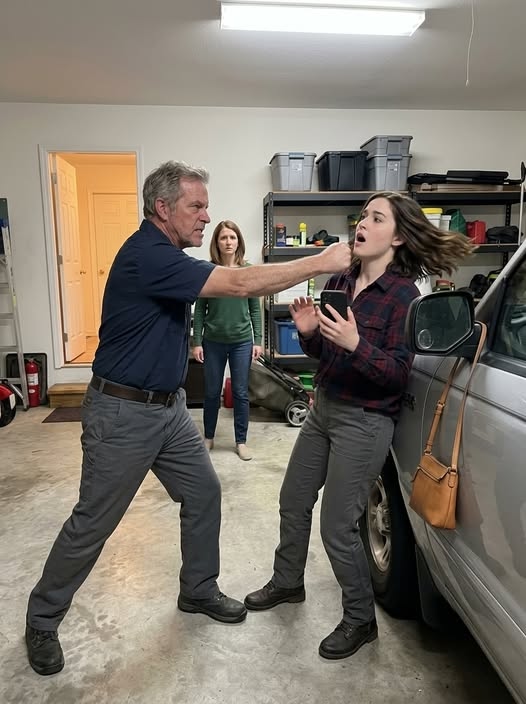
I Woke From a 14-Day Coma—and My Mother Called Me a Liar
The last thing I remembered before the hospital was buying strawberries.
Not screaming.
Not arguing with my father.
Not falling onto the concrete floor of my parents’ garage while someone I had trusted my entire life stood over me.
I remembered standing beneath the bright fluorescent lights of a grocery store, comparing an expensive organic box with a cheaper one and wondering whether the larger berries were worth three extra dollars.
It was such a small, ordinary decision that my mind kept returning to it, as though the strawberries marked the final border between the life I had understood and the one waiting for me when I opened my eyes.
At first, there was only light.
White light above me, a low mechanical hum nearby, and a voice whispering, “She’s opening her eyes.”
The woman sounded relieved, but she also sounded cautious, like saying the words too loudly might frighten me back into the darkness.
I tried to turn my head toward her and discovered that pain had been waiting for me.
It arrived in pieces.
My jaw throbbed first, a deep pressure that sharpened when I attempted to swallow.
Then came my ribs, my left wrist, the back of my skull, and a burning ache across one side of my face.
Every breath felt measured by someone else.
Every movement seemed to belong to a body I had never lived in before.
A nurse leaned over me, her tired eyes fixed on mine as she asked whether I knew my name.
I answered, but the word emerged rough and broken.
She asked my birthday, the year, and where I lived.
I managed those too.
Then a doctor stepped closer and asked when I had last seen my father.
“Sunday dinner,” I said.
It was not a memory so much as the last safe answer my brain could find.
The nurse looked away.
The doctor did not correct me immediately.
That frightened me more than the machines, the pain, or the strange heaviness in my limbs.
I asked what day it was.
When he told me, I thought I had misunderstood.
Fourteen days had passed.
Fourteen mornings, fourteen nights, and nearly half a month had vanished into a blank space inside my head.
The doctor explained that I had been unconscious since the night emergency responders brought me in.
He spoke slowly, stopping often to make sure I was following him, but the words refused to settle into anything that made sense.
He showed me images on a tablet.
My left cheekbone was fractured.
Three ribs were broken.
My wrist was cracked.
The concussion was severe enough that no one could promise when, or whether, every missing memory would return.
I stared at the pale shapes on the screen and asked if I had been in a car accident.
The doctor hesitated.
That hesitation became the first warning that whatever had happened to me was worse than an accident.
“The police report says the assault occurred inside your parents’ garage,” he said.
I laughed.
The sound hurt my ribs, but I could not stop it because the sentence was too ridiculous to accept.
My parents’ garage was where my father kept old tools, half-empty paint cans, and a lawn mower he complained about every spring.
It was where my mother stored holiday decorations in labeled plastic bins.
It was not a place where people nearly died.
I asked who had attacked me.
The doctor said a detective would explain what investigators knew once I was stable enough.
That was when my mother walked into the room.
For one second, relief moved through me so quickly that I almost cried.
She was wearing the same plain coat she had owned for years, and her purse hung from her shoulder exactly the way it always did when she was in a hurry.
I thought she had come to take my hand.
I thought she would tell me my father was in the hallway, too ashamed or frightened to enter.
I thought she would explain the missing fourteen days and make the impossible world feel familiar again.
Instead, she stopped beside the bed and stared at my swollen face.
Her expression held no relief.
No grief.
No fear for the daughter who had just awakened from a coma.
She leaned toward me and spit on my cheek.
“I’d bury you before I’d ever believe a liar like you.”
For a moment, nobody moved.
The spit felt warm against my skin, and I remember thinking that I should wipe it away, but my injured wrist would not cooperate.
Security reached her before she could come closer.
She fought them as they pulled her into the hallway, shouting that I had tried to destroy our family and that everything happening to my father was my fault.
The door closed, but I could still hear her voice outside.
The doctor handed me a tissue.
There is no dignified way to wipe your own mother’s hatred from your face while lying beneath hospital lights.
I asked what she believed I had lied about.
No one in the room knew how to answer.
An hour later, Detective Ethan Cole entered carrying a clear evidence bag.
He introduced himself, pulled a chair near the bed, and asked whether I felt strong enough to talk.
His voice was calm, but he watched me with the careful attention of someone expecting one wrong word to break something open.
Inside the evidence bag was my phone.
The screen was shattered from corner to corner, and a dried dark smear remained near the charging port.
Detective Cole said officers had found it underneath me on the garage floor.
From the position of my arm, they believed I had been trying to protect it even after I could no longer protect myself.
The phone barely responded when he pressed the side button, but one notification still appeared beneath the cracks.
Popular Posts
→- 1
- 2
- 3
- 4




Recently Viewed
Stories you read recently will appear here.





