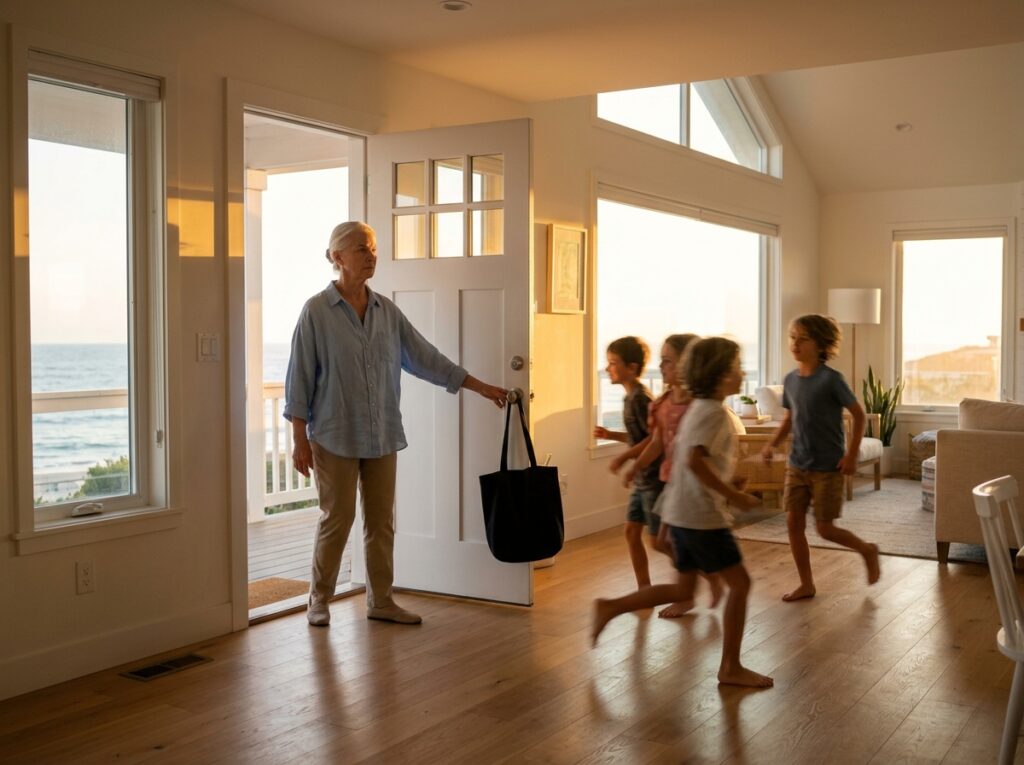
I was seventy years old when I walked into my own beach cottage and found twenty-one people already sleeping, eating, and making vacation plans inside it. Six unfamiliar cars filled my driveway, every bedroom had been claimed, and wet bathing suits were draped across furniture my late husband Henry and I had owned for decades. Then my son looked at me and said, “Mom, you were supposed to come tomorrow.”
“PART 1:
I was seventy years old when I walked into my own beach cottage and found twenty-one people already sleeping, eating, and making vacation plans inside it. Six unfamiliar cars filled my driveway, every bedroom had been claimed, and wet bathing suits were draped across furniture my late husband Henry and I had owned for decades. Then my son looked at me and said, “Mom, you were supposed to come tomorrow.”
For a moment, I honestly thought I had misunderstood him. I stood in the doorway with my overnight bag over one shoulder while music blasted from the deck and children I had never seen ran through the hallway carrying plastic beach toys. Someone had pushed our wedding photograph partly behind a Bluetooth speaker, covering half of Henry’s face. The entire house smelled like sunscreen, coffee, fried shrimp, and somebody else’s vacation.
My vacation home.
My house.
I had driven down one day early because I wanted one quiet evening before my son Robert, his wife Megan, and my two teenage grandchildren arrived. The plan I knew about was simple: four nights, four family members, and time together at the cottage Henry and I had owned for thirty-seven years. Robert had learned to swim there, Henry taught him to fish from the old pier, and later our grandchildren slept in the same little upstairs room their father once filled with jars of shells. After Henry died four years earlier, I visited less often because every room remembered him too clearly.
The hardest room was the sunroom facing the ocean. Henry spent his final summer there after cancer made walking to the beach too exhausting. Every morning I brought him coffee, and he sat beneath those windows with a blanket over his knees watching the tide. Sometimes we talked, sometimes we did not, and near the end silence became enough.
That was where I expected to sit alone that evening.
Instead, someone had apparently planned to sleep there.
I walked into the kitchen and stopped cold. A young man I did not recognize was drinking coffee from Henry’s chipped navy mug with the faded white anchor. He immediately noticed my expression and asked if the mug belonged to me. Before I could answer, Megan appeared in a white beach cover-up holding a bowl of watermelon.
“Oh,” she said. “You’re here.”
I looked at her. “I appear to be.”
Megan glanced at the young man holding Henry’s mug and said, “Everything here is basically family stuff.” Then I looked past her at Robert, my forty-seven-year-old son, standing beside the island and refusing to meet my eyes. That was when I understood something I had been too generous to notice before. In their minds, my belongings had slowly stopped being mine and become available.
“How many people are staying here?” I asked.
Megan answered before Robert could.
“Twenty-one.”
Fourteen adults and seven children. Her parents, her sister and brother-in-law, cousins, friends from Atlanta, another couple I had never met, plus all their children. Every bedroom had been assigned, the pullout sofa was taken, air mattresses were upstairs, and someone had claimed the sunroom.
I looked at Robert. “You knew?”
“We thought it would be fun.”
“Who is we?”
“Megan and me.”
Then he repeated the sentence that changed the meaning of everything.
“You were supposed to come tomorrow.”
Not *I’m sorry.*
Not *We should have asked.*
I had arrived too early at my own house.
When I asked how twenty-one people had even gotten inside, Robert admitted he had used the emergency lockbox code I gave him years earlier for storms and agreed family visits. He said the lockbox was not “just for emergencies” anymore. I reminded him that access had always existed because I allowed it.
Then I asked Megan what she had told all these people.
“The family beach house.”
“It is my beach house.”
The kitchen went quiet.
Megan told me there was not really space for “another person” that night because the bedrooms had already been assigned. I stared at her, because apparently I had become another person in my own home. Then I remembered something she had said three weeks earlier without knowing I was outside the open kitchen window.
“When it’s ours, the first thing going is that ugly little sunroom.”
Robert had reminded her that I loved that room.
Megan had answered, “She won’t be there.”
Then she started talking about opening the wall, expanding the kitchen, making the back side glass, and eventually renting the cottage for income. I had stood outside my own home listening to them plan renovations around a future in which I no longer existed. Not *if* the house became theirs.
When.
That conversation had already pushed me to call my attorney, Samuel Greene. For years, Henry and I assumed the cottage would eventually pass directly to Robert. After hearing Megan talk about demolishing Henry’s sunroom and after months of questions about property values, taxes, rental income, and renovations, I quietly changed that plan.
I did not disinherit my son.
I did not punish my grandchildren.
But the cottage would no longer pass automatically to Robert.
Samuel had also prepared a document revoking Robert’s unrestricted access during my lifetime. I had not signed it yet because part of me hoped I was overreacting. Then I walked into twenty-one people occupying every bed and heard there was no room for me.
I pulled out my phone.
Megan gave a nervous laugh. “Are you calling a hotel?”
“No.”
I called Samuel.
“I want you to send the letter.”
He asked if I was certain.
I looked at Robert, at Megan, and at Henry’s photograph partly hidden behind someone else’s speaker.
“Yes.”
Then I gathered all twenty-one guests and calmly explained that I believed most of them genuinely thought they had been invited with the owner’s permission. Several nodded. I told them I believed them, but that the gathering had never been authorized by the owner.
“That is me.”
Popular Posts
→- 1
- 2
- 3
- 4




Recently Viewed
Stories you read recently will appear here.





