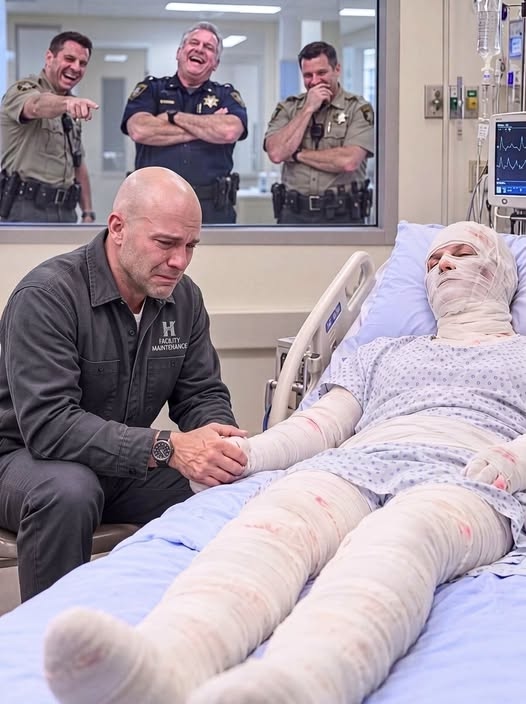
I was mopping a courthouse floor when I learned the county sheriff had shot my seventeen-year-old son through both knees and laughed while he screamed. At the hospital, the sheriff thought I was just an aging janitor. He had no idea what I used to do.
The call came while I was pushing a mop bucket past Courtroom Three.
“Mr. Bennett? Your son has been shot.”
For one second, I forgot how to breathe.
Seventeen years old. Two gunshot wounds. Both knees. Emergency surgery. County Sheriff Travis Cole was involved.
I left the mop where it stood and drove straight to St. Matthew’s.
Ethan lay beneath a white blanket, his face gray, metal braces surrounding both legs.
“Dad…” His voice cracked. “I don’t think I’ll ever walk again.”
I gripped the bedrail. “What happened?”
“Sheriff Cole pulled me over near the old feed store. He said my truck matched one from a burglary. I put my hands on the hood like he told me.”
“Then what?”
“He asked who taught me to stare at cops like that. I said I wasn’t staring. He kicked my legs apart. I fell.”
Ethan looked toward the door.
“I told him I was recording.”
“What recording?”
“My phone. It was in the cupholder.”
Then he whispered, “He smiled, Dad. He said, ‘Record this.’ Then he shot me.”
A deputy appeared in the doorway.
“Mr. Bennett, Sheriff Cole needs your son’s phone as evidence.”
I looked at the body camera on his chest.
The red light was off.
“Where’s Cole?”
“Downstairs. He says the shooting was justified.”
I removed a card from my wallet that I had not used in twelve years.
The deputy read it.
His face changed instantly.
Because the gray-haired courthouse janitor standing in front of him had once led federal investigations into corrupt law-enforcement officers.
The deputy suddenly realized this was no longer a frightened father asking questions. But before I could find out what Sheriff Cole was hiding, someone tried to take the one piece of evidence that could destroy him. The rest of what happened is in the comments.
The deputy’s eyes moved from the card to my face.
“You’re Daniel Bennett?”
“I was.”
Twelve years earlier, I had been a supervisory investigator with the Department of Justice Civil Rights Division. My team handled cases involving officers who believed a badge made them untouchable. I left after my wife died and moved back home to raise Ethan. I never talked about the old job. The courthouse cleaning contract gave me steady hours and kept my life quiet.
Until that night.
The deputy handed the card back. “Sheriff Cole said you were a janitor.”
“I am.”
I stepped closer.
“Now tell him not to touch my son’s phone.”
His jaw tightened. “It’s evidence.”
“So is his body camera. So is yours. Preserve both.”
Before he could answer, a woman in navy scrubs entered. Dr. Hannah Patel, the orthopedic surgeon, said Ethan’s injuries were catastrophic but not hopeless. The bullets had shattered bone, yet the major arteries had survived. Walking again was possible.
Ethan closed his eyes in relief.
Then my phone rang.
Unknown number.
I answered.
A man whispered, “If you’re Ethan Bennett’s father, don’t let them take that phone.”
“Who is this?”
The call ended.
Seconds later, Ethan’s truck disappeared from the sheriff’s impound database.
I knew because I checked.
That was when fear replaced anger.
Someone was already cleaning the scene.
I called Rebecca Sloan, an attorney I trusted from my federal years. She arrived twenty minutes later and immediately demanded a preservation order for dispatch recordings, vehicle GPS data, body-camera footage, impound logs, and traffic cameras.
Cole arrived before she finished.
He was broad, silver-haired, and perfectly calm.
“Terrible situation,” he said. “Your boy reached for something.”
Ethan tried to sit up. “That’s a lie.”
Cole smiled at him.
Not kindly.
“Trauma can confuse memory.”
I moved between them.
“Leave.”
Cole studied me. “You think an old credential scares me?”
“No. Records do.”
For the first time, his expression slipped.
Then Rebecca’s phone buzzed.
She looked at the screen and went pale.
“Daniel, Ethan’s phone just uploaded something to his cloud account.”
We opened the file.
The video showed Ethan’s dashboard, Cole’s boots, and Ethan’s hands clearly raised.
Then Cole’s voice:
“You Bennett kids always think your name protects you.”
My blood went cold.
Ethan had no brother.
Rebecca replayed it.
Then another voice came through the recording, faint but unmistakable, from Cole’s radio.
“Make sure the boy can’t run like the other one.”
Ethan stared at me.
“What other boy?”
Before I could answer, the hospital lights flickered.
A fire alarm began screaming.
And through the glass doors at the end of the hall, I saw the same deputy from earlier pushing Ethan’s wheelchair toward the service elevator—with my son no longer in his bed.
What do you think will happen next? I’d love to hear your honest guess or reaction. I’d love to hear your opinions – your comments really make me happy and inspire me to keep writing.
I ran.
Rebecca was beside me before I reached the elevator.
The deputy raised one hand. “Don’t shout. I’m the one who called you.”
His nameplate read Aaron Pike.
Ethan sat in the wheelchair, pale and shaking, an IV bag hanging beside him.
I grabbed the handles. “Why did you take him?”
“Because Cole’s chief deputy just came through the emergency entrance with two off-duty men. The fire alarm was pulled manually.”
Rebecca stepped closer. “Make this make sense.”
Pike pulled a flash drive from inside his vest.
“I’ve been collecting evidence for eight months.”
He looked at Ethan.
“Your son wasn’t the first Bennett.”
The other boy was Owen Bennett, my brother’s nineteen-year-old son.
Six months earlier, Owen had left town after we were told he assaulted an officer during a traffic stop and violated probation. My brother believed it. So did I.
Pike said it was false.
Popular Posts
→- 1
- 2
- 3
- 4




Recently Viewed
Stories you read recently will appear here.





