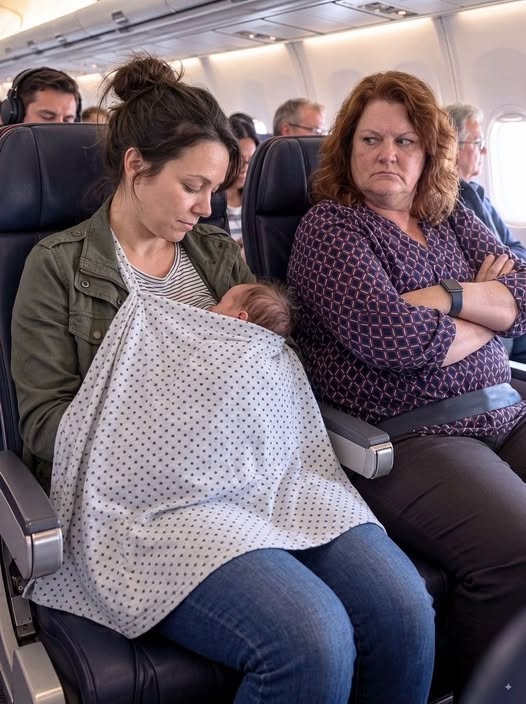
Five weeks after I buried my husband, a stranger on a six-hour flight told me to lock myself in the bathroom to feed my baby. “What kind of mother are you?” she asked, loud enough for the whole cabin to hear. My 8-year-old daughter offered to switch seats with me. Then she opened her tablet and asked the woman one quiet question—and the woman ran.
PART 1
“You should be ashamed of yourself.”
The woman’s voice carried over three rows. I felt my face go hot before I even looked up.
“Go lock yourself in the bathroom,” she said. “This is a public seat, not a nursery.”
My son Theo was five months old, and he was hungry, and I was thirty-two thousand feet over Nevada with a nursing cover draped over my shoulder and nowhere else to go. I opened my mouth to apologize — again — but before I could get a word out, my daughter Louise stood up in the row behind us.
“Mom,” she said, “why don’t you take my seat? I’ll sit next to this lady so she won’t feel uncomfortable.”
I didn’t understand why she wanted to trade. Not yet.
We switched seats in the narrow aisle, my elbow knocking a stranger’s shoulder, Theo fussing against my chest. I settled into row 19, and Louise slid into the seat I’d just left, next to the woman in the gray blazer who’d spent the last three hours making sure everyone around her knew she was suffering.
I watched my daughter reach into her backpack and pull out her school tablet.
She didn’t say anything cruel. She didn’t raise her voice. She just turned the screen toward the woman and asked one quiet question.
I couldn’t hear what Louise said. I only saw what happened next.
The woman’s face went white. Then red. She grabbed her purse, stood up so fast she hit her head on the overhead bin, and hurried down the aisle toward the back of the plane, past the flight attendant, past rows of passengers who were now openly staring.
I didn’t know it yet, but that moment — my eight-year-old, calm as still water, holding up a tablet screen — was the reason a stranger’s cruelty ended up being the smallest part of this story.
To understand what happened on that plane, you have to go back three days, to a folding chair in a funeral home in Springfield, Missouri, where I sat holding my son while forty people I barely remembered told me how sorry they were for my loss.
My husband, Daniel, died on a Tuesday afternoon in March. He was thirty-six. He’d complained about chest pressure for two days and blamed it on stress from work, and then his heart just stopped while he was loading the dishwasher. I was in the next room with Theo. Louise was doing homework at the kitchen table. By the time the paramedics got there, there was nothing left for them to do but be kind to us.
I don’t remember most of the five weeks after that. I remember signing papers. I remember a casserole dish someone left on my porch that I never returned. I remember my mother, Barbara, calling from Sacramento every single day, saying the same thing in a dozen different ways: Come stay with me. Let me help you breathe for a while.
I finally said yes on a Thursday night, three weeks after the funeral, when I found myself standing in Theo’s nursery at 2 a.m., unable to remember if I’d fed him or just imagined it.
I booked three tickets. Springfield to Sacramento, one layover in Denver, a flight full of strangers who had no idea what my family had just survived — and one of them was about to remind me why traveling alone with a newborn and a grieving eight-year-old felt like walking a tightrope with no net underneath.
PART 2
Packing for that trip took me four days, which made no sense, because it was only a carry-on and a diaper bag. But every decision felt enormous. Which onesies. Whether Theo’s pediatrician would want us to bring his growth chart. Whether Louise should take her stuffed rabbit, Mr. Buttons, or if an eight-year-old flying with a stuffed animal in public would embarrass her.
She wanted to bring him. She just held him a little lower in her backpack, so he wouldn’t be the first thing people saw.
Louise had been quiet since her father died. Not sad in the way people expect a child to be sad — she didn’t cry much in front of me — but watchful. She started checking on Theo constantly, adjusting his blanket, telling me when she thought he was too warm. I think she’d decided, somewhere in her eight-year-old mind, that if she paid close enough attention, nothing else in our family would be allowed to go wrong.
My outer goal on that trip was simple: get my children to my mother’s house in one piece. My inner problem was harder to name. I had spent five weeks being strong for two children because there was no one else left to be strong for them, and some quiet, exhausted part of me needed someone — anyone — to take that job off my hands for even a few days.
I hadn’t asked for help from a stranger. I hadn’t expected to need it.
At the gate in Springfield, a woman in a gray blazer sat two seats down from us, scrolling through her phone with the particular irritation of someone whose flight had already been delayed once. I didn’t think much of her. I was busy trying to keep Theo’s pacifier from hitting the floor of a terminal that a hundred other people had walked across that morning.
When they called our zone, I picked up the car seat, the diaper bag, and Theo, and Louise carried her own backpack and Mr. Buttons, whom she’d smuggled in after all.
Popular Posts
→- 1
- 2
- 3
- 4




Recently Viewed
Stories you read recently will appear here.





