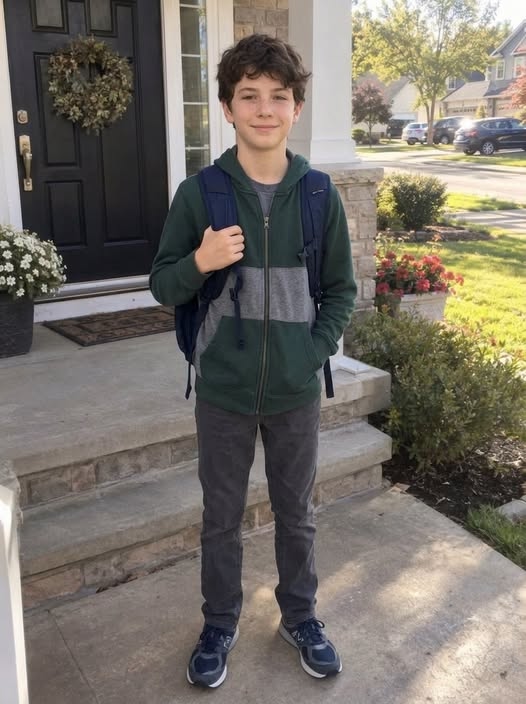
The kitchen clock did not tick so much as it chewed through the silence of the afternoon, an electric hum that seemed to vibrate straight into the enamel of my molars. It was 3:12 PM. The digital face of the stove glowed in sickly green phosphorescence: 3:12. Outside, the late October sky had the dull, bruised cast of an old pewter plate, sagging low over the asphalt shingle roofs of Blackwood Terrace.
A sharp, vibrating buzz against the polished grain of the butcher block startled me, the phone skittering half an inch across the polyurethane finish.
On my way. Leaving locker now.
My thumb hovered over the glass. I let out a breath I hadn’t realized was locked behind my collarbone, watching the screen dim to black. Don’t hover, I told myself, the internal voice brittle, sounding too much like my own mother’s when she used to watch me pedal away on my hand-me-down Schwinn. He is eleven. He has his father’s stubborn chin and your long shins. He knows the crossings.
Still, I walked to the bay window, pulling back the heavy linen drape just enough to let the gray light spill across my apron.
Blackwood Terrace was not a dangerous place, not by any metric the county sheriff’s department would publish, but it was old. It was a pocket of post-war timber and cracked sidewalks caught between the river valley and the northern spur of the commuter rail. In autumn, the ancient sugar maples dropped leaves the size of dinner plates, burying the concrete gutters in slippery, bronze drift. Two streets over sat the culvert—a deep, overgrown limestone trench where the town’s storm runoff tumbled down toward the quarry woods. It was a place parents warned children away from with low, rhythmic scoldings that sounded almost like hymns.
Three houses down, the garage door of number forty-two remained shut, a hand-painted piece of corrugated cardboard taped beneath the mail slot: LOST. Golden Retriever. Fourteen years. Answers to Barnaby. Needs medication. Please.
The rain had ruined the edges of the ink three days ago, during Tuesday’s microburst, bleeding the red marker into an illegible pink wash. Barnaby was half-blind, his muzzle white as chalk, his hips clicking like dry castanets whenever he hauled himself off Ivy’s braided rugs. When the thunder had torn open the ceiling of the valley at three in the morning on Tuesday, the gate had blown off its rusty latch. By sunrise, Ivy was on our porch in her nightgown and garden boots, her hands trembling so violently that the tea I poured her slopped over the saucer and stained the oilcloth.
“He doesn’t hear the cars, Clara,” she had sobbed, the skin around her pale blue eyes puckered and raw. “He doesn’t know to get out of the road. If he went toward the tracks…”
We had walked the perimeter of the township twice. The neighbors had formed a ragged line through the woods until the briars tore their jackets, but the quarry was vast, jagged with abandoned limestone slabs and flooded limestone sinks. An old dog did not survive four nights in the wet frost. Everyone knew it; no one said it to Ivy.
I glanced at the stove again. 3:21.
Nine minutes.
It was precisely eight-tenths of a mile from the front steps of Saint Jude’s Parochial to our front door. If an eleven-year-old boy walked at a brisk clip, kicking an empty soda can or dragging a stick along the chain-link fence of the water district, it took twelve minutes. If he dawdled to look at a squashed toad or trade a Pokémon card with Toby Vance, it took fourteen.
At 3:26, my fingers began an involuntary rhythm against the sill.
He’s eleven, I whispered, trying to anchor the words to the floorboards. He’s fine. He took the sidewalk by the dry cleaner’s.
“Straight home,” I had made him swear that morning over a bowl of soggy Honey Nut Cheerios. I could still see his cowlick standing straight up at the crown of his head, his small shoulders hunched defensively against my hovering. “No cut-throughs behind the auto repair. No stopping by the drainage creek. You cross where the crossing guard is, on Elm, and then you stay on our side of the blacktop.”
“Mom, I’m not in kindergarten,” he had groaned, his voice cracking into that strange, sandpaper register that was beginning to replace his little-boy cadence. “Toby’s mom lets him ride his bike all the way to the state park.”
“Toby’s mom doesn’t have my nervous system,” I had snapped, instantly regretting the edge in my voice, but softening it with a hand pressed against the warm hollow between his shoulder blades. “You have your phone. You have your house key on the lanyard. Just show me you can do it.”
3:31.
Twenty minutes.
A cold weight dropped into the pit of my stomach, heavy as an iron sash weight falling down a dry well. The street was dead quiet. A crows’ congress sat perched on the telephone wire across from the Miller house, feathers ruffled against the rising wind. The wind was changing direction, blowing from the east, carrying that distinct, sharp smell of ozone and wet river gravel that preceded a hard frost. The meteorologist had warned of a freeze warning starting at sundown. If the temperatures plunged as low as predicted, the shallow pools on the pavement would be black ice by six.
My phone remained completely silent on the counter.
I picked it up, my thumb trembling slightly as I unlocked the screen.
Joel? I typed. You should be on the porch.
The blue message bubble sat there, stark and unreturned. No little gray ellipses appeared to indicate he was typing.
3:33.
I pulled open the hall closet, grabbed my fleece jacket, and didn’t even bother to kick off my wool house slippers. I was halfway through the deadbolt when the ringtone shattered the room.
The screen flashed: IVY CALLING.
Popular Posts
→- 1
- 2
- 3
- 4




Recently Viewed
Stories you read recently will appear here.





