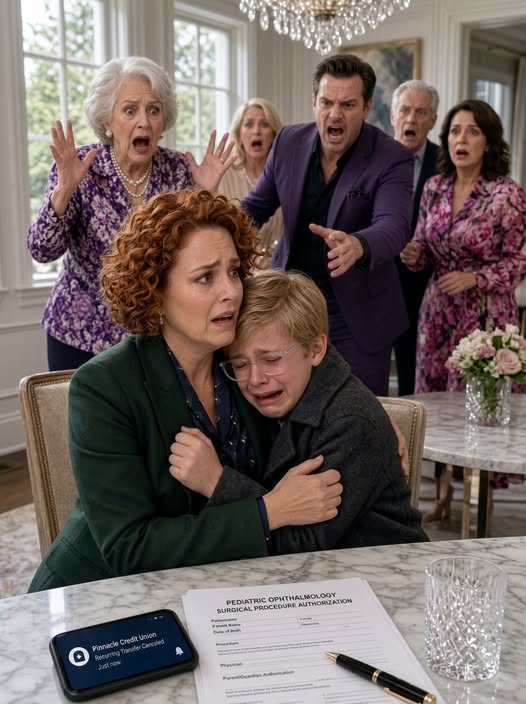
Title: The Cost of Clarity
Chapter 1: The ATM in the Business Suit
Certain bloodlines nurture each other with unconditional affection, boundless patience, and meticulously maintained boundaries. My lineage, however, trades exclusively in uninvited critiques, weaponized incompetence, and the baffling arrogance of individuals who are entirely convinced they hold the map to your life. If you have ever pondered how rapidly a mundane domestic dynamic can devolve into a full-scale theater of the absurd, pull up a chair. You have found your people.
My name is Diane Sterling. I am thirty-nine years old, and I operate as the Senior Director of Global Procurement for a sprawling medical device conglomerate. If there exists a commercial airport within the borders of the continental United States featuring lukewarm, acidic coffee and exactly one functional wall outlet, the odds are extraordinarily high that I have drafted contract negotiations while sitting on its carpeted floor. My existence is a blur of altitude and asphalt. Dallas on Monday, Chicago by Wednesday, Atlanta before the weekend. I touch down at my home just long enough to cycle a load of laundry, restock the refrigerator, interrogate my twelve-year-old son as to why there are seven dessert spoons hoarded beneath his mattress, and summon an Uber back to the departure terminal.
The compensation for this relentless grind is substantial. Following my most recent elevation in title, my annual salary eclipsed $140,000. I hold the deed to a pristine, three-bedroom colonial nestled in the quiet suburbs of Columbus, Ohio. My sedan is entirely paid for, and my high-yield savings account boasts a robust emergency cushion. I am not extraordinarily wealthy by any coastal metric, but I possess a catastrophic combination of attributes: a comfortable liquid income and a family roster that knows precisely how much I deposit every two weeks.
My son, Leo, is twelve. He is brilliant, devastatingly sarcastic, entirely consumed by astrophysics, and has somehow crossed the developmental threshold where the simple act of placing soiled garments into a designated laundry basket is viewed as a draconian violation of his civil liberties.
He also possesses catastrophic eyesight.
I do not mean he has to squint to decipher the whiteboard if he is seated in the final row of his middle school math class. Without his thick, specialized corrective lenses, Leo can barely distinguish my facial features from the opposite side of our kitchen island. His corneas have been morphing and thinning at an alarming velocity due to a progressive, degenerative ocular condition known as Keratoconus. Over the preceding fourteen months, his visual acuity had plummeted, outpacing every new prescription we threw at it.
We had navigated the labyrinth of modern medicine: two general ophthalmologists, followed by a pediatric corneal specialist, and finally a specialized surgical consultant. This marathon was largely because our health insurance provider operates under the grim philosophy that the most effective remedy for a degenerative disease is forcing an exhausted mother to fax the same heavily redacted authorization form seven times until her will to live simply evaporates.
Eventually, after a grueling half-year of clinical appointments, denied claims, and furious appeals typed from various airport lounges, Leo was finally green-lit for a highly specialized corneal cross-linking procedure. It was a surgical intervention guaranteed to halt the structural degradation of his eyes.
The out-of-pocket residual, post-insurance, was $8,400.
That figure stung. I will not feign nonchalance. I had been quietly hoarding those specific funds for a master bathroom renovation. Nothing ostentatious—I merely desired a shower enclosure that could be secured without requiring the structural support of a wedged bath towel. But the porcelain upgrades could be deferred. Leo’s retinas could not.
We waited an agonizing six months for the surgeon’s calendar to clear. Six long months. I had that specific Thursday in late October seared into my digital schedule, my corporate planner, a magnetic calendar on the refrigerator, and quite possibly tattooed on my subconscious. I had rerouted three international supplier audits. I declined a lucrative summit in Seattle. The pantry was stocked with his favorite soft foods. I had preemptively secured Thursday and Friday off. I had even purchased the utterly ridiculous, plush velociraptor sleep mask he had requested for his post-operative recovery.
When I bought it, he had groaned, “Mom, I’m twelve.”
I had replied, “You selected the raptor, Leo.”
“I did,” he conceded. “Ironically.”
Apparently, pre-teens are now authorized to engage with dinosaur merchandise, provided it is shielded by a thick layer of post-modern irony.
Ironically, my mother, Evelyn, was intimately aware of this entire timeline. As was my older brother, Vance.
Evelyn and Vance cohabitated in the exact same sprawling, aging ranch home where Vance and I were raised. My father passed away suddenly eight years prior. In the wake of his absence, my mother floundered beneath the crushing weight of property taxes and a ballooning adjustable-rate mortgage. She received a modest pension, but it fell drastically short of maintaining the property’s upkeep. Vance had moved into the basement to “assist” her.
That was seven years ago.
Vance’s interpretation of “assistance” was notoriously elastic. On rare occasions, it involved transporting grocery bags from the trunk to the kitchen counter. Bi-annually, it might feature the replacement of a high-altitude lightbulb. Primarily, however, his assistance consisted of occupying the subterranean level of the house and loudly debuting a brand-new, foolproof career trajectory every four to six months.
My brother possessed more system reboots than a virus-laden hard drive.
At twenty-seven, he was destined to revolutionize the personal training industry. That ambition evaporated the morning he realized his clientele expected him to be conscious and enthusiastic before nine o’clock in the morning. At twenty-eight, he launched a bespoke apparel company. He shuttered it because, in his words, “Managing physical inventory is the death of raw creativity.” When I gently noted that managing inventory in a retail apparel business was generally referred to as “having shirts to sell,” he accused me of harboring toxic, corporate negativity.
Popular Posts
→- 1
- 2
- 3
- 4




Recently Viewed
Stories you read recently will appear here.





