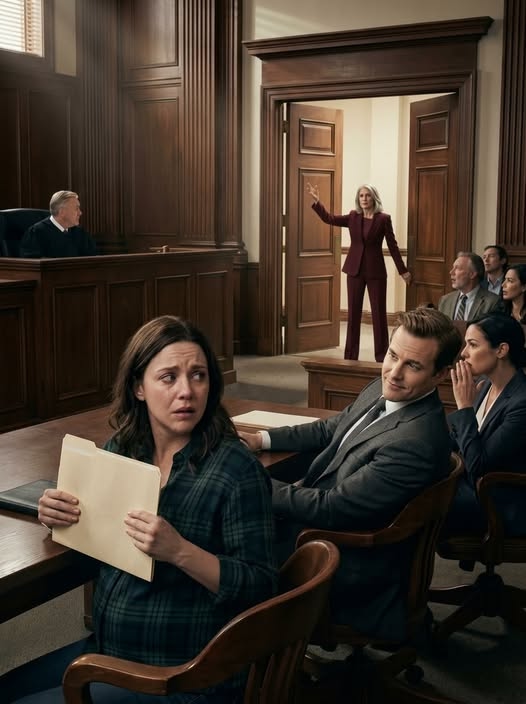
The judge held the document in both hands and read it again.
Marcus had gone so still that even his attorney noticed.
“Mrs.
Vale,” Judge Elena Mercer said, “who else has a copy of this?”
I had been waiting for that question.
“The original medical records are maintained by St.
Anne’s Hospital,” I said.
“The photographs and contemporaneous statement were preserved with my former physician’s office.
My complete evidence packet was also provided to the appropriate authorities through counsel assisting me outside this divorce proceeding.”
Marcus turned sharply toward me.
“Through counsel?”
It was the first time all morning that his voice sounded uncertain.
I nodded.
I had chosen to represent myself at the hearing, but I had never claimed I had spent the previous year navigating everything alone.
A former colleague had helped me understand where the boundaries lay between the divorce case, potential criminal issues, and the financial records I had uncovered.
She had not come to court to speak for me because, on that morning, I wanted Marcus to see me stand on my own.
His mistake had been assuming that an empty chair beside me meant an empty strategy.
Judge Mercer placed the document down.
“Mr.
Vale, your proposed settlement contains a representation that both parties have made complete financial disclosures.”
Marcus’s attorney shifted in his chair.
“That was my understanding, Your Honor.”
The judge looked at him.
“Was your understanding based on information supplied by your client?”
“Yes.”
The answer came more slowly this time.
I opened the folder to the section marked with blue tabs.
Six bank transfers appeared on the first statement.
Three more appeared on the next.
Each had been made after our separation began, and each moved marital funds into an account connected to a consulting company Marcus had never disclosed.
For months, he had insisted the investment account had fallen because of market losses.
It had not.
Money had been leaving in carefully measured amounts.
His lawyer studied the statements.
“Marcus,” he whispered, “what company is Northbridge Advisory?”
Marcus stared straight ahead.
“It’s dormant.”
“Then why did it receive these transfers?”
“I don’t remember.”
I almost smiled.
Marcus remembered the serial number on every watch he owned.
He remembered restaurant bills from five years earlier if he thought someone owed him twenty dollars.
He remembered every sentence I had ever spoken badly enough to use against me later.
But now he could not remember where nearly three hundred thousand dollars had gone.
Judge Mercer ordered the documents marked for review and turned to me.
“How did you obtain these records?”
“From statements from an account on which I remained an authorized joint holder, along with records produced during discovery.”
Marcus looked at me as if I had betrayed him by knowing how our own finances worked.
“You went through my accounts?”
The judge’s gaze hardened.
“Mr.
Vale, you will address the court, not your wife.”
He sat back.
For the first time, Denise was no longer looking at me with contempt.
Her eyes moved between her son and the documents as though she were trying to decide which version of reality she still wanted to believe.
Marcus’s attorney rose.
“Your Honor, we may need a brief recess to review material that appears not to have been previously supplied to us.”
“I supplied requests for the underlying records three times,” I said.
“The responses stated that no such accounts existed.”
I handed the clerk copies.
The lawyer’s face tightened.
Those denials bore Marcus’s signature.
The judge called a recess.
Marcus stood immediately, but instead of following his lawyer into the hallway, he crossed toward me until the bailiff moved between us.
“You think this makes you clever?” Marcus said quietly.
I closed my folder.
“No.”
His jaw tightened.
“You’re trying to ruin me.”
“I’m showing records.”
“That’s the same thing to you, isn’t it?”
I looked at him for several seconds.
For years, arguments with Marcus had worked because he could change the subject faster than I could defend myself.
If I asked about money, he accused me of mistrust.
If I mentioned his temper, he said I provoked him.
If I cried, I was unstable.
If I stayed calm, I was cold.
Every road led back to my guilt.
But a courtroom had rules.
So did evidence.
“I’m not responsible for what the records show,” I said.
His attorney called his name from the hallway.
Marcus stepped back.
Then he noticed my bare shoulder again.
His eyes moved to the scars.
“You can’t prove how those happened.”
The bailiff heard him.
So did Denise.
Her mouth opened slightly.
Marcus realized too late what he had said.
I did not answer.
I did not need to.
When court resumed, Judge Mercer addressed the financial issue first.
She said the proposed settlement would not be approved while questions remained about undisclosed assets.
She ordered additional financial disclosure and preservation of relevant accounts pending review.
Marcus’s carefully prepared agreement remained unsigned on the table.
Clause Seventeen remained nothing more than ink on paper.
Then the judge turned to the second section of my folder.
“This court is not conducting a criminal trial,” she said.
“I want that understood clearly.
But allegations of coercion or abuse can be relevant to whether an agreement was freely negotiated and to certain protective issues before this court.”
I nodded.
Marcus’s attorney nodded too.
Marcus did not.
The first medical record was dated three years earlier.
I remembered the night without needing to read it.
I had arrived at St.
Anne’s after midnight with an injured shoulder and bruising along my upper arm.
I told the doctor I had fallen against a cabinet.
That lie lived in the first half of the report.
What Marcus had never known was that I later asked the nurse to return after he stepped outside to take a call.
I told her the truth.
Not everything.
I was still too afraid for everything.
But enough.
Popular Posts
→- 1
- 2
- 3
- 4




Recently Viewed
Stories you read recently will appear here.





