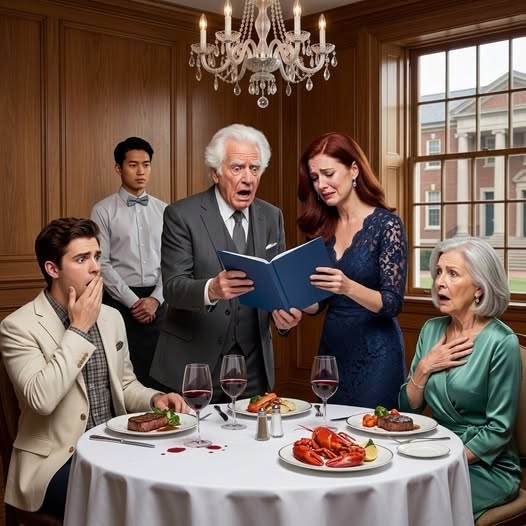
My Father Skipped My Wedding Until My 580 Million Dollar Hotel Empire Made The News
My father skipped my wedding eight years ago, and for a long time I believed that was the worst thing he would ever do to me. I was wrong about that, but it took a valuation of five hundred and eighty million dollars to bring out the worse thing, and by the time it arrived I was finally strong enough to meet it.
Let me start with the wedding, because everything else grows out of that empty chair.
He did not miss it because he was sick. He was not stranded at an airport, not caught in traffic, not felled by any of the small disasters that give a person a reason. He simply decided, in the weeks leading up to it, that my marrying Evan Cole was proof that I had thrown my future away, and he decided that a man could not be expected to sit and smile while his daughter threw her future away, and so he stayed home.
Evan was a public-school history teacher. He had student loans and no family money and a secondhand car and a way of explaining the causes of the First World War that made ninth graders lean forward in their seats, and my father looked at all of that and saw a poor prospect, a step down, a daughter settling for less than the Carter name deserved.
I come from money, is the thing you have to understand. Not old money, but real money, built by my father’s own hands, which made him prouder of it and more possessive of it than any inheritance could have. Carter Development had put up half the strip malls and office parks and mixed-use complexes in our part of Georgia, and my father had built it from a single backhoe and a loan he never let anyone forget he had paid back early.
He had raised the three of us, my brother Grant and my sister Natalie and me, inside that success, and he had raised us to believe that the family and the company were the same thing, that loyalty to one was loyalty to the other, and that the worst thing a Carter could do was leave.
And I was leaving. That was what my marriage really represented to him, I understand now. Not Evan’s salary. My exit. I had worked at Carter Development through college and after, learning the business, being groomed, everyone assumed, to take it over one day, and then I had fallen in love with a history teacher and announced I was going to build a life that was mine instead of one that was ours, and my father could not forgive it.
At 10:14 on the morning of my wedding, while I was in a hotel room with my hair half done and my mother’s borrowed earrings in my hand, my phone lit up with a text from him. I won’t sit there and pretend I approve. That was all. Eleven words, and a lifetime inside them.
My mother had died when I was nineteen, which is a detail that matters here, because those were her earrings, and because she was the one who would have overruled him, the one who had always been able to reach the softer thing buried under my father’s certainty. Without her, there was no one to tell him he was being a fool, no one whose disapproval he feared more than he enjoyed his own. So the earrings in my hand were the closest thing to a parent I had in that room, and they were cold, and they did not say anything.
I read the text, and I set the phone face down on the vanity, very gently, as though it might go off. And I went into the hotel bathroom and I cried in a way that I did not want anyone to see, the ugly heaving kind, holding a hand towel against my mouth so the bridesmaids in the next room would not hear me and come knocking. I remember looking at myself in that bathroom mirror,
half a bride, mascara running, and thinking, with a strange detached clarity, that he had timed it. Not two days before, when I might have had space to grieve it.
Not after, when it could not have wounded me. He had sent it at 10:14 on the morning of the wedding, close enough to the ceremony that it would color the entire day and far enough that I could not respond, and I understood even then, even weeping into a towel, that the timing was the message. He wanted the day to hurt. He wanted the empty chair to be the thing I remembered.
And then I ran cold water and I fixed my mascara, because a bride’s face does not get to fall apart, and I walked back out and I finished getting ready, and an hour later I walked down the aisle on the arm of my uncle, my father’s own younger brother, a gentler man who had looked at the empty seat in the front row and quietly, without a word about it, offered me his elbow. I have loved my uncle without reservation ever since.
I married Evan under a white arch with the Blue Ridge mountains going blue and gold behind us in the late afternoon light, and it was, despite everything, a beautiful day, and I have never once regretted it. But there was an empty chair in the front row, and I felt it the entire time, the way your tongue keeps finding the gap where a tooth used to be, and some part of me spent that whole perfect afternoon aware of the hole where my father should have been.
And then I built a life anyway. That is the part he never counted on.
Popular Posts
→- 1
- 2
- 3
- 4




Recently Viewed
Stories you read recently will appear here.





