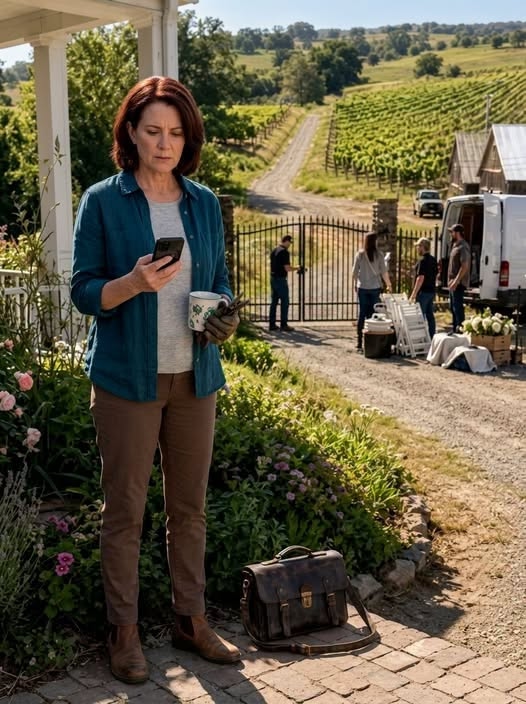
The florist was the reason I called.
That is what I want to say first, because it matters that the morning started with something ordinary. I had poured my coffee, the same black cup I have poured every morning for forty years, and I was thinking about the south gate and whether Ben had confirmed the turning radius for the delivery trucks,
and I called my daughter the way you call someone about a logistical detail, expecting a logistical answer.
Samantha answered on the fourth ring.
Her voice was tight in a way I recognized but did not immediately name. Not busy. Not the pleasant distraction of someone in the middle of wedding preparations. Something else, something with more careful edges, the voice of a person who has been rehearsing a conversation and is now arriving at it.
“What time is the florist coming?” I asked. “Ben needs to know which gate to keep clear.”
A long pause. Traffic behind her. A car door.
“Mom,” she said. “There’s something we need to talk about.”
I set my coffee down on the kitchen table. The table my husband Richard built in the second year of our marriage from wood milled on this property, wide oak planks joined with the patient precision of a man who believed things worth having were worth making correctly. I have eaten thirty years of meals at that table. I sat down at it now.
“What is it?”
Another pause. Then she said it the way you say something you have been carrying and have finally decided to put down regardless of where it lands.
“I don’t think you should come to the wedding.”
I sat with this for a moment. The wedding was in four days. The ceremony would take place near the rose garden I had planted and tended for twenty-two years. The tent was being erected on my south lawn. The wine served to two hundred guests would come from grapes grown in my soil, harvested by
my crew, aged in my cellar. I had written the checks for the caterer, the florist, the string quartet, the tent company, the rental furniture, the guest accommodations in the stone house I had spent two years and considerable money restoring.
“What do you mean I shouldn’t come,” I said. It did not come out as a question.
“Greg thinks you might make his family uncomfortable.” She said this quietly, the way people say things they know are wrong while they are saying them. “You’re just different from them. You don’t really fit in with his crowd.”
I looked through the kitchen window at the vineyard. The rows were green and orderly in the morning light, each vine trained along its wire with the disciplined patience of twenty years of attention. The grapes were not yet ready. August harvest, if the weather held.
“My husband doesn’t want you there,” Samantha said.
Greg was not yet her husband. I noticed she had already begun calling him that.
I thought about the evening a week earlier, the patio under the string lights, the velvet box I had placed on the table between us. The brass key to the stone house by the creek. Eight million dollars at current market, though I had not said that because it seemed beside the point. I had said only that I wanted her
to begin her married life without debt, which was true, and which was the thing Richard would have done if he had lived to see this.
Samantha had cried.
Greg had picked up the key and turned it over in his hand and said he supposed they would need to hire a proper landscaper because they couldn’t have the property looking like a working farm when his friends came to visit. Then he had looked at my hands, which were stained from the morning’s work,
and said something about my boots that I did not entirely catch because I was watching my daughter laugh at the observation.
I had told myself they were nervous. Young. Absorbed in the approaching wedding. I had driven my pickup back to the main house and washed my hands at the kitchen sink and told myself that people are complicated and that love, when it arrives, sometimes comes wrapped in things you have to learn to look past.
I had let it go.
Until that morning.
“Understood,” I said.
I ended the call.
For several minutes I sat at Richard’s table and listened to the refrigerator hum and the distant sound of one of the vineyard trucks starting beyond the barn. Outside, the morning was clear and warm, the kind of August morning that makes you understand why people spend their lives growing things.
The silence in the house did not feel lonely.
It felt clean.
I finished my coffee. Then I carried my cup to the sink and rinsed it and set it on the rack and went into the study and opened my laptop.
The pending payments were all there in the account interface. Caterer. Florist. Quartet. Tent company. Rental service. Linen supplier. Several smaller vendors. All scheduled to process at noon.
I looked at each one.
Then I picked up my phone and called Ben.
Ben Okafor had managed this property for sixteen years. He had come to us when he was twenty-eight, fresh from an agricultural program in Davis, with opinions about drainage and cover crops that Richard had initially challenged and ultimately adopted. After Richard died, Ben had become the person who
kept the operation running during the years when I was learning how to manage grief and an eighty-acre vineyard simultaneously. He did not confuse the two jobs but he understood that they were happening at the same time.
He answered on the second ring.
“Morning, Andrea.”
“Morning, Ben. I need you to change the access code at the private gate.”
A half-second pause. Not surprise, exactly. Processing.
“All right.”
“And replace the lock at the stone house.”
Popular Posts
→- 1
- 2
- 3
- 4




Recently Viewed
Stories you read recently will appear here.





