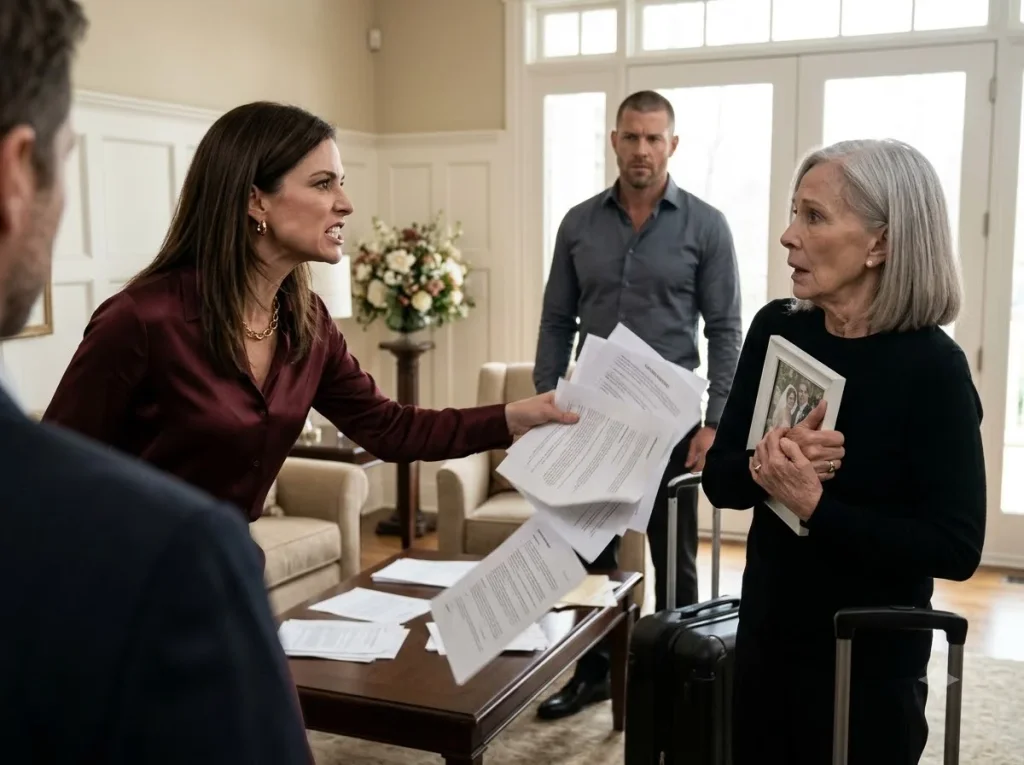
Five days after I buried my husband, my daughter-in-law told me to pack my bags and sleep on the streets.
She said it in my living room, beneath the dusty rectangle where our wedding portrait had hung for forty years.
Vanessa’s red fingernail tapped a yellow sticky note she had slapped onto my piano, the one Henry bought me the year our son Daniel was born.
“Now that he’s gone,” she said, smiling without warmth, “cry all you want, pack your things, and go live on the streets.”
Daniel stood behind her in his black funeral suit, his face pale, his hands buried in his pockets.
He did not look at me.
That silence broke something in me that grief had only cracked.
The house on Maple Avenue still smelled of lilies, casseroles, and rain-soaked coats from mourners who had already returned to their own lives.
I could still see Henry’s slippers beside his chair.
His reading glasses lay open on the end table, facing the last crossword he never finished.
I had lived in that house since I was twenty-six.
I had waxed the floors, paid the taxes when Henry’s business struggled, taken double shifts at Saint Vincent’s Hospital, and tucked Daniel into bed under that roof while snow gathered against the windows.
But Vanessa walked through it as though she had inherited a hotel.
She had legal papers spread across my bed before the grave dirt settled.
A “voluntary transfer,” they called it.
The house, the property, the savings account Henry and I had built penny by penny.
All of it to Daniel.
I stared at my son, waiting.
“Daniel,” I whispered.
His jaw moved once.
Nothing came out.
Vanessa stepped closer.
“Don’t make this dramatic, Margaret.
You’re seventy-one.
You don’t need a whole house.
Daniel and I have plans.”
Plans.
The word chilled me.
I reached into my coat pocket and closed my fingers around the tiny brass key Henry had pressed into my hand three weeks before he died.
He had been lying in his hospital bed, thin as paper, his breathing ragged, his eyes brighter than they had any right to be.
“Keep this safe,” he had whispered.
“And whatever happens, don’t tell anyone.
Not even Daniel.”
At the time, I thought pain medication had filled his mind with shadows.
Now, looking at Vanessa’s hungry smile, I was no longer sure.
I packed one suitcase.
Two sweaters.
My nursing shoes.
My Bible.
My mother’s quilt.
Our wedding photograph, lifted from the floor where Vanessa had left it like trash.
Before I walked out, I paused by Henry’s chair.
Beneath the crossword was a faint circular mark in the wood, as if his coffee mug had been set there too many years to count.
I touched it once.
Daniel still said nothing.
That night, in a cheap motel off Route 119, the walls smelled of bleach and old cigarettes.
I sat on the edge of the bed with my suitcase unopened, the brass key on my palm, and remembered a business card Henry had slipped into my purse months earlier.
MARTIN REYES, ESTATE ATTORNEY.
47TH STREET, MANHATTAN.
My hands trembled as I dialed.
The phone rang twice.
A man answered, low and alert.
“Mrs.
Whitaker?”
I froze.
“How did you know?”
There was a pause, then the faint scrape of a chair.
“Because your husband told me you would call only after they threw you out,” he said.
“And Margaret, listen carefully.
If they know you have the key, you may not be safe.”
At that exact moment, someone knocked on my motel door.
The knock came again, harder.
I did not breathe.
The motel room seemed to shrink around me, its thin curtains twitching above the heater, its yellow lamp throwing my shadow against the wall like a frightened stranger.
The brass key lay in my open palm, tiny and cold, and Martin Reyes’s voice pressed against my ear.
“Mrs.
Whitaker,” he said sharply, “are you alone?”
Someone outside the door dragged something across the metal threshold.
A shoe, perhaps.
Or a key card being tested.
“I was,” I whispered.
“Do not open that door.”
Another knock.
“Mom?”
Daniel’s voice came through the wood.
Soft.
Shaking.
“Please.
I need to talk to you.”
My chest clenched so violently I had to grip the edge of the mattress.
For a second, grief, habit, and motherhood rose in me all at once.
My son was on the other side of that door.
My boy.
The child who once cried when thunder shook the windows.
The man who had stood silent while his wife erased me from my own home.
“Mrs.
Whitaker,” Reyes said, quieter now, “is that your son?”
“Yes.”
“Is his wife with him?”
I moved carefully to the window and shifted the curtain a finger’s width.
Popular Posts
→- 1
- 2
- 3
- 4




Recently Viewed
Stories you read recently will appear here.





