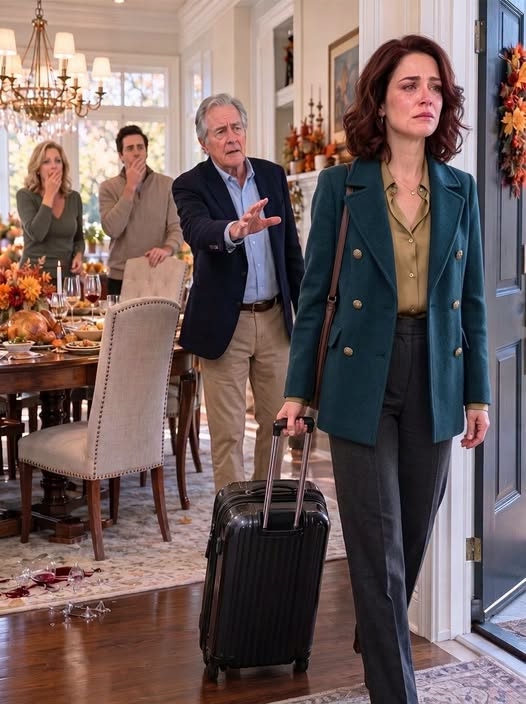
Dad’s head snapped up. “You’re suing your own brother and sister?”
“No,” Clara said, rising from the booth with a grace that seemed entirely separate from the wreckage around her. “I am protecting my family. The only member of it who ever possessed a conscience.”
She laid a three-hundred-dollar cash stack on the table to cover the meal. She did not look at Robert. She did not look at Eleanor.
“Come, Emily,” she said. “Let’s go home.”
I stood up. I slipped the heavy silver key fob into my satchel, pulled my coat around my shoulders, and turned to follow her.
“Emily!”
Mother’s hand reached out, catching the edge of my sleeve. Her fingers were claw-like, desperate, stripped of all dignity.
“Emily, please,” she sobbed, looking up at me from the ruins of her dinner. “You’re my daughter. We did what we thought was best for the family. You can’t let her do this to us. We’ll lose everything. Tell her to drop the lawsuit. Talk to your brother. Please, Emily… we’re your blood.”
I looked down at her hand on my sleeve. I felt no rage. I felt no triumph. I felt only a profound, liberating stillness—the quiet of an empty corridor after a long, agonizing shift.
I reached down and, finger by finger, peeled her hand from my coat.
“Blood didn’t buy me that car, Mother,” I said softly. “And blood didn’t pay for my degree. You told me I wasn’t cut out to be a nurse because I had to struggle. But you were wrong. The struggle taught me how to tell when something is already dead.”
I let go of her hand. It fell back onto the stained tablecloth.
“Have a safe drive home,” I said.
Outside, the November air was sharp, clean, and bracing. It tasted of woodsmoke and early winter. I walked to the front bay, pressed the unlock button on the fob, and heard the familiar, double-chirp of the silver crossover as its amber running lights flickered to life.
I opened the driver’s door. The interior was warm, smelling faintly of clean leather and cedar. I adjusted the mirrors, settled into the seat, and started the engine. The dashboard illuminated with a smooth, azure glow, the digital display reading All Systems Normal.
Aunt Clara pulled her town car up beside me, lowered her window, and gave me a single, firm nod.
I put the crossover into drive, eased off the brake, and pulled out into the wide, open expanse of the avenue, leaving the restaurant, the dinner, and the Carters far behind in the dark.
The legal settlement took six months to finalize.
It did not go to trial. When Clara’s attorney presented my parents’ counsel with the certified bank draft from 2022, the matching deposit slip from my mother’s personal checking account, and the immediate withdrawal of nine thousand eight hundred dollars made payable to the Franklin County Clerk of Courts for Jason’s delinquent property liens, their lawyer advised them that defending the case in open court would likely trigger a criminal referral for elder exploitation and grand larceny.
My parents signed an agreed judgment.
They agreed to pay back the full ten thousand dollars, plus twelve percent statutory interest, structured over thirty-six monthly payments of three hundred and twenty dollars. Every month, an automated ACH transfer moves from Robert Carter’s pension account directly into the servicing portal of my nursing school loans.
They also signed a formal, recorded quitclaim and release, disclaiming any past, present, or future interest in the silver crossover.
Jason’s life unraveled with the predictable precision of an engine run without oil. Deprived of the trust management fee he had already pledged to private lenders, his logistics consultancy collapsed before signing a single client. The luxury house in Dublin was sold at a short-sale auction three months later. He moved his family into a rented three-bedroom duplex in Marysville and took a position as an assistant manager at a commercial tire depot—an honest, difficult, forty-hour-a-week job that required him to punch a timecard at six in the morning.
He did not call me. My parents did not visit.
In May of the following year, the final envelope arrived from the student loan servicer.
I sat at the small laminate dining table in my apartment, the late afternoon sunlight streaming through the blinds, casting warm, golden bars across my kitchen floor. Outside, parked under the shade of a flowering crabapple tree, my silver crossover gleamed, its windshield reflecting the pale blue sky.
I unfolded the letter.
Account Balance: $0.00. Loan Obligation Satisfied in Full.
I held the paper for a long time. I thought of the freezing bus stops on 14th Street; I thought of the saltines eaten in hospital closets; I thought of the tears I had cried on my parents’ carpet while my father looked at his television.
I took the letter and pinned it to my corkboard, directly beneath my Bachelor of Science in Nursing diploma and my Pediatric Advanced Life Support certification.
My phone buzzed on the tabletop.
A text message from Eleanor Carter:
“Emily. Jason’s oldest girl has her middle school graduation on Saturday. The family is having a gathering at our place afterward. We would like you to come. It’s time we put the past behind us. A family cannot survive without forgiveness.”
I looked at the message for ten seconds.
I did not feel angry. I did not feel the old, familiar knot of guilt pulling at the base of my skull, demanding that I surrender my peace to maintain their comfort.
I tapped the screen, selected the thread, and hit Block Caller. Then I did the same for Jason and my father.
A gentle knock sounded at my door.
I opened it to find Aunt Clara standing in the hallway, wearing a tailored cream blazer, holding a bottle of crisp Chablis and a box of fresh pastries from the French bakery near her downtown office.
Popular Posts
→- 1
- 2
- 3
- 4




Recently Viewed
Stories you read recently will appear here.