He rose at table one with a glass of Bordeaux in hand and began to talk about loyalty.
Family.
Responsibility.
Children who knew their place.
Then, almost offhandedly, his eyes drifted toward table twenty-two.
Several guests followed his gaze.
I kept sipping my wine.
I smiled.
Fifteen years ago, a speech like that would have shattered me.
I would have fled to the bathroom.
I would have sobbed into a hand towel.
I would have spent the rest of the night asking myself what I had done wrong.
But I was no longer twenty-two.
I had changed.
I had flown through sandstorms.
I had landed aircraft in zero visibility.
I had dragged strangers out of water, fire, and wreckage.
I had watched people at their very worst.
And I had learned something that mattered.
Not everyone who rejects you deserves the power to define you.
My father still believed I was the daughter who ran away.
He had no idea how many people I had brought home.
Then Margaret’s brother, Richard Hail, walked up beside my table.
Richard was my father’s business partner.
He was a big man with a thick neck, an expensive Tom Ford suit, and a Rolex that flashed in the candlelight whenever he moved his wrist.
“Military, huh?” he said.
“Good for you.”
He took a sip of scotch.
“Somebody has to do it.”
Then he smiled.
“I just prefer people who can actually build something, not simply follow orders.”
The conversation around us dropped to a hush.
My father appeared almost at once.
It felt rehearsed.
Gerald stood at my left.
Margaret stood behind me.
Richard stood across the table.
For a moment, the three of them looked like a small tribunal in formalwear.
My father leaned in close.
I could smell his cologne.
“You see all these people?” he asked.
I looked around the ballroom.
“Every one of them knows you’re the daughter who abandoned her family.”
I said nothing.
He smiled.
“You’re still searching for something you’ll never get.”
“What is that?”
“My approval.”
There it was.
The old wound, spoken aloud.
He expected tears.
He expected rage.
He expected proof that beneath everything I had become, I was still the same insecure twenty-two-year-old woman desperate to win her father’s approval.
I gave him silence instead.
That seemed to unsettle him more than any argument could have.
His posture shifted.
His voice grew louder.
Then he delivered the line he was sure would finally humiliate me.
“If it wasn’t for pity, no one would have invited you.”
Part 2: The Envelope
The room changed.
Silverware stopped moving.
A waiter froze with a basket of bread in his hands.
Conversations died all at once.
Margaret touched my father’s arm.
She was not trying to stop him.
She was making sure the performance stayed polished.
I raised my glass.
I took one slow sip.
Then I smiled.
“Funny thing about pity,” I said quietly.
“The people who offer it usually need it the most.”
For the first time all evening, my father had no reply.
Then something stirred across the ballroom.
Clare rose from her seat.
Her husband, David, leaned over to help gather the train of her gown.
The band faded down.
The lights seemed to draw toward the small stage.
Clare walked to the microphone.
She held a kraft-paper envelope in both hands.
Her face was pale.
Her shoulders were squared.
My father settled back in his chair, expecting a traditional wedding speech.
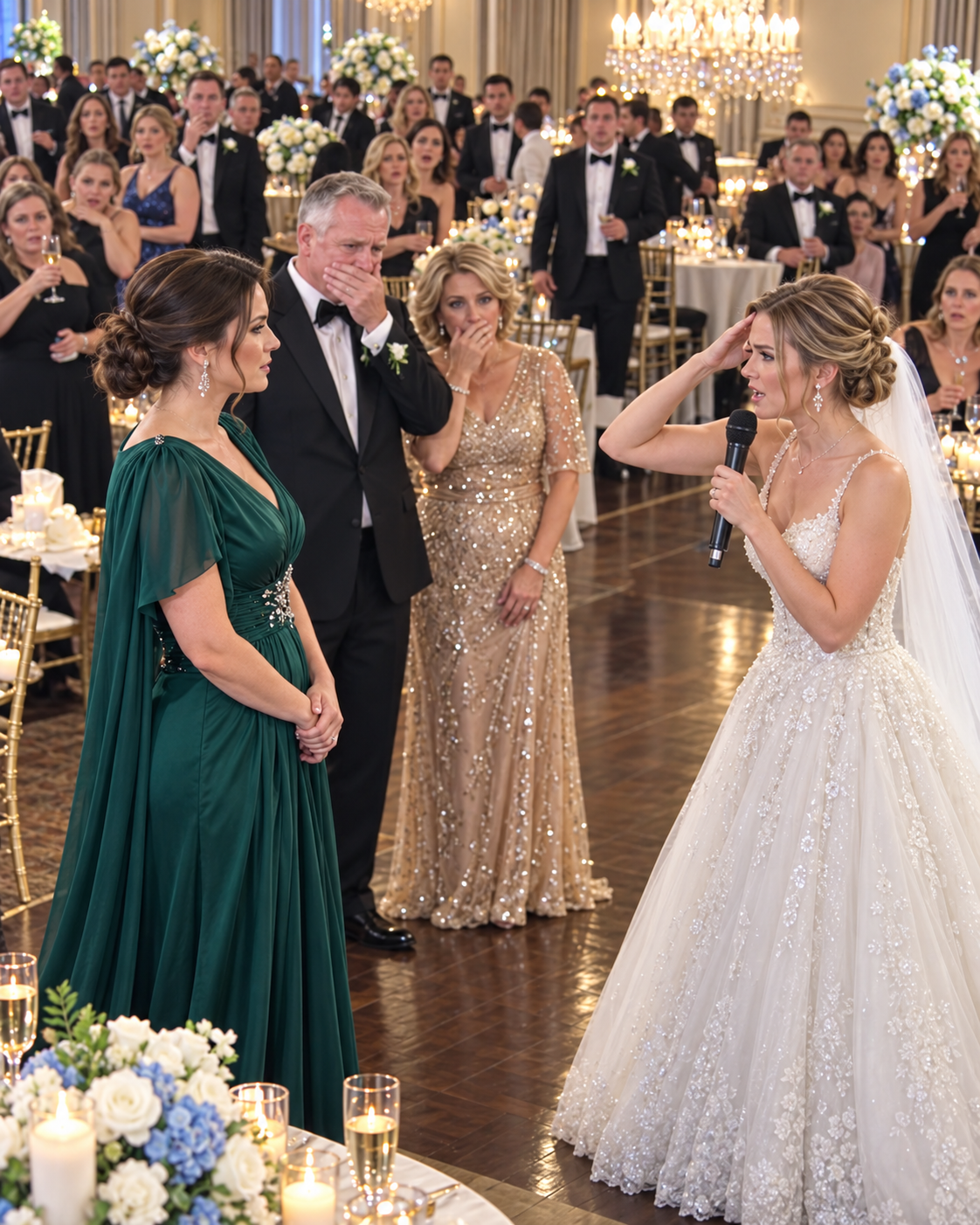
Margaret smiled, looking pleased.
She seemed to think this was the moment she had been waiting for all night.
But Clare was not looking at them.
She was looking straight at me.
At table twenty-two.
“I need to honor someone tonight,” she said.
Her voice shook slightly through the speakers.
“Someone this family tried to erase.”
A stir went through the room.
My father’s smile vanished.
Clare lifted the envelope.
From across the ballroom, I could make out the seal.
My stomach clenched.
It was the seal of the Department of the Air Force.
My hand tightened around my wine glass.
Clare opened the envelope.
She unfolded the document inside.
Then she began to speak.
“Seven years ago, I nearly died.”
Silence fell over the room.
“Some of you know that story. Some of you don’t.”
She glanced down for a moment.
Then she went on.
“I was driving home during a storm when my car went off Millstone Bridge.”
A murmur rippled through the guests.
“I remember the water.”
Her voice broke.
“I remember the cold.”
She swallowed.
“And then I remember nothing.”
Everyone was listening now.
Every single person in the ballroom.
Clare told them her car had plunged into freezing water.
She had been trapped inside.
Her seat belt had jammed.
Popular Posts
→- 1
- 2
- 3
- 4




Recently Viewed
Stories you read recently will appear here.





