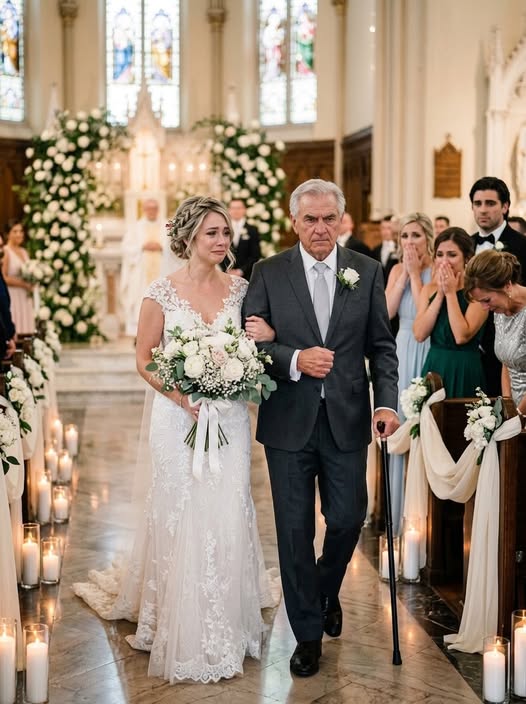
The scent of white lilies had always smelled like formaldehyde to Clara Stone.
They were massed in iron urns along the perimeter of the bridal preparation suite, their heavy, waxy throats gaping under the clinical hum of recessed halogen lights. Outside the leaded-glass windows of St. Jude’s Episcopal Church, an October drizzle silvered the slate rooftops of Chestnut Hill, slicking the cobblestone drive where valets in damp wool coats were parking German sedans and antique town cars. The elite of Philadelphia had gathered to watch a Stone daughter marry, though they had come mostly out of morbid curiosity. Clara was the daughter who had never played field hockey at Agnes Irwin, never debuted at the Academy of Music, and never worn her pearls with the careless slouch of someone whose lineage dated back to the Pennsylvania charter.
Clara stood before the triptych mirror, letting the dressmaker’s silk settle against her skin. It was an understated gown of ivory crêpe de Chine, devoid of the seed pearls, cascading tulle, and six-foot trains that had swaddled her older sisters. Her hands, resting lightly on the dressing table, were steady. Beneath the polished mahogany surface lay her leather bridal clutch, its interior stuffed not with touch-up powder or peppermint lozenges, but with two thumb drives and an authenticated court docket.
The suite door opened without a knock.
Margaret Stone swept inside, carrying the draft of the church corridor and the sharp, medicinal chill of her signature gardenia perfume. At fifty-eight, Clara’s mother looked like a portrait commissioned by an insecure monarch: her silver-blonde bob lacquered into an unyielding helmet, her posture honed by thirty years of Pilates, her lilac silk mother-of-the-bride suit cut with edges so sharp they seemed capable of severing an artery.
Flanking her like gilded bookends were Paige and Lauren. Paige, thirty-two, adjusted a platinum tennis bracelet encrusted with three tiers of emeralds, her wrist flashing in the vanity lights. Lauren, thirty, wore a smirk as carefully manicured as her French tips, her champagne silk maid-of-honor dress clinging to an expensive, gym-toned frame.
“Twenty minutes, Clara,” Margaret said. She did not look at her daughter’s face; her gaze caught Clara’s reflection in the glass, dissecting it with the cold efficiency of a meat inspector. “The organist is running through the Purcell voluntary. And the press from the Inquirer society page is seated in the third pew. Not that they care about an associate auditor marrying a municipal civil rights attorney, but they were promised a complete Stone family portrait.”
“I am a senior forensic accountant, Mother,” Clara said, her voice dropping into the quiet, resonant register she had learned to use in deposition rooms. “And Daniel is a partner.”
“Semantics,” Margaret snapped, turning her wrist to check a Cartier Tank watch. “Regardless, we have a minor logistical adjustment. I won’t be walking you down the nave.”
The air in the suite thinned. In the reflection, Clara watched Paige suppress a cruel little puff of laughter behind her manicured hand.
“We discussed this in August,” Clara said evenly. “You insisted on walking both Paige and Lauren down the center aisle alongside Dad. You told the Philadelphia Style magazine that modern matrilineal heritage was the core pillar of the Stone Foundation.”
Margaret gave a dry, rhythmic sigh, the sound of dry grass rubbing together in the wind. She stepped closer, stopping just behind Clara’s left shoulder, close enough that Clara could smell the white wine on her breath.
“That was for your sisters,” Margaret whispered, her tone carrying the terrifying calm of an executioner reading a brief. “Paige gave this family an alliance with the Van der Bilt trust. Lauren expanded our gallery holdings across three states. You, Clara, have spent your entire adult life auditing strangers and asking vulgar questions about ledgers that were none of your concern. You made yourself a thorn in your father’s side the moment you opened your mouth about your grandmother’s will.”
Margaret’s lips parted in a tight, venomous crescent. “I proudly walked both of my real daughters down that aisle because they were miracles wrapped in lace. But I refuse to walk my greatest regret to an altar. Your father will take your arm at the vestibule. If you embarrass us with tears, I will have the ushers pull the curtain on your exit.”
Behind her, Lauren leaned against the console table, humming a low, amused note. “Honestly, Clara, you should be grateful she’s even sitting in the family pew. Look at that foundation you’re wearing. Drugstore matte. It’s settling into your forehead lines.”
“Leave her alone, Lauren,” Paige chimed in, though her eyes danced with malice. “She chose her lifestyle. She wanted to work sixty hours a week looking at spreadsheets while we represented the family name. Some people are just built for basements.”
Clara did not blink. She looked at her reflection—the cool gray eyes, the high cheekbones inherited not from the vanity of Margaret Stone, but from a woman whose photograph had been systematically removed from the family home over twenty years ago: Evelyn Stone.
The heavy oak door rattled, and Thomas Stone stepped into the room. At sixty-two, the patriarch of the Stone Family Foundation carried himself with the heavy, unearned dignity of inherited wealth. His gray tuxedo was tailored by Savile Row, his cuff links stamped with the Stone crest—an eagle gripping an open ledger.
“What’s the delay?” Thomas demanded, checking his pocket watch. “The rector wants to begin the processional. The board members from the hospital are all here, Margaret. Harlan Croft is sitting in the transept. He’s deciding on the three-million-dollar endowment match today.”
“Your daughter is being obstinate about the walking arrangements, Thomas,” Margaret said, smoothing her cuffs.
Thomas looked at Clara, his mouth turning down in profound irritation. “Clara, for God’s sake. Don’t start this nonsense today. You’ve always been a difficult girl. Ever since you were seven years old, picking fights over your bedroom, whining about your college accounts, refusing to show proper gratitude. Just take my arm when the bell rings, keep your eyes on the cross, and try to smile. You’ve cost us enough headache over the years.”
Popular Posts
→- 1
- 2
- 3
- 4




Recently Viewed
Stories you read recently will appear here.





