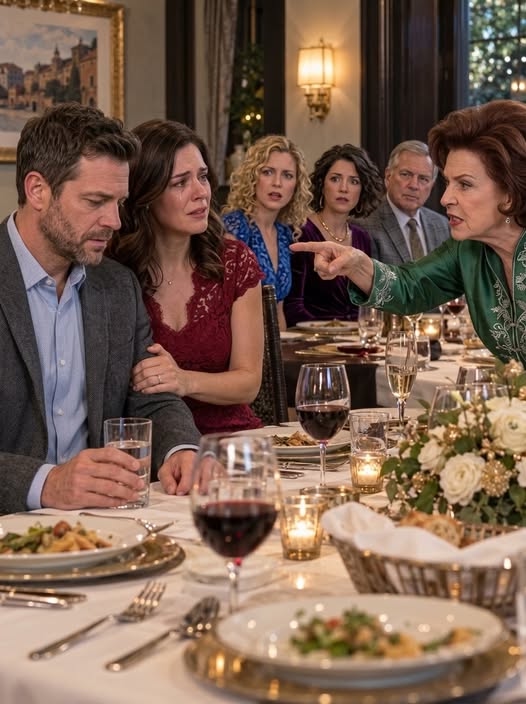
At my in-laws’ 50th anniversary, my mother-in-law announced that my husband would inherit nothing from their $5 million estate because “Mark doesn’t need it.” Ten minutes later, she asked him to fix her garage door.
He did—because he always did.
But the next morning, I learned why the will suddenly wasn’t the real issue anymore.
My mother-in-law raised her champagne glass during her fiftieth wedding anniversary and announced that my husband would inherit nothing.
Ten minutes later, she asked him to repair her garage door.
I wish I were exaggerating.
Richard and Patricia Bennett’s anniversary dinner had been perfectly pleasant until then. They had rented a private room at an Italian restaurant outside Columbus, one of those places with white tablecloths, silverware heavy enough to double as a weapon, and waiters who refilled your water before you noticed it was low.
About thirty-five people were there—family, longtime neighbors, retired teachers Patricia had worked with, and a few men Richard knew from his contracting years.
By eight-thirty, most guests were gathering coats or moving toward the bar, leaving the immediate family around the large table by the windows.
That was when Patricia started talking about their house in Dublin.
She mentioned how much the neighborhood had changed since she and Richard bought there. Richard complained about property taxes, and Susan, Mark’s older sister, teased him that complaining about taxes had become his favorite retirement hobby.
Then Patricia said almost casually, “Actually, your father and I finally updated the estate documents.”
That got everyone’s attention.
Susan lowered her coffee. “Well, that sounds cheerful for an anniversary.”
Patricia laughed. “Oh, stop. We’re not dying. We’re planning.”
Richard leaned back. “Your mother’s been after me about it for two years.”
Patricia ignored him and explained that between the house, investments, retirement accounts, and savings, their estate was worth roughly five million dollars.
I knew my in-laws were comfortable.
I hadn’t realized comfortable meant five million dollars.
Then Patricia said, “When we’re both gone, everything will be divided equally between Susan and Rebecca. The house too.”
For a moment, nobody said anything.
I looked at Mark.
He sat beside me, one hand around his water glass. He didn’t move, although I saw his thumb press harder against the glass.
Rebecca, Mark’s younger sister, finally asked the obvious question.
“Wait. What about Mark?”
Patricia looked genuinely surprised.
“Mark doesn’t need an inheritance.”
She sounded proud of the decision, which made it worse.
“Mark and Claire both have good jobs,” she continued. “They own their home. They’ve always taken care of themselves.”
Richard nodded. “Your sisters could use the security more than you could, son.”
Susan went completely still.
Rebecca looked uncomfortable enough that I almost felt sorry for her, even though none of this was her fault.
Mark took a sip of water.
Then he said, “Okay.”
That was all.
No argument.
No questions about percentages.
No demand to know why being responsible had somehow become grounds for exclusion.
Just okay.
Patricia reached over and touched his arm.
“I knew you’d understand.”
I remember thinking she couldn’t have chosen a worse sentence.
Apparently, the evening wasn’t finished.
About ten minutes later, while people collected their coats, Patricia approached us.
“Mark, before you leave, could you look at the garage door? It’s making that clicking noise again.”
For a second, I thought I’d misunderstood.
Mark hadn’t.
“Sure, Mom.”
So naturally, we stopped at their house on the way home, because apparently the clicking garage door faced a medical emergency and couldn’t possibly wait until Saturday.
Richard opened the garage while Mark removed his jacket and rolled up his sleeves.
I stood beside the workbench as my husband knelt on the cold concrete and examined the safety sensor.
Patricia hovered behind him.
“See? It does that little jerk.”
“I see it.”
“Is it the motor?”
“No.”
“Is it expensive?”
“I don’t know yet, Mom.”
She went inside to make coffee.
I waited until the kitchen door shut.
Then I stared at my husband.
He glanced over his shoulder. “What?”
“Nothing.”
“Claire.”
I lowered my voice. “You were informed ten minutes ago that you don’t need anything from them, and now you’re on your knees fixing something they need from you.”
He looked at me briefly.
Then he turned back to the sensor.
“Hand me that screwdriver.”
That was Mark.
For the twelve years we had lived twenty-five minutes from his parents, he had been their first call for almost everything.
When Richard had cataract surgery, Mark drove him.
When Patricia needed a colonoscopy, Mark used a vacation day.
When hail damaged their roof, Mark handled the insurance adjuster because apparently dealing with insurance companies was another family responsibility that had skipped his sisters.
He had replaced their garbage disposal, rebuilt two deck steps, found them a plumber, fought with their cable company, organized Medicare paperwork, and somehow become the only person alive who knew where Richard kept the password to his brokerage account.
When Richard had his knee replaced, Mark used eleven vacation days between the surgery, the miserable first week afterward, and physical therapy.
Susan lived in South Carolina.
Rebecca lived in Arizona.
They weren’t bad daughters.
Susan called every Sunday. Rebecca visited when she could. Both remembered birthdays, sent presents, and loved their parents.
But whenever something leaked, broke, beeped, expired, needed a signature, or required a driver before eight in the morning, Mark’s phone rang.
On our drive home from the anniversary dinner, I waited until we reached I-270.
“Do you want to talk about the will?”
“No.”
“You sure?”
“Yes.”
I let another mile pass.
“Because I’d be angry.”
Mark kept his eyes on the road. “It’s their money.”
“I know.”
“They can leave it to whoever they want.”
“I know that too.”
He glanced at me. “You agreeing with me this much is making me nervous.”
I almost smiled.
“Mark, I’m not asking whether they have the legal right to do it.”
He knew what I meant.
Popular Posts
→- 1
- 2
- 3
- 4




Recently Viewed
Stories you read recently will appear here.





