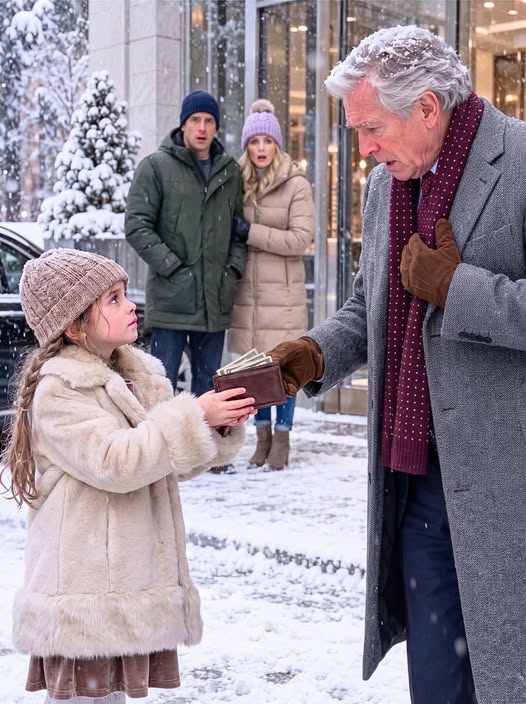
Part 1: The Girl Who Waited in the Rain
The little girl had been standing outside my headquarters in the pouring rain for nearly two hours before I realized she was waiting for me. I did not know her name, and until that moment, I did not even know I had lost my wallet.
I was Arthur Vance, sixty-one years old, owner of four commercial high-rises in Austin and employer of hundreds of people. That afternoon, I had just finished negotiating a multimillion-dollar deal, yet the thing that stopped me in the lobby was one of my managers casually pointing toward the glass doors.
“Security should move that kid along. She’s been standing out there forever.”
The girl looked about eight years old, wearing an oversized green raincoat and soaked sneakers while clutching a plastic grocery bag to her chest. Our security chief told me he had invited her inside several times, but she refused to surrender whatever she was carrying.
“She says it belongs to you personally.”
I reached into my jacket.
My wallet was gone.
I immediately stepped outside, and the girl pulled a worn brown leather wallet from the plastic bag. Before handing it over, she opened it and carefully compared my face with the photograph on my driver’s license.
“Are you Arthur Vance?”
“Yes.”
“I found this near a bench by the park.”
Everything was still inside, including my credit cards, building passes, and more than six hundred dollars in cash. Tucked into the deepest pocket was an old photograph of my daughter Julia at seventeen, laughing on a beach, one of the few things I still carried from before she stopped speaking to me three years earlier.
“Why didn’t you leave it with security?”
The girl glanced toward the building.
“My mom says if something is important, you give it back to the person who lost it.”
Her fingers were red from the cold, and when I asked how long she had waited, she simply looked down at her shoes. The security guard answered instead.
“One hour and fifty-two minutes.”
I took her into the coffee shop and ordered hot chocolate. She refused to drink until I counted the money in front of her and confirmed that nothing was missing.
“It’s all there.”
Only then did she take a sip.
I pulled several hundred-dollar bills from the wallet and pushed them toward her.
“Take this. You earned it.”
She answered immediately.
“No.”
“It’s a reward.”
“I don’t need it.”
Her name was Renata. When I asked where her mother was, she pointed across the street toward a municipal building and explained that Marisol was inside interviewing for a job.
Minutes later, Marisol came running through the rain and dropped beside her daughter, checking her hands, forehead, and soaked shoes before she even noticed me. When I explained what Renata had done, Marisol thanked me politely but became visibly upset that her daughter had waited outside for so long.
The rain worsened, so I offered them a ride home. Their small apartment had a failing heater, nearly empty kitchen shelves, a utility shutoff warning, and an eviction notice taped to the refrigerator.
“I’m not looking for a handout, Mr. Vance.”
“I wasn’t going to offer one. I wanted to ask about your interview.”
Marisol told me she had spent eight years supervising cleaning crews before losing her job after refusing to approve falsified timesheets. Management had been recording shorter shifts than workers actually completed, cutting wages while demanding the same amount of labor.
Then she named the buildings her crews had serviced.
The last address was mine.
My flagship tower.
The polished floors beneath my expensive shoes had been maintained by workers whose wages were being quietly stolen, and the contract allowing it carried my signature.
For the first time that day, I understood that the wallet Renata returned was not the only thing I had failed to notice.
Part 2: The Job She Refused to Accept as Charity
I barely slept that night. At 2:13 in the morning, I logged into our internal system from my home office and pulled every vendor contract connected to the facilities company Marisol had named.
It took only a few minutes to find my signature, and seeing it there made my stomach tighten. Two years earlier, I had approved the agreement after reviewing the financial summaries and cost projections, but I had never examined the labor addendums, field reports, or worker complaints because the numbers looked profitable and I had trusted other people to handle the details.
At eight the next morning, I called Marisol and offered her a position at Vance Enterprises. Her response came so quickly that I barely had time to finish the sentence.
“I want to offer you a job at Vance Enterprises.”
“No.”
She did not ask about the salary or the title. Instead, she made it clear that Renata had returned my wallet because it was the right thing to do, not because they wanted something from me.
“Mr. Vance, my daughter returned your wallet because it was the right thing to do. That does not give you the right to purchase our dignity.”
Her words hit harder than I expected because she was right. I had spent much of my adult life treating money like a universal solution, and now I was trying to use it to erase the discomfort of realizing how much damage I had ignored.
I changed my approach and asked Marisol to meet me at a public library. There, I placed a formal recusal document in front of her that legally removed me from any hiring decision involving an open vendor-compliance position.
“This is a real vacancy. You would have to pass the same interviews and practical audit tests as everyone else.”
Marisol studied the paperwork carefully before looking up.
“So this is an opportunity, not a favor?”
“It is an opportunity you earned through eight years of experience.”
Popular Posts
→- 1
- 2
- 3
- 4




Recently Viewed
Stories you read recently will appear here.





