For several seconds, all I could hear was Mara breathing.
Then came the faint rustle of paper.
My son’s voice sounded somewhere beyond her, sharp and impatient.
“What is that?”
Mara didn’t answer him immediately.
I could picture her perfectly. She had worked beside my husband and me for twenty-seven years.
She was sixty-two now, silver beginning to thread through her dark hair, and she had a particular way of becoming very still when someone tried to intimidate her.
“It was left for you,” she finally said.
“By who?”
“Your mother.”
Silence.
Even through the phone, I felt it.
Then my son laughed.
Not a happy laugh.
A dismissive one.
“My mother doesn’t have authority here anymore.”
Mara said nothing.
I closed my eyes.
That sentence hurt more than I expected.
Not because I believed it.
Because he did.
I heard the envelope tear.
Paper unfolded.
Five seconds passed.
Then ten.
When my son spoke again, the arrogance had disappeared from his voice.
“What is this?”
Mara answered calmly.
“You should read the entire letter.”
“I read it.”
“Then you know you need to leave your father’s office alone.”
“This is ridiculous.”
Another voice entered the background. The locksmith, perhaps, asking whether he was still needed.
My son snapped at him to wait.
Then he came back to Mara.
“Where is my mother?”
Mara looked to me for permission even though he couldn’t see it.
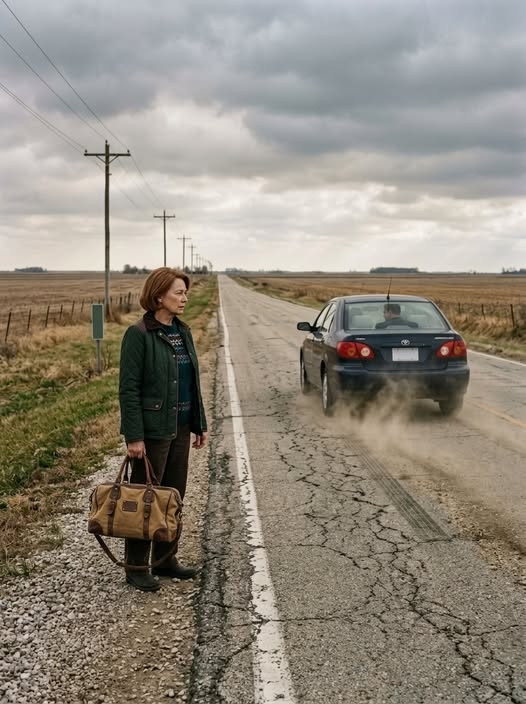
“Tell him I’m exactly where he left me.”
She repeated the words.
The silence afterward was different.
He understood.
“What?”
Mara didn’t soften it.
“Your mother said she is exactly where you left her.”
His breathing became audible.
Then his voice dropped.
“Put her on.”
Mara paused.
“He wants to speak to you.”
“No.”
That one word came easier than I expected.
For most of my life, motherhood had trained me to answer.
To come when called.
To fix what was broken.
To smooth whatever rough edge threatened my child.
Even when that child became a grown man.
Even when the person breaking things was him.
“Tell him the attorney’s number is in the letter,” I said. “He can call him.”
Mara repeated it.
My son started shouting.
I moved the phone slightly away from my ear.
The young gas station clerk glanced at me from behind the register. I gave him an apologetic smile.
Then another voice came through Mara’s phone.
One of our employees.
“Sir, you need to step away from the door.”
My son shouted something I couldn’t make out.
Mara returned.
“I think I should call the police.”
My stomach tightened.
Not because I wanted to protect my son from consequences.
That reflex was still there, but something stronger had finally appeared beside it.
Clarity.
“Is anyone in danger?”
“No.”
“Has he threatened anyone?”
“No. He’s angry. He keeps insisting the building belongs to him.”
“Then ask him to leave. If he refuses, call whoever you need to call.”
Mara exhaled.
“All right.”
“And Mara?”
“Yes?”
“Thank you.”
Her voice softened.
“You don’t need to thank me.”
“Yes,” I said. “I do.”
I ended the call.
For a moment, I simply stood there holding the clerk’s phone.
My reflection floated in the gas station window.
Black funeral dress.
Dust-covered shoes.
Hair flattened by wind.
A woman who had buried her husband that morning and been abandoned by her only son before lunch.
I should have looked destroyed.
Instead, I looked awake.
“Ma’am?”
I turned.
The clerk was holding out a bottle of water.
“On the house.”
That nearly broke me.
Not the funeral.
Not the road.
Not even my son.
A stranger offering me water.
I pressed my lips together.
“Thank you.”
I drank half of it before I trusted myself to speak again.
Then I borrowed the phone one more time.
This call was to our attorney.
He answered immediately.
“I’ve been expecting you.”
Apparently Mara had already contacted him.
I told him where I was.
He was silent for a second.
“Your son left you there?”
“Yes.”
“Do you have transportation?”
“No.”
“I’m coming.”
“You don’t have to.”
“Yes,” he said. “I do.”
Forty minutes later, a dark sedan pulled into the gas station parking lot.
Our attorney stepped out.
But he wasn’t alone.
Mara climbed out of the passenger side.
I stared at her.
She crossed the parking lot quickly and wrapped both arms around me.
That was when I cried.
Not gracefully.
Not quietly.
My face pressed against her shoulder and thirty-four years of marriage, three weeks of anticipatory grief, one funeral, one empty road and one unbearable betrayal came out of me all at once.
Mara held me.
She didn’t tell me everything would be all right.
She didn’t say my son hadn’t meant it.
She just held me until I could stand without shaking.
Our attorney waited several feet away.
When I finally pulled back, Mara wiped her own cheek.
“He left,” she said.
“My son?”
“Yes.”
“Did you have to call the police?”
“No. The locksmith left first. I think that embarrassed him more than anything.”
Despite myself, a strange laugh escaped me.
Mara smiled sadly.
“He kept saying there had been a mistake.”
“There hasn’t.”
“I know.”
The attorney opened the rear door for me.
I hesitated.
“Where are we going?”
He looked at me carefully.
“Where do you want to go?”
The question stopped me.
I had expected him to say the office.
Or the house.
Or his office to sign documents.
But where did I want to go?
For the first time all day, nobody was telling me.
“Home,” I said.
The drive took thirty minutes.
As we turned onto my street, I saw my son’s car in the driveway.
My body went rigid.
Mara noticed.
“We don’t have to go in.”
I stared at the house.
The home where my husband and I had raised our son.
The porch my husband rebuilt twice because he was never satisfied with the railing.
The maple tree we’d planted the year our son was born.
Popular Posts
→- 1
- 2
- 3
- 4




Recently Viewed
Stories you read recently will appear here.





