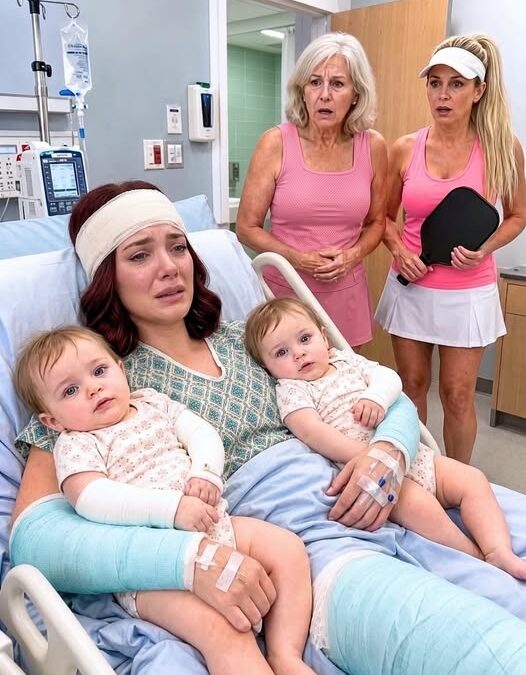
Part 1: The Call That Changed Everything
The first thing I remembered after the crash was the sound of twisting metal. The second was my mother’s voice telling me that pickleball mattered more than my children. When I opened my eyes beneath the harsh lights of the trauma unit, every breath sent pain through my body. My pelvis was fractured, two ribs were broken, and the orthopedic surgeon warned that it could take months before I walked again.
My one-year-old twins, Noah and Lily, had survived only because they were safely secured in their rear-facing car seats. The hospital’s emergency childcare program could care for them for just twenty-four hours, and with my husband having passed away the year before, my parents were the only family members I had left to ask for help.
I tightened my grip around the phone despite the pain shooting through my hips and called my mother. Every movement hurt, but the thought of my babies having nowhere to go frightened me far more than my injuries ever could.
“Mom,” I whispered. “I need you and Dad to take the twins until I can stand. Just a few weeks.”
Instead of concern, she let out a long, impatient sigh.
“I still need time for pickleball! Your sister never bothers us the way you do.”
“Mom, I was almost killed.”
“And we are not built-in babysitters, Mara. Figure it out.”
The line went dead before I could say another word.
I lay staring at the ceiling while years of quiet sacrifices replayed in my mind one after another. I had paid the mortgage on my parents’ house, covered the lease on their SUV, kept their health insurance active, paid their country club dues, funded family vacations, rescued my sister Claire’s failing boutique, and even paid for a new roof after my father jokingly called it an “early inheritance in reverse.” For eight years, I had quietly become the family’s financial safety net while Claire remained the untouchable favorite who was never expected to contribute anything.
A soft cry drifted into my room, and I immediately recognized Lily’s voice. I tried to push myself upright, but pain exploded through my body before I could even reach the edge of the bed. I couldn’t lift my daughter, and I could barely turn over without assistance. That helplessness hurt far more deeply than any broken bone ever could.
As I listened to my children only a few feet away, something inside me quietly changed. Beneath the grief and physical pain, a calm certainty settled over me that I had never felt before. I realized I was finished trying to purchase love from people who had never intended to give it freely.
A nurse named Elena walked into my room just as tears began slipping silently down my face. She caught my phone before it fell from my hand and gently asked the question no one else had bothered to ask.
“Who can I call?”
I looked through the glass toward Noah and Lily sleeping peacefully in borrowed hospital cribs. After a long moment, I finally answered.
“Daniel Cho,” I said. “My attorney.”
Daniel answered immediately.
“I want every family payment stopped tonight,” I told him. “Cards, insurance, club fees, allowances, everything. No exceptions.”
He paused for only a second before asking the one question he knew mattered most.
“Including the residence?”
“Yes.”
My parents always referred to it as their house, but legally it belonged to my holding company. They had never qualified for a mortgage, so I purchased the property, paid every tax bill, and allowed them to live there rent-free under a renewable occupancy agreement. Daniel understood exactly what that decision would mean.
“They will panic.”
“They should have thought of that before abandoning two babies.”
Just after midnight, every automatic payment came to an end. Their authorized credit cards stopped working, the SUV lease was flagged for return, and Claire’s monthly “consulting fee” quietly disappeared from my company’s payroll. Seven minutes later, my mother called six times in a row, but I simply turned my phone facedown on the bedside table.
For the first time in eight years, I allowed my family to face the consequences of their own choices instead of rescuing them from every crisis they created.
Part 2: The Family’s Real Plan
By sunrise, my family had suddenly remembered I existed. My father left a voicemail demanding that I “correct the banking mistake,” my mother complained that her country club payment had been declined in front of her friends, and Claire texted me a photograph of the overdue rent notice for her boutique with a single accusation.
“You are destroying all of us.”
Not one of them asked how I was recovering. None of them asked whether Noah or Lily were safe.
While they focused entirely on their money, Daniel quietly arranged for a licensed nanny through my company’s emergency-care program. Elena helped move the twins into a family recovery suite beside my hospital room, and as I slowly learned how to transfer from my bed into a wheelchair, Noah and Lily slept close enough that I could hear every peaceful breath they took. Their presence reminded me exactly who deserved my strength and who no longer did.
Three days later, Claire arrived at the hospital wearing oversized sunglasses and expensive perfume as though she were attending a social event instead of visiting her injured sister. She never asked how I was feeling. Instead, she immediately launched into an emotional speech about how devastated our mother supposedly was.
“Mom is devastated.”
“I am recovering nicely. Thank you for asking.”
She ignored my response completely.
“You cannot punish everyone because she set a boundary.”
“A boundary?” I asked, glancing toward Noah, who was happily stacking plastic cups on the floor. “She refused to help after I nearly died.”
Popular Posts
→- 1
- 2
- 3
- 4




Recently Viewed
Stories you read recently will appear here.





