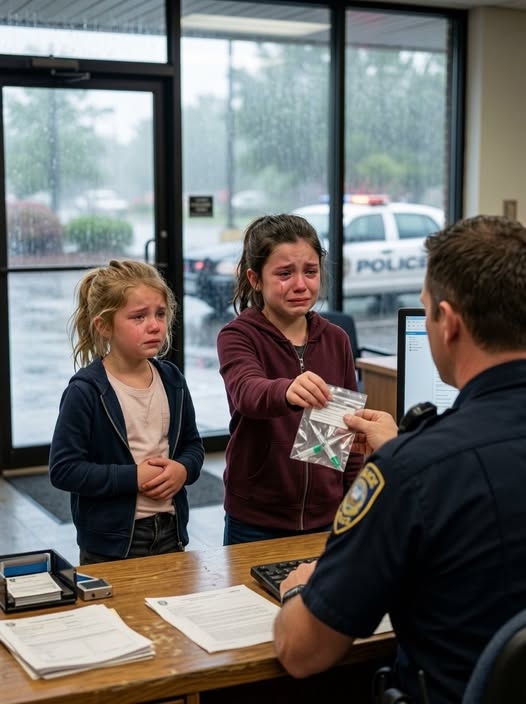
The three-bladed oscillating fan on the filing cabinet had a bent wire cage that clicked on every westward sweep: tick-tick-whir, tick-tick-whir. It pushed a tired tide of humidity, scorched chicory, and the smell of drenched wool across the front counter of the Blackwood Borough Substation. Outside, the October downpour did not fall in drops; it descended in gray, greasy sheets that turned the maple leaves on the curb into slick orange paste, drowning the neon lettering of the Rexall pharmacy two doors down until the letters ran like smeared watercolor against the asphalt.
Officer Paul Hayes sat with his wrists resting against the rim of a beige Smith-Corona electric typewriter, his fingers stained blue from carbon receipt paper. He was thirty-two, with the flat, thickened collarbones of a man who had spent four years in the Marine infantry before taking his father’s old locker in the basement of this building. He had thirty minutes left on a double tour that had begun with a basement drain collapse on the south side and ended with a drunk municipal water inspector who had backed his flatbed into a hydronic heating main.
His shift log lay open beneath a paperweight made from a section of spent copper line pipe: 16:11 — 217 North Main, illegal curb idling, summons refused by driver.
The front door didn’t slam. The hydraulic door closer had leaked its oil three winters back, so the double panes of wire-reinforced glass simply swung shut with a sigh that stirred the dust bunnies behind the magazine rack.
The cold air that came with them smelled like damp denim and crushed hemlock needles.
Paul did not look up from the carriage lever until he heard the double scuff—the stuttering, off-beat scrape of rubber soles that were too wet to grip the speckled linoleum. Two children stood four feet inside the threshold.
They were small enough that their chins barely cleared the dark walnut wainscoting that ran along the lobby wall. They wore identical fleece-lined hoodies, the color of wet river slate, with yellow plastic zippers that had both lost their pull-tabs and been repaired with brass safety pins. The hoods were pulled down, plastered to their skulls by forty minutes of steady rainfall, their identical faces framed by dark, wet ringlets of hair that clung like soot to their cheekbones. Seven years old, perhaps eight, though their wrists looked like peeled birch twigs protruding from the cuffs.
The girl on the right was holding her sister by the four fingers of her left hand, her grip so fierce that the knuckles were bloodless.
The girl on the left was not standing straight. She had her small frame folded over her middle at a forty-five-degree angle, her forehead almost touching the brass edge of the counter’s umbrella stand. Every three seconds her chest hitched—not with a sob, but with the dry, hollow gasp of an animal that had taken a boot to the ribs.
Paul rose. The steel casters of his swivel chair screeched against the green floor tiles, striking the base of the cabinet with a sharp, hollow clang.
“Hey,” Paul said. He did not step over the counter; he used the swinging half-door near the mail slot, keeping his hands outside his utility belt, thumbs tucked into the side seams of his trousers to show empty palms. “Hey, you two. Where’s your umbrella? Where’s your folks?”
The girl on the right did not flinch from the uniform. That was the first thing that set the wire humming along Paul’s collar. Children who ran from home or got turned around at the county fair looked for a mother’s coat or backed into the corner by the water cooler. This girl took two steps forward, dragging her doubled-over twin with her, until the wet toes of her sneakers bumped the toe-cap of Paul’s left boot.
“My sister is Violet,” she said. Her voice was not thin. It was flat, dry, and terrifyingly level, the tone of a child reciting a grocery list she had spent three miles memorizing so she wouldn’t forget the bread. “Daddy said she would feel sleepy in the car, but she says it hurts like hot grease.”
Violet did not look up. Her knees buckled without warning, her small body sliding toward the wet linoleum with the sudden, boneless weight of a rag doll. Paul dropped to one knee, catching her beneath the armpits before her forehead struck the floor.
Her skin, through the sodden cotton of her sleeve, was blazing hot—a dry, feverish heat that seemed to radiate through his wool gloves—yet her teeth were chattering with such violent force that a line of clear saliva was bubbling between her lips.
“Violet?” Paul touched her jaw. Her pupils were unequal: the left pinpricked and dark, the right wide, glassy, and slow to catch the light of the green desk lamp. “Violet, can you hear me? Look at my badge. Look at the eagle.”
“Don’t,” the other girl whispered.
She had stepped directly between Paul’s shoulder and her sister’s face, her small shoulder blades hard as pine knots beneath the wet fleece.
“Don’t make her go home,” she said.
The silence that followed was broken only by the tick-tick-whir of the fan. Behind the dispatch partition, the teletype machine began to chatter—three quick bursts of five-hole punch tape dropping into the wicker basket like dry peas.
Paul didn’t move his knees from the tile. “Nobody’s going anywhere until we get some dry towels. What’s your name, sweetheart?”
“Nora.”
“Nora. Look at me. Not the door—look at my chin.” She brought her gray eyes up. They were identical to her sister’s, but there was an unnatural, adult calculation behind them that made Paul’s stomach drop two inches into his belt. “Is Violet sick? Did she swallow something from the medicine cabinet under the sink?”
“She didn’t swallow it,” Nora said. She looked down at her right foot. Her sneaker was an old blue canvas deck shoe, the rubber sole parting from the canvas near the little toe like an open mouth, held together by two wraps of gray electrical tape.
Popular Posts
→- 1
- 2
- 3
- 4




Recently Viewed
Stories you read recently will appear here.





