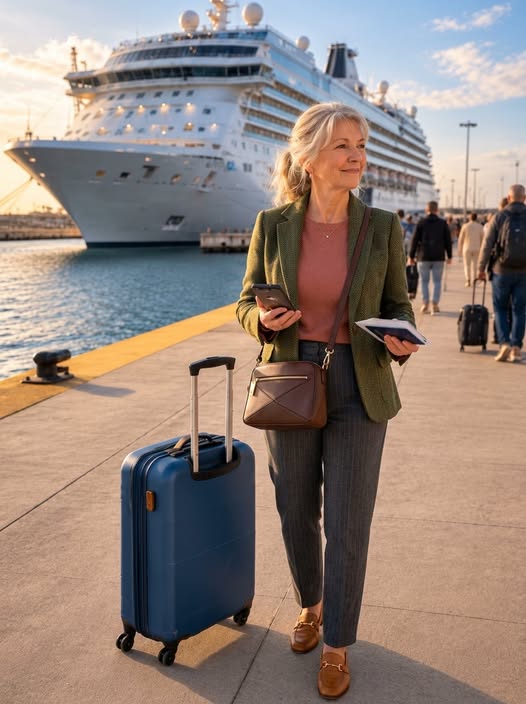
The Blue Suitcase
I buried my husband, and nobody knew that in that very same week I bought a ticket for a one year cruise. When my son left three cages in my living room as though I were his housekeeper, I understood that my mourning was finished. My daughter in law did not even greet me. She pushed the cages onto my rug and said, “There are your instructions.” I smiled at her. And by dawn, when the ship pulled away from the Port of Miami, my absence was going to rearrange their entire lives.
My husband Ernest died on a gray Tuesday in February.
I buried him in his white linen shirt, the good one he only wore to weddings, with his rosary wound between his fingers and the photograph from our trip to Key West tucked into his breast pocket. He is smiling in that picture, and I am laughing at something he had just said, and neither of us knew we were being photographed. It was the last thing I put on him before they closed the lid.
I cried for seven days. Real crying, the kind that empties you out and leaves you sitting on the bathroom floor at three in the morning with no idea how you got there.
On the eighth day, I bought the ticket.
Not out of caprice. Out of survival. I want that understood before I say anything else, because people hear a story like mine and they think it is about revenge, and it is not. It is about a woman who realized she had approximately fifteen good years left and had already given away forty.
For four decades I was a wife, a mother, a nurse, a cook, a driver, a nanny, a bank, and a crying towel. When Ernest got sick, I sold my wedding earrings to a jeweler on Flagler Street to cover a month of medication his insurance had decided not to approve. He never knew. I told him I had lost them at the beach and he scolded me gently for being careless and I let him. When my son Austin lost his job at the dealership, I gave him my savings, the whole of it, eighteen thousand dollars I had scraped together over eleven years. When his wife Chloe had the baby, I slept on their couch for three months, waking at two and at four and at six, so that she could rest.
But on the day of the funeral, my son did not embrace me.
He waited until the last of the cars had pulled out of the cemetery, and he put his hand on my shoulder, and he asked, “Mom, have you thought about what you’re going to do with the house?”
I still had cemetery dirt on my shoes. I did not answer him, because if I had opened my mouth in that moment, forty years of swallowed things would have come out all at once, and I did not want that to be what I remembered about the day I buried Ernest.
A week later he arrived unannounced. He was wearing a new shirt and dark sunglasses and using that authoritative tone he had adopted ever since Chloe started telling him he was the man of the family now.
“Mom, we’re going to the Bahamas for a few days.”
“That’s nice, son.”
“You’re going to watch the pets.”
He did not ask. There was no question anywhere in the sentence.
Chloe came in behind him carrying the cages. Two parakeets screeching in one, a white rabbit trembling in the corner of another, and a cat crouched inside an old plastic carrier that stank of fear and urine. She set them down on my living room rug, right beside the small table where Ernest’s memorial photograph stood between two candles.
No flowers. No how are you. Three cages and a bag of pet food.
“Change the water for the parakeets twice a day,” she said, scrolling on her phone as she spoke. “Don’t give the rabbit lettuce, it does something to their stomachs. The cat gets stressed so don’t let him out of the carrier much. And clean up properly, because it starts to smell after a couple of days.”
I looked at her. “Chloe. I buried my husband nine days ago.”
She sighed, thoroughly put out, the way a person sighs at a slow cashier. “Oh, Mrs. Theresa. Everybody has problems.”
Austin did not flinch. He did not even look up from his phone. “Besides, that’s why you’re here, Mom. You’ll get bored all by yourself in this house.”
And something snapped inside me.
It was not rage. I have thought about this a great deal since and I want to describe it accurately, because the difference matters. It was clarity. It was the feeling of a fog lifting off a road you have been driving down for years without being able to see where it goes. I looked at the cages on my rug, and I looked at my son standing next to his father’s photograph without having glanced at it once, and I smiled.
“Of course, sweetheart,” I said. “Leave them with me.”
Chloe raised an eyebrow. I think she had been braced for an argument and did not know what to do without one.
“We also left you the spare key to our apartment,” she said, “in case you need to get more food.”
Austin kissed me on the forehead the way a person kisses a piece of old furniture on their way out of a room. “Thanks, Mom. We can always count on you.”
We can always count on you.
That was what I had become. An open account. An available bed. A stocked refrigerator. A useful old woman with a car and a spare bedroom and no needs of her own that anyone had ever bothered to ask about.
That night, after they left, I did not cry.
Popular Posts
→- 1
- 2
- 3
- 4




Recently Viewed
Stories you read recently will appear here.





