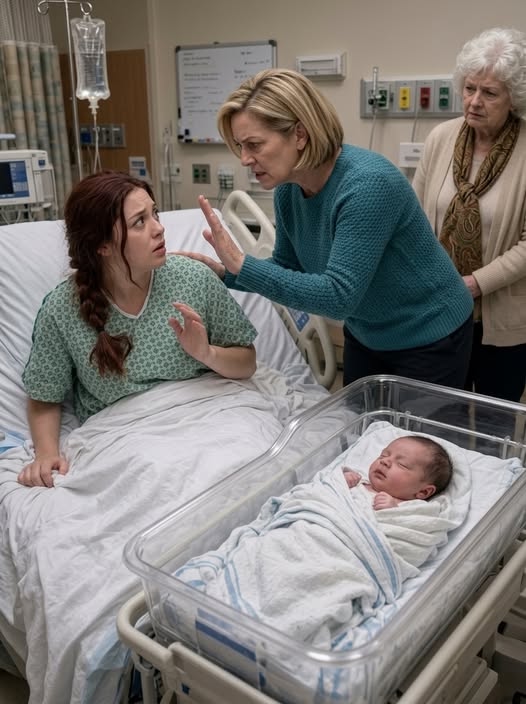
My mother sat in the chair across from my hospital bed. For several seconds, she couldn’t look at me. The room had become strangely quiet after security escorted my mother-in-law away.
Only my baby’s soft cries broke the silence. The nurses had removed most of the black substance from his skin, but faint gray stains remained around his tiny fingernails and behind one ear.
Every time I looked at them, something inside me twisted.
He had been alive for only a few hours.
A few hours.
And already someone had used him as a weapon.
My husband stood beside my bed with one hand resting protectively on the rail.
“Tell her,” he said to my mother.
My mother wiped her face.
“I thought…”
Her voice broke.
I waited.
She tried again.
“I thought your mother-in-law had caught you doing something terrible.”
I stared at her.
“You thought that?”
She nodded weakly.
“She was screaming that the baby wasn’t your husband’s. Everyone was looking at him, and she kept saying his skin proved it.”
My husband clenched his jaw.
I looked directly at my mother.
“So you hit me.”
Her face crumpled.
“I reacted.”
“No.”
My voice came out stronger than I expected.
“You made a choice.”
She stared at me.
“You walked into a hospital room where your daughter had just given birth. You saw me half-conscious, bleeding, exhausted and barely able to sit up.”
My throat tightened.
“And instead of asking me one question, you slapped me.”
She began crying harder.
“I’m sorry.”
I shook my head.
“I needed my mother.”
Those four words changed her expression completely.
She covered her mouth.
I continued.
“I woke up surrounded by people staring at me like I was disgusting. My baby was crying. I didn’t know what had happened to him. And then my own mother hit me.”
“I’m so sorry.”
“You should be.”
My husband squeezed my hand.
For once, nobody interrupted me.
Nobody told me to calm down.
Nobody asked me to forgive anyone because we were family.
My mother whispered, “What can I do?”
I looked toward my son.
“Leave.”
She stared at me.
“Please—”
“I need you to leave.”
“But you’re my daughter.”
“And he is my son.”
My voice shook.
“I have to protect him, even when protecting him means protecting him from people I love.”
My mother’s shoulders dropped.
For a moment, I thought she might argue.
Instead, she stood.
Before reaching the door, she turned around.
“I don’t expect you to forgive me.”
I said nothing.
She looked at my husband.
“Take care of her.”
He answered quietly.
“I will.”
Then she left.
The door clicked shut.
And I broke.
Not dramatically.
Not loudly.
I simply folded into my husband’s chest and cried.
He held me carefully because of my stitches.
“I’m sorry,” he whispered.
I pulled away.
“For what?”
“For leaving the room.”
“You went to get my bag.”
“I should’ve been here.”
“You couldn’t have known.”
He looked toward our baby.
“I knew my mother didn’t like you.”
That sentence made me stop.
He sat beside me.
“I knew she made comments. I knew she questioned things. I knew she thought nobody was good enough for me.”
He swallowed.
“But I kept telling myself she was just difficult.”
I understood exactly what he meant.
His mother had always been difficult.
That was the word everyone used.
Difficult.
She criticized our wedding.
Difficult.
She complained when we bought a house twenty minutes farther from her.
Difficult.
She questioned why I kept my last name professionally.
Difficult.
When I became pregnant, she asked my husband whether he was “absolutely sure.”
Difficult.
Each insult had been treated like an annoying personality trait instead of what it really was.
A warning.
My husband looked at me.
“I won’t make that mistake again.”
Before I could answer, the charge nurse returned.
She had another woman with her.
The woman introduced herself as the hospital’s patient advocate.
She pulled a chair beside my bed and explained everything slowly.
The incident had been formally documented.
The substance removed from my baby’s skin had been preserved for identification.
My mother-in-law had been banned from returning to the maternity floor.
Security had recorded statements from the nurses.
And because the victim was a newborn, additional reports would be made according to hospital policy.
I listened while holding my husband’s hand.
Then I asked the question I was terrified to ask.
“Is my baby okay?”
The nurse’s face softened.
“So far, yes.”
I closed my eyes.
Those three words felt like oxygen.
She explained that the substance appeared to be cosmetic pigment mixed with something oily.
Thankfully, my son hadn’t swallowed any.
None had entered his eyes.
His breathing remained normal.
They would continue monitoring him.
My husband asked, “Can we hold him?”
The nurse smiled.
“Absolutely.”
She lifted our son and placed him carefully against my chest.
He immediately stopped crying.
I will never forget that moment.
His cheek rested against me.
His tiny mouth opened once.
Then his fingers curled around nothing.
I kissed the top of his head.
“I’m sorry,” I whispered.
My husband heard me.
“Don’t.”
I looked at him.
“None of this was your fault.”
I knew that logically.
But motherhood had arrived with a strange new kind of guilt.
The feeling that anything bad happening to my child must somehow mean I had failed.
My husband leaned closer.
“You protected him the second you woke up.”
I looked down at our son.
That was when I made myself a promise.
Nobody would ever use the word “family” to force me into accepting cruelty again.
Not with him.
Not with me.
Never.
We stayed in the hospital for two more nights.
My mother-in-law called my husband seventeen times.
He didn’t answer once.
Then the messages started.
At first, they were angry.
“You embarrassed me.”
Then defensive.
“I was trying to protect you.”
Then manipulative.
“After everything I’ve sacrificed for you.”
Then desperate.
“Please answer me.”
Popular Posts
→- 1
- 2
- 3
- 4




Recently Viewed
Stories you read recently will appear here.





