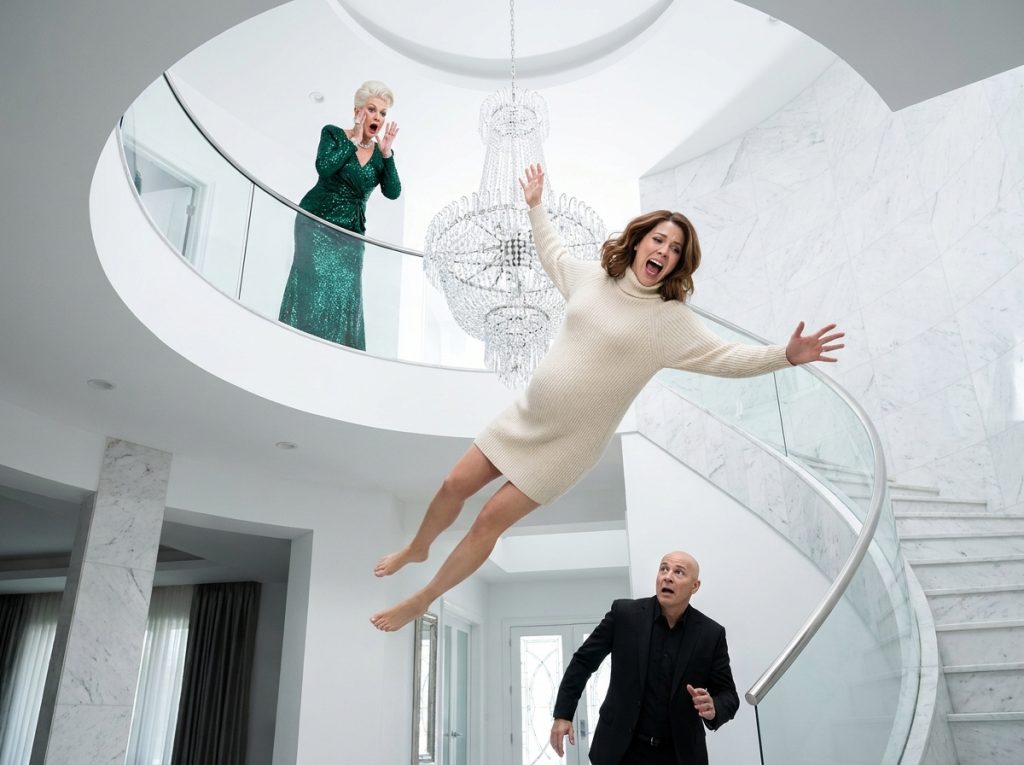
The mist off the sound never truly lifted from the lower terraces of Harbor Crest Drive; it merely thinned into a salt-choked haze that turned the limestone gray and coated the leaded casements in fine, damp grit. Vance Manor rose out of that gloom like a monument to an empire that had forgotten how to breathe. It was eighty thousand square feet of cold Carrara marble, coffered mahogany, and imported Flemish glass, paid for by three generations of shipping timber and iron ore down the coast. Yet inside, the air was as dry and dead as an unsealed crypt.
Arthur Finch understood the house better than anyone who shared its name. For forty-two years, his patent leather shoes had made no sound upon the parquetry. He knew which floorboards sighed beneath the runners in the gallery, which chimneys drew poorly when the nor’easter blew off the cape, and precisely how long it took for a human heart to rot once vanity took root.
That morning, the light filtering through the vaulted atrium was the color of bruised plums.
Arthur stood behind the fluted colonnade of the lower hall, his linen towel folded over his forearm, inspecting the brass sconces with a jeweler’s loupe. Across the vast, echoing expanse of the foyer, two junior housemaids—girls hired from the village whose eyes were permanently fixed upon their hems—knelt over the border stones with oil and pumice. Near the center table, Mrs. Gable worked a rag into the grain of a seventeenth-century pedestal table. Her shoulders were rigid, her knuckles raw and whitened.
“Keep your head lowered, Clara,” Mrs. Gable muttered under her breath, not daring to flick her glance upward. “If she sees you looking at the portrait again, she’ll have your wages docked before luncheon.”
High above them, upon the cantilevered mezzanine that bridged the east wing to the master suites, a door clicked shut with the precision of a guillotine blade falling into place.
Eleanor Vance appeared at the balustrade.

At fifty-four, she was an exquisite preservation of spite. Her silver-ash hair was swept into an architectural chignon that seemed defying both age and gravity; her silk crepe blouse, the color of crushed pearls, whispered against the tailored lines of her slate-gray trousers. Around her throat hung three strands of South Sea pearls—a gift from Richard Vance on their fifth anniversary, purchased three weeks before the stroke that had bound him to a motorized chair and left his estate open to the slow, systematic siphon of her signatures.
In her right hand, she held a strip of glossy thermal paper, pinching it between her index finger and a lacquered nail like an offending insect.
Beneath her, coming up the sweeping curve of the west staircase, Sarah Vance paused. Sarah moved with the deliberate, heavily balanced gait of a woman whose body was no longer entirely her own. She was eight months into a difficult pregnancy, carrying low, her dark linen dress hanging loose around swollen ankles. Her cheeks were pale, hollowed out by months of morning sickness and the low-grade, relentless terror that lived in the manor’s corridors. Her palm rested constantly against the curve of her belly—a subconscious ward against the house itself.
“Arthur,” Eleanor’s voice cascaded down from the mezzanine, smooth as paraffin and twice as slick. “Have you seen Julian this morning?”
Arthur stepped out from the shadow of the colonnade, his spine an unbending line of black wool and stiffened starch. “Mr. Julian departed for the city terminal at six-fifteen, Madam. The maritime arbitrations in Boston could not be conducted by wire.”
“Of course,” Eleanor murmured, leaning over the low decorative balustrade. The railing was an eighteenth-century ironwork salvage from an Italian palazzo, gorgeous and ornamental, rising scarcely twenty-eight inches from the stone floor—scarcely mid-thigh on an adult. “Julian is so dreadfully predictable. Run off to play merchant prince while the house falls to pieces. Just like his father.”
Sarah reached the landing below the upper gallery, her knuckles white upon the polished oak handrail. “Julian went because the board requested him personally, Eleanor. You know that. His father’s partners still recognize his signature.”
The barb struck true, though Eleanor’s expression didn’t so much as flicker. The subtle tightening around her mouth was the only sign that the reminder of Richard’s will had drawn blood.
“Ah, the brave little kindergarten teacher,” Eleanor purred, turning her attention downward. She extended the glossy paper out over the void. “Tell me, Sarah, is this the sort of crude vulgarity they teach you to celebrate in the public school system? I found it on the side table in the library, wedged between my first editions like a receipt from a petrol station.”
Popular Posts
→- 1
- 2
- 3
- 4




Recently Viewed
Stories you read recently will appear here.





