The ring felt entirely different now.
Twenty-four hours ago, under the cathedral arches of the Langham Hotel in downtown Chicago, the platinum band had been heavy with reverence. It had slipped over my knuckle while six hundred guests held their collective breath, framed beneath cascading boughs of white Phalaenopsis orchids and trembling pillar candles. Julian had wept. Big, glistening, photogenic tears had tracked down his hollow cheekbones, his voice breaking as he swore before God and the city’s merchant nobility to honor, shield, and cherish me until the grave. He had pressed my trembling knuckles to his lips and whispered that I was his sanctuary, his ballast, his absolute home.
Now, in the sullen light of a suburban Illinois sunrise, that same ring was a knuckle-duster ground violently into my zygomatic arch.
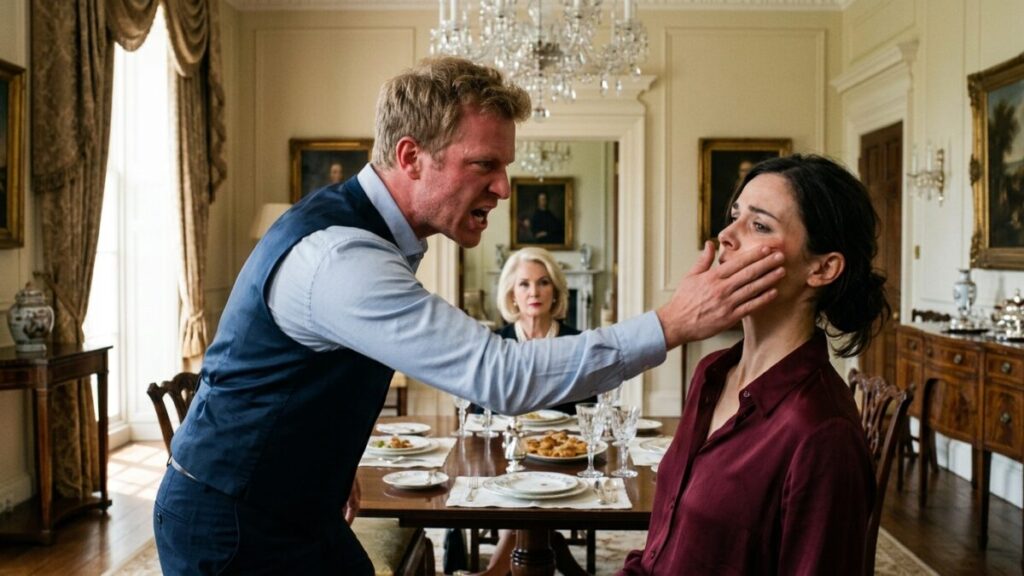
The impact arrived without a breath of warning. It was not a theatrical, open-handed shove; it was a calibrated, stinging crack delivered with the stiff heel of Julian’s palm. The ring caught the soft flesh high on my left cheekbone, carving a clean, burning furrow through the skin. My head snapped sideways. My shoulder struck the cold quartz lip of the kitchen island, sending an antique Haviland porcelain plate skittering across the butcher block before it plummeted to the oak floorboards and shattered into half a dozen jagged shards.
The sharp detonation of the blow hung in the room, thick and suffocating, competing with the smell of scorched butter and the low, rhythmic ticking of a grandfather clock in the foyer.
I stood dead still. My vision swam with gray constellations. A warm, wet heat blossomed across my skin, trickling downward toward the corner of my mouth.
At the head of the trestle table, Beatrice Sterling sat immaculately upright. Her cashmere cardigan was the pale, bloodless shade of skimmed milk; her designer loafers rested parallel upon the Aubusson rug. She held her teacup with both hands, fingers curled precisely around the eggshell-thin porcelain, bringing the rim to her lips with steady, unhurried grace. She might have been watching a novice busboy drop a fork at the Saddle and Cycle Club.
Beside her, Arthur Sterling—Julian’s father, whose silver hair was combed with pomade to disguise the thinning patches along his crown—kept his chin tucked against his sternum. He stared with hypnotic intensity at his half-eaten eggs Benedict, sawing through a strip of Canadian bacon with a dull knife, the blade squeaking against ceramic.
Across from him, twenty-two-year-old Cynthia leaned back in her ladderback chair. She was wearing a monogrammed silk robe that smelled faintly of last night’s gin, one French-manicured thumb pressed against her lips. She didn’t bother to hide the gleam in her eyes—a small, predatory sparkle of absolute triumph.
“Do not,” Julian breathed, his chest hitching beneath an Italian linen shirt that I had picked up from the dry cleaner on Friday afternoon, “ever look at me with that insolent sneer.”
He smoothed his cuffs, his pulse visibly hammering in the side of his neck. The rage in his eyes was not sudden; it was the frantic, frantic fury of a man who realized he had failed an audition in front of his directors and needed an immediate scapegoat.
“You embarrassed me,” he spat, stepping into my personal space, his cologne—Santal 33, charged to my corporate card—stifling in the morning heat. “You made an exhibition of yourself in front of my mother. In front of Cynthia. We don’t bring petulant, vulgar downtown attitudes into this house. You will learn to conduct yourself like a Sterling, or by God, I will teach you myself.”
A copper tang seeped onto my tongue. I raised two fingers, touching the split skin. When I pulled them away, the pads were slick with carmine.
“A Sterling,” I whispered.
My voice was barely audible, but it carried an edge that made Arthur’s knife stutter against his plate.
“Clara,” Beatrice intervened, her tone sliding down into that cool, modulated register favored by federal magistrates and probate judges explaining why an estate has been liquidated. “Sit down.”
I didn’t move.
“I said sit down, child,” Beatrice repeated, setting her cup into its saucer with an imperceptible, crystalline tap. “When an outside woman enters an established bloodline, there is an inevitable period of friction. You come from trade. You come from people who believe that a balance sheet equates to breeding. We understood that when Julian brought you home. We made allowances for your lack of pedigree because you seemed earnest. But an ancient tree does not bend its branches to accommodate the vine.”
She smoothed the front of her cardigan with dry, liver-spotted palms.
“This is not your River North apartment. You do not hold court here. You do not set the rhythm of this house. In this family, a wife’s first duty is structural obedience. If you cannot respect the hierarchy of the breakfast table, how do you expect to carry our name into the world?”
It was a magnificent speech, delivered with the practiced cadence of someone who had spent four decades rehearsing cruelty under the guise of etiquette. It was also utterly, breathtakingly absurd.
Because the River North condo she spoke of with such clinical contempt was a three-bedroom penthouse overlooking the Chicago River—deeded exclusively to my name, its property taxes paid from an irrevocable trust established by my grandfather. The black Mercedes GLS sitting in the driveway had been leased through my clinical LLC. The bespoke charcoal tuxedo Julian had worn at the altar had been paid for by my card. Even the very eggs Arthur was currently chewing into paste had been purchased by me at 5:15 this morning from an all-night grocer on Halsted.
The entire morning had been designed as an execution.
It had begun the evening before, at midnight, while the champagne was still bubbling in the veins of the wedding party. Beatrice had cornered me in the bridal suite while Julian was in the adjoining bathroom splashing cold water on his flushed face. She had gripped my shoulder—her fingers like dried wood—and whispered, “Six sharp tomorrow, Clara. The first morning after the sacrament belongs to the elders. The bride prepares the first meal from scratch. It is our tradition. It binds the hearth.”
Popular Posts
→- 1
- 2
- 3
- 4




Recently Viewed
Stories you read recently will appear here.