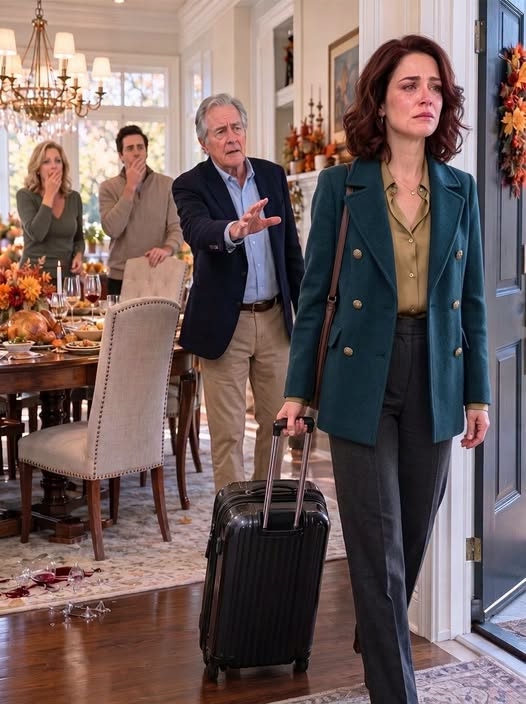
Billionaire Jet Owners Shamed a CEO in Their Hangar — Then the $770 Million Payment Screen Turned Red
At 6:42 on a cold Thursday evening, Naomi Carter stepped out of a black sedan at the edge of a private aviation complex in Westchester County and looked through twenty-foot glass doors at the twelve aircraft she was supposed to buy before midnight.
Together, they were worth seven hundred seventy million dollars.
The number had appeared so often over the previous four months that it had almost stopped sounding like money.
$770,000,000.
It was printed on valuation models, financing commitments, insurance schedules, board presentations, escrow instructions, tax memoranda, maintenance projections, and a purchase agreement so thick that Naomi’s legal team had divided it into six separate binders.
Yet standing beneath the freezing January wind, Naomi was not thinking about the money.
She was thinking about her father.
Thirty years earlier, Samuel Carter had stood in hangars much smaller than this one wearing blue coveralls, steel-toed boots, and the tired expression of a mechanic nearing the end of another twelve-hour shift.
He had spent most of Naomi’s childhood maintaining aircraft that belonged to people wealthier than everyone on their Baltimore block combined.
Samuel rarely talked about the owners.
He talked about machines.
“Airplanes don’t care who signs the check,” he once told his daughter while cleaning hydraulic fluid from his hands at their kitchen table. “They only care whether the person tightening the bolt did the job right.”
Naomi had been nine.
She asked why some passengers received champagne while her father came home smelling like jet fuel.
Samuel smiled.
“Different jobs.”
“That’s not fair.”
“Fair isn’t everybody having the same thing.”
He tapped her forehead.
“Fair is everybody being treated like they matter.”
Naomi remembered the sentence now because she was about to buy an aviation company from men who had repeatedly described their organization as a family.
She had learned to distrust that word in business.
Families could be generous.
Families could also hide everything nobody wanted discussed.
The sedan’s driver opened the trunk.
“Do you want me to take the folder?”
Naomi looked toward him.
Marcus Ellis had driven her for six years. He knew that asking twice would accomplish nothing.
“I’ve got it.”
He glanced at her coat.
“You’re going to freeze.”
“I’ll survive seventy feet.”
The coat made disagreement difficult anyway.
Emerald-green faux fur fell almost to the pavement, its enormous collar framing Naomi’s shoulders and trailing behind her in the wind. Beneath it she wore a fitted black velvet dress with a wide belt at the waist, black fishnet tights, and thigh-high leather boots. Narrow sunglasses concealed her eyes despite the late hour, more fashion than necessity beneath the hangar lights.
Her long black hair had been pulled sleekly away from her face before falling behind her shoulders.
A structured black handbag hung from one arm.
In her other hand was a thin acquisition folder.
Marcus nodded toward the building.
“Mr. Ellison texted. He’s inside.”
“Good.”
“Want me to wait here?”
“Yes.”
“Should I have security come around?”
“No.”
Marcus gave her a look.
Naomi smiled.
“I’m buying airplanes, not invading a country.”
“You’d be surprised how similar rich men make those things look.”
She laughed.
“Stay warm.”
Then Naomi crossed the pavement alone.
Whitmore Vale Aviation occupied three enormous connected hangars at the western end of the field. The company had begun twenty-six years earlier with four charter aircraft and two wealthy founders. It now managed, leased, and brokered nearly eighty private jets for corporate clients across North America.
The twelve aircraft Naomi intended to acquire were the crown jewels.
Ultra-long-range jets.
Late model.
Low hours.
Custom cabins.
Global operating capability.
They belonged directly to the Whitmore Vale ownership group rather than charter clients, making them unusually attractive as a fleet acquisition.
Carter Meridian Holdings had spent four months negotiating for them.
Naomi’s company had not begun in aviation.
It had begun with logistics software.
Then warehouses.
Then infrastructure.
Then specialized transportation.
Over fifteen years, Carter Meridian had expanded into emergency supply networks, secure executive transport, data-center infrastructure, medical logistics, and international project support.
The aircraft were meant to become the foundation of Carter Meridian Global Response.
Not vanity planes.
Working aircraft.
Engineers could be moved between continents when critical infrastructure failed. Medical specialists could reach remote projects. Acquisition teams could travel without losing days connecting through commercial hubs. During natural disasters, several aircraft could be converted for emergency personnel and high-value medical cargo.
The board had approved the purchase reluctantly.
Naomi had fought for every dollar.
Now only one final walkthrough remained before the payment authorization became irrevocable.
She pushed open the glass door.
Warm air and laughter greeted her.
The hangar looked less like an industrial building than a luxury auto showroom enlarged for aircraft.
A white jet dominated the center floor beneath rows of high industrial lights. Its polished fuselage reflected the people gathered beneath it. Leather chairs and temporary cocktail tables had been arranged near the conference office. Champagne sat inside silver buckets.
Roughly thirty people were present.
Bankers.
Aircraft brokers.
Executives.
Attorneys.
Maintenance managers.
Investors.
Naomi recognized several from photographs.
Most had never met her.
That had been intentional.
Grant Ellison, Carter Meridian’s chief operating officer, had led the seller-facing negotiation. Naomi attended only two video calls, both with cameras disabled because she had been traveling.
The acquisition entity itself was a subsidiary named CM Strategic Mobility.
The sellers knew Carter Meridian stood behind the transaction.
Some understood Naomi controlled it.
Others apparently did not.
She entered without announcement.
A young receptionist near the door looked up.
“Good evening.”
“Good evening.”
“Are you here with one of the service teams?”
Naomi paused.
“No.”
The receptionist’s eyes moved toward the coat, dress, and boots.
She looked embarrassed.
“I’m sorry. Are you attending the closing reception?”
“Yes.”
“Name?”
Before Naomi could answer, laughter erupted beside the aircraft.
A silver-haired man in a charcoal suit was telling a story to a semicircle of executives.
Popular Posts
→- 1
- 2
- 3
- 4




Recently Viewed
Stories you read recently will appear here.