The metal door of locker 412 shut with a dull, hollow clatter that echoed through the sub-basement nurses’ lounge of St. Jude’s Memorial. It was four-fifteen on Christmas afternoon. Outside the slit of reinforced glass near the ceiling, daylight was curdling into the bruised violet of an approaching lake-effect squall. Inside, the air smelled of industrialized pine floor cleaner, lukewarm decaf, and the faint, sweet chemical tang of nitrile.
Claire tightened the drawstring of her navy scrub pants, reached for her phone to set it on silent before her thirty-six-hour rotation kicked into the evening trauma surge, and saw the screen already pulsing.
Three missed calls. All from Ellie.
Claire’s thumb swiped before her brain could form the alarm. “Ellie? Sweetheart, what’s wrong? I’m about to scrub in for—”
“Mom?”
The word was barely more than vapor. It was clipped around the edges by harsh, shuddering breaths, the kind a child took when they had been running against freezing wind for too long without their scarf pulled up.
“Ellie, where are you?” Claire pressed the receiver so hard against her cartilage that the plastic housing creaked. “Put Grandma on.”
“I’m not there.”
“What do you mean you’re not there?”
“I’m home. In our kitchen.” A thin, reedy swallow traveled through the wire. “The door was locked, but you left the spare key under the slate by the milk chute. My fingers were too cold to turn it at first, but I got it. I’m inside.”
Claire’s hand went rigid against the cool enameled face of the lockers. Her house was on Mercer Street. Her parents’ home—the grand, four-square colonial with the wrap-around porch that her grandmother had built sixty years ago—was on Oak Ridge. Nine blocks away. Nine suburban blocks cut through by three major four-lane arteries, an unplowed railway underpass, and black ice slicking every curb.
“Why are you at home, Ellie? Grandma was supposed to keep you until tomorrow morning. Did Uncle Mark drive you?”
“No.” A pause stretched, filled only with the mechanical hum of the Mercer Street refrigerator vibrating through the receiver. “I walked. I had my boots on, but the snow went over the tops. My socks are wet, Mom. Grandma said… Grandma said I couldn’t come in.”
Claire’s lungs seized. “She said what?”
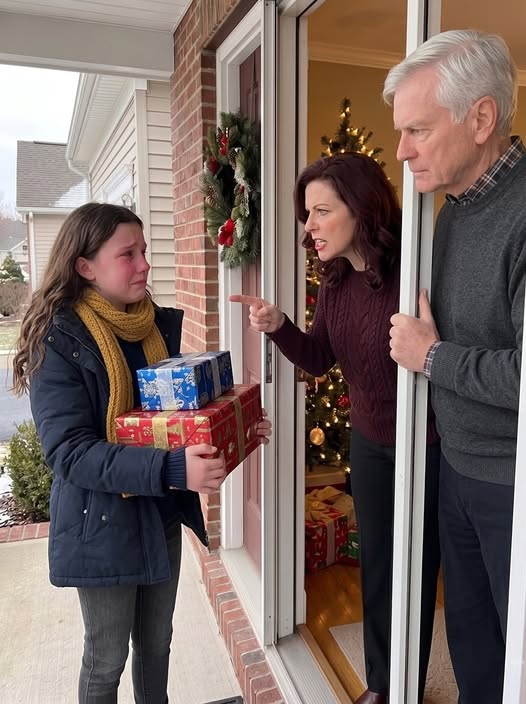
“I knocked on the back door like always. Uncle Mark’s truck was in the driveway, and I could hear Liam and Chloe laughing in the dining room. I had the boxes, Mom. I was carrying the boxes I spent all month wrapping. But Grandpa came to the storm door. He didn’t even push it open all the way. He just looked at me through the screen and said I was making him look bad by hanging around the back porch looking like a stray.”
“Ellie, stop. Breathe.” Claire was already stripping her badge from her lanyard, her ID card snapping against the elastic reel. “Sit on the floor by the radiator. Do not open that door for anybody. Do you hear me? Not for a delivery, not if you hear a car in the driveway. Nobody.”
“Grandma told me Christmas would be more peaceful this way,” Ellie whispered, her voice dropping an octave into that terrifying, premature stoicism children adopt when they realize the adults around them are cruel. “She said the other kids were uncomfortable around me.”
“You sit tight. I’m coming.”
Claire hung up, her pulse thumping like a muffled drum behind her eyes. She dialed her mother’s landline. It rang five times, leisurely, before the click of an antique receiver brought the ambient sounds of clinking silverware, Vivaldi’s Winter playing on the stereo, and the high-pitched bray of Mark’s laugh into Claire’s ear.
“Evelyn,” Claire said, skipping every greeting she had ever been taught. “Where is my daughter?”
A delicate pause. The clink of a fork resting against fine bone china—Grandma Clara’s china, which Claire had inherited on paper, but which had never once left her mother’s sideboard.
“Claire,” Evelyn sighed, using that practiced, melodic cadence usually reserved for explaining basic manners to a dim-witted child. “Must you bring this frantic energy into everything? We were just sitting down to the roast.”
“My eleven-year-old child just walked nine blocks alone through twenty-degree weather with three inches of snow on the ground. She is sitting in my unheated kitchen with soaked boots.”
“Well, she shouldn’t have run off,” Evelyn replied smoothly, entirely unbothered. “She made a scene at the door. Her boots were caked in mud, Claire. Mark spent three hours detailing the hardwood in the foyer yesterday because the appraiser—well, because we wanted the house looking decent for the holiday. Mark’s children were already dressed in their velvet sets. Ellie came barreling up the walk with those raggedy cardboard boxes of hers, demanding to hand things out before dinner was even served. Your father merely asked her to wait on the porch for a moment while we sorted things out.”
“You locked an eleven-year-old out of the house on Christmas afternoon?”
“Nobody locked her out! We simply told her that with her attitude, she might be happier at home until she learned how to conduct herself around her cousins. You always turn everything into a theatrical production involving that girl. You’ve spoiled her, Claire. She expects the world to stop because she made a few trinkets out of clay. Mark’s kids don’t act like that. They know their place.”
“She walked through the underpass, Evelyn. By herself.”
“She’s eleven, not an infant. She has legs. And frankly, your father and I felt that a few hours of quiet reflection would do her some good. You coddle her because you feel guilty about her father running off, but that is not this family’s cross to bear.”
Claire’s knuckles were bone-white where she gripped her phone. The rage that hit her wasn’t hot; it was sub-zero, absolute and clear. It was the same icy focus that took over when a code blue was called and the monitors went flat.
Popular Posts
→- 1
- 2
- 3
- 4




Recently Viewed
Stories you read recently will appear here.