The quiet “okay” that changed everything. The house they tried to take from them was never theirs to begin with.
I thought my daughter’s birthday would be remembered for the candles, the laughter, and the photos we would look back on years later. I thought the biggest worry that evening would be whether there was enough cake for everyone. I was wrong.
A room full of guests watched as my mother-in-law, Evelyn, turned a child’s birthday party into the very moment my entire marriage began to crumble.
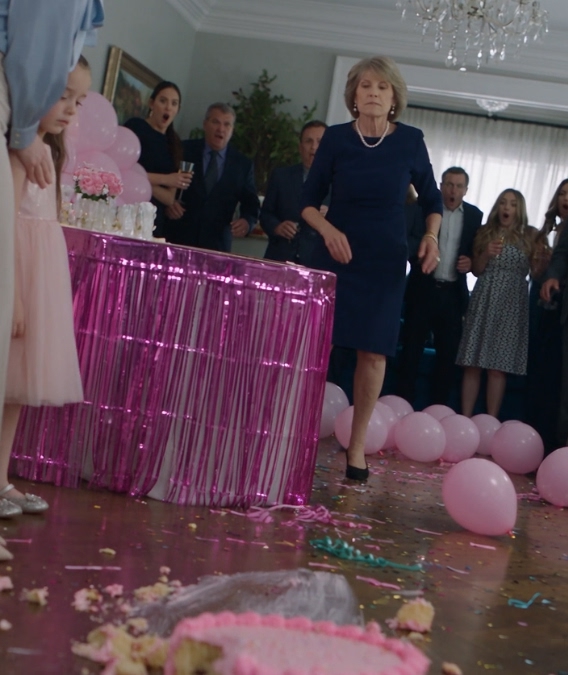
My ten-year-old daughter, Lily, stood frozen beside the birthday table. One hand rested against her cheek. Her eyes were wide open, and she fought so hard against her tears that it hurt me more than the crying itself ever could.
The cake, which had taken hours to make, was no longer on the table. Pink frosting covered the polished floor. The cake stand lay shattered beside it. Nobody moved. Nobody knew what to say. Then Evelyn looked around the room and lifted her chin.
“No grandson, no party.”
The words struck us harder than the sound of the cake crashing to the floor.
For years, I had heard similar messages in subtle forms. Evelyn never had to state outright that she disliked my daughters. She found quieter, sharper ways to make it clear.
A grandson was her vision for the future. A grandson was the child who, in her mind, would complete the family. My girls were cherished by me, by their friends, and by everyone who truly knew them, yet somehow that was never enough for her.
Every time Evelyn made a cruel remark, my husband, Daniel, found a way to smooth it over.
“She doesn’t mean it like that,” he would say.
“She belongs to a different generation.”
“You know how my mother is.”
I knew exactly how his mother was.
What I had refused to accept until that moment was just how deliberately Daniel had chosen to look away.
I turned to him, waiting for the instinct any parent should have. I waited for him to step between his mother and his child. I waited for him to say that Lily mattered more than anyone’s expectations.
Instead, Daniel glanced over at the wealthy clients gathered across the room—people he had spent months trying to impress, people whose opinions mattered more to him than the little girl standing only a few feet away. Then, he shrugged.
“She’s right.”
A dead silence fell over the room. Lily looked at me. I will never forget that moment.
She didn’t look confused about the cake. She didn’t look upset about the ruined party. It felt as though she was finally giving voice to a question she had been too afraid to ask: “Are you going to keep letting them do this to me?”
A child should never have to wonder whether their own mother will stand up to protect them. I didn’t scream.
I didn’t call Evelyn cruel in front of everyone. I didn’t give Daniel an argument he could later write off as emotional or dramatic.
I walked slowly toward the floor where the birthday decorations had fallen. I knelt down, picked up one of the candles that had rolled away from the cake, and placed it gently on the kitchen counter. Evelyn watched me. A faint smirk crossed her face.
She thought she had won.
She thought I was accepting her behavior. She thought my silence meant submission. I looked her right in the eye.
“Okay.”
Her smile widened. Daniel’s shoulders relaxed. For the first time that evening, he looked relieved.
“Good,” he said. “Maybe now we can stop making everything so dramatic.”
I looked at him for a moment and said nothing. Because I had finally realized something I should have understood long ago: the problem wasn’t just that Evelyn treated my daughters differently.
The problem was that Daniel stood by, watched it happen, and decided it was easier to stand with her than with us. I turned away. I took my younger daughter’s hand, then reached out and took Lily’s hand.
Both of my daughters looked at me, uncertain about what was happening. I grabbed my purse from the chair beside the table and walked toward the front door. The chatter that had just begun to pick up died down instantly. Daniel was the first to notice.
His expression shifted the moment he realized I wasn’t stepping out to calm down. I was leaving.
“Maya?” he called out.
I kept walking. The front door was only a few steps away. That was when his tone changed.
The composed husband who had told me not to make a drama vanished entirely. The man who thought he had everything under control suddenly sounded panicked.
“If you leave this party, you’re leaving MY house! Don’t you ever come back!”
Behind me, I heard Evelyn go completely quiet. I heard the guests shifting uncomfortably. I heard the footsteps of my daughters beside mine. But I did not turn around.
Because neither Daniel nor Evelyn understood what my quiet “okay” actually meant. They thought I had accepted defeat.
They had no idea that I already knew something about the house they were trying to take from me—something they should have told me years ago.
The house. That was their leverage.
For years, Daniel and Evelyn had talked about it as though it were entirely theirs, as though the walls, the rooms, and every memory inside carried their names and not mine. Yet they had overlooked one vital detail: I had kept the documents.
When we bought the house, Daniel told me it was only a temporary arrangement. His business was growing, we needed to be smart with our money, and it was safest for me to handle the paperwork since I was “better with details.”
I believed him.
I signed what I thought were standard closing documents. I organized the files. I kept the records. I paid attention, because someone had to.
Popular Posts
→- 1
- 2
- 3
- 4




Recently Viewed
Stories you read recently will appear here.





