No Problem
When the plane touched down at Portland International Airport, the tires hit the runway with a scream so loud that the woman next to me grabbed her armrest.
I didn’t move.
I had stopped flinching at things three days earlier.
My name is Amelia. I’m thirty-five years old. And that morning, in a little village in northern Portugal, I buried my husband, James, in soil that didn’t belong to either of us.
I turned my phone on before the plane even reached the gate. The flight attendant gave me a look. I didn’t care.
My fingers were shaking.
Not from the cold.
From hope. Some small, stupid, desperate part of me still believed my family would be waiting.
I opened our family group chat. It was called The Brandts with a little house emoji. My mother had named it. It had my mom, my dad, my older brother Troy, his wife Kelsey, and me.
I typed:
My flight arrives at 5:00 p.m. Can someone please pick me up?
I hit send before I could change my mind.
The three typing dots appeared almost right away.
For a second, I felt something loosen in my chest. Someone was answering. Someone was coming.
Then Troy’s message popped up.
Troy: We’re overwhelmed today. Just get an Uber.
I read it once. Then again.
A few seconds later, my mother answered.
Mom: Why didn’t you plan this more carefully? You know Tuesdays are difficult for everyone.
I stared at the screen until the words went blurry.
Plan more carefully.
As if I had scheduled my husband’s brain aneurysm.
As if his death had been something I could have put on the family calendar a few weeks ahead, between Kelsey’s book club and Dad’s dentist appointment.
The plane jerked to a stop at the gate. All around me, people stood up and started pulling bags out of the overhead bins. Somebody’s elbow hit my shoulder. A man behind me was on the phone telling someone, “Yeah, babe, just landed, I’ll see you outside in ten.”
I looked down at my phone again.
I didn’t argue.
I didn’t remind them that for the past five days, I’d identified James’s body in a cold room in a foreign hospital. That I’d signed forms in a language I didn’t speak, with a translator who kept apologizing. That I’d chosen a coffin by pointing at a picture in a binder. That I’d stood alone at his grave that morning while an old priest said words I didn’t understand.
I just typed two words.
No problem.
Then I put the phone face down on my lap and waited for the aisle to clear.
At the time, I had no idea that in less than twenty-four hours, every person in that group chat would be watching what came next on the evening news.
By the time I got to baggage claim, my phone buzzed again.
My father.
Dad: They’re predicting rain tonight. Be careful driving home.
Driving. I didn’t even have my car. My car was in our garage, where James had parked it the night before we left, because he said the airport lot was a rip-off.
Before I could answer, Mom sent another one.
Mom: Your father and I are having dinner with the Hendersons tonight. We accepted the invitation weeks ago.
I read that one twice too.
The Hendersons. My parents’ friends from church. Nice people. Gary Henderson had a boat and liked to talk about it.
A dinner reservation mattered more than meeting their daughter at the airport the day she buried her husband.
I locked the phone and slid it into my coat pocket.
The luggage belt groaned and started moving.
Two big black suitcases came around the corner. Mine and James’s. I’d packed both of them that morning in the hotel room in Portugal, kneeling on the floor, folding his shirts the way he liked them folded. Arms in, then in half, then in half again.
They held almost everything I had left of him.
His shirts. His running shoes. His shaving kit with the cheap razor he refused to replace. The navy tie he wore to our anniversary dinner every single year, because I told him once that it made his eyes look darker, and he never forgot it.
I grabbed the first suitcase and pulled it off the belt. It was heavy. I hadn’t eaten anything real in two days and my arms felt like rope.
I got the second one onto a luggage cart, then stacked the first one on top.
I pushed the cart toward the exit.
One of the front wheels jammed.
The cart stopped dead.
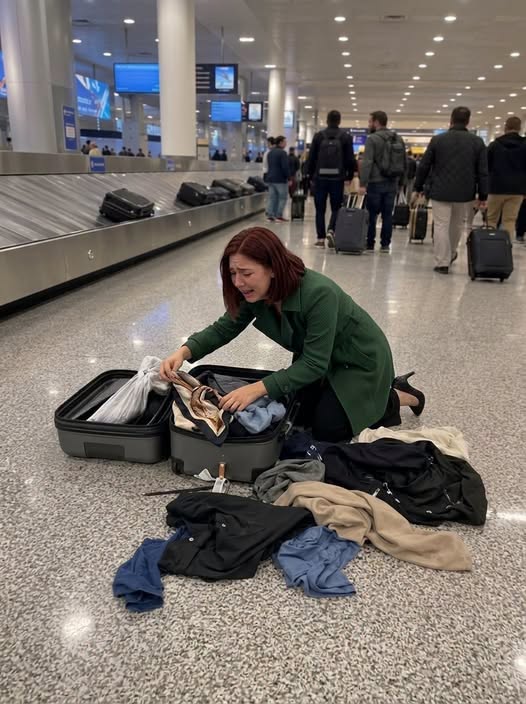
The top suitcase slid forward, tipped, and hit the floor so hard the zipper burst open along one whole side.
James’s things spilled across the polished tile.
Socks. Ties. His gray hoodie. Folded shirts that still smelled faintly like his cologne. A paperback he’d been reading on the flight over, with a boarding pass still stuck in it as a bookmark. Page 211. He never got to page 212.
People stepped around me.
A man in a suit sighed loudly and lifted his roller bag over James’s running shoe.
A teenager glanced at me, then looked away fast, the way you look away from someone crying on a bus.
I dropped to my knees and started grabbing things. Shoving them back into the suitcase. A sock. The book. His hoodie.
Then I picked up the navy tie.
And that’s when I stopped being able to breathe.
I just knelt there on the floor of the Portland airport holding a tie, with my mouth open, making a sound I didn’t recognize.
“Hey. Hey, honey.”
A woman crouched down next to me. She was older, maybe sixty, in pink hospital scrubs with a lanyard around her neck. She didn’t ask what was wrong. She just started picking up shirts and folding them, quickly and neatly, like she’d done it a thousand times.
Popular Posts
→- 1
- 2
- 3
- 4




Recently Viewed
Stories you read recently will appear here.





