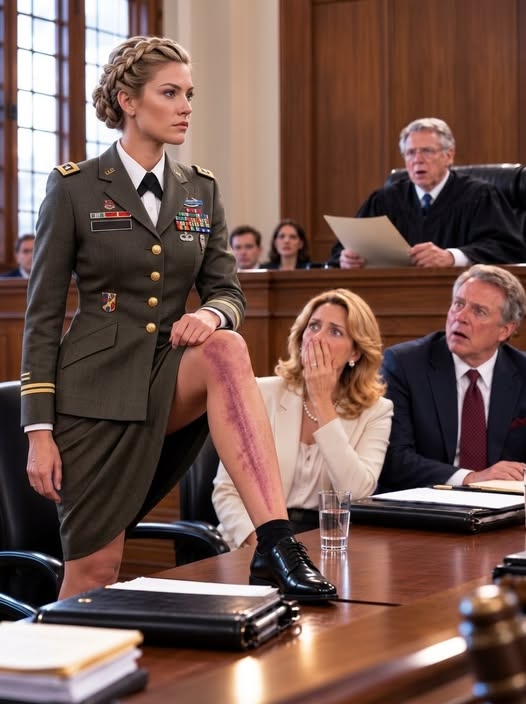
PART 2
Judge Simmons held the document by its upper corner as though age had made the paper fragile.
For several seconds, nobody spoke.
I knew the signature at the bottom.
Samuel Carter.
My grandfather had always signed his name with an oversized S and a final stroke that climbed upward, almost optimistic.
My father knew it too.
He leaned slightly forward.
Mom’s hand stopped moving against the strand of pearls at her throat.
Judge Simmons adjusted his glasses.
“This is a notarized property agreement dated March 16, 2012,” he said.
“It was recorded with the Portsmouth Circuit Court land records three weeks later.”
Dad blinked.
“There must be some mistake.”
Judge Simmons looked over the top of the page.
“About the signature?”
“No, Your Honor.
About what it means.”
The judge considered that answer for a moment.
“Then perhaps we should read what it means.”
I remained standing beside the defendant’s table.
The courtroom seemed unusually still.
Even the ventilation system sounded loud.
Judge Simmons read slowly.
“Samuel Edward Carter grants Evelyn Marie Carter sole beneficial ownership of the property located at 1187 Willow Creek Road, together with all structures and improvements thereon, while retaining a life estate for himself.”
My father closed his eyes briefly.
I knew enough about property law to understand the words.
Grandpa had kept the right to live there while he was alive.
After his death, the farmhouse was mine.
Not informally.
Not because of something scribbled in a birthday card.
Legally.
Completely.
Judge Simmons continued.
“The document also states that neither Robert Carter nor Margaret Carter holds an ownership interest.”
Mom whispered, “Robert.”
Dad didn’t look at her.
The judge lowered the paper.
“Mr.
Carter, were you aware of this instrument?”
Dad cleared his throat.
“I knew Dad intended Evelyn to have the house eventually.”
“Eventually?”
“He talked about it.”
Judge Simmons tapped the document gently against the desk.
“This isn’t a conversation.”
“No, sir.”
“This is a recorded deed arrangement.”
Dad shifted in his chair.
It was a small movement, but I recognized it.
He used to do the same thing at the dinner table whenever Grandpa challenged him.
My grandfather had been one of the few people Dad couldn’t intimidate with silence.
Judge Simmons looked toward me.
“Commander Carter, were you aware this document had been recorded?”
“I knew my grandfather left me the farmhouse, Your Honor.
I had a copy of his will.
I didn’t know about this specific filing.”
The judge nodded.
“That explains part of what I’m seeing here.”
He lifted another sheet.
“Property taxes have been paid consistently through an escrow account associated with Commander Carter’s military credit union.”
Dad turned sharply toward me.
I met his eyes.
For the first time since I had walked into the courtroom, he looked less angry than confused.
“You paid them?”
I almost laughed, but there was nothing funny about it.
“Every year.”
His eyebrows drew together.
“But the county notices—”
“Went to the farmhouse,” I said quietly.
“The payment drafts came from my account.”
Judge Simmons looked from my father to me.
“Mr.
Carter, your complaint alleges that you personally paid all property taxes beginning in 2015.”
Dad didn’t answer immediately.
Mom stared down at her purse.
Finally, Dad said, “I believed I had.”
Judge Simmons’s expression remained neutral.
“That’s different from having paid them.”
“I understand.”
Something changed in the room.
Not dramatically.
There was no gasp from the spectators, no triumphant swell inside me.
Instead, I felt something unexpected.
Disappointment.
Dad looked smaller sitting there.
Not physically smaller.
Just older.
For twelve years I had imagined my parents frozen exactly as I’d left them—unyielding, certain, convinced that my choices were evidence of some personal defect.
But gray had spread through my father’s hair.
There were fine lines beside my mother’s eyes I didn’t remember.
Time had happened to them too.
Judge Simmons placed the papers together.
“I have several questions before this court proceeds.”
He asked my parents about the farmhouse.
Dad explained that after Grandpa died, they had occasionally checked the property.
The roof had begun leaking.
The porch needed structural work.
The well pump had failed twice.
They had hired contractors.
Mom had arranged lawn maintenance for a time.
Dad had replaced several windows.
As he talked, I realized something uncomfortable.
Some of it was true.
I had paid the taxes.
But I had not lived there.
During deployments, I had barely thought about whether the gutters were clear or the porch boards were rotting.
Grandpa’s place had existed in my mind almost like a photograph—unchanging, protected by memory.
Buildings didn’t work that way.
Neither did families.
Judge Simmons asked Dad to provide receipts.
Dad opened a leather folder.
“There.”
A clerk carried them to the bench.
The judge studied the pages.
“These appear to reflect repairs.”
“They do.”
“But not property taxes.”
Dad nodded reluctantly.
“No.”
Judge Simmons looked at my parents.
“Then why does your complaint state otherwise?”
Mom finally spoke.
Her voice was quieter than I remembered.
“Because we misunderstood something.”
Dad turned toward her.
“Margaret.”
She looked back at him.
“No, Robert.”
He stiffened.
Mom took a folded paper from her purse.
“I told you we should have asked first.”
My stomach tightened.
Judge Simmons held out his hand.
“May I see that?”
She walked it forward herself.
When she returned to her seat, she didn’t reach for her pearls again.
Judge Simmons unfolded the page.
His eyebrows rose.
“Interesting.”
I hated that word.
Interesting was rarely reassuring in a courtroom.
“What is it?”
I asked.
The judge glanced at me.
“A county property statement from 2018.
It lists your grandfather’s estate as the mailing contact.”
“That’s impossible,” I said.
“He died in 2014.”
“Correct.”
Dad leaned forward.
“That’s what I told the clerk.”
Judge Simmons examined the document more carefully.
“And someone apparently changed the mailing address afterward.”
My pulse slowed.
“To whose address?”
The judge read it.
My parents’ house.
Dad nodded.
“We started receiving notices.”
Popular Posts
→- 1
- 2
- 3
- 4




Recently Viewed
Stories you read recently will appear here.





