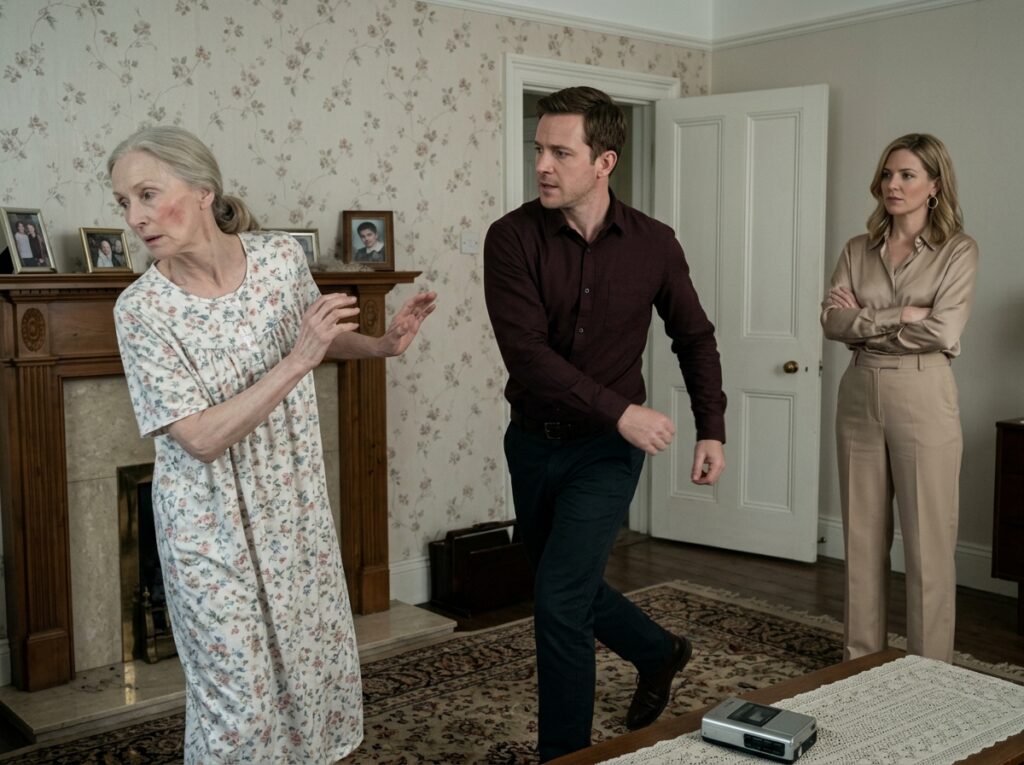
“Let’s See How You Survive Now, Mom.” He Said It on Christmas. By Morning, Every Dollar Was Gone.
Part 1
“Pay Rent or Get Out.”
My daughter-in-law chose Christmas dinner to say it, with the pecan pie still warm in my hands and my son sitting at the head of the table, watching me like I was already gone.
The Christmas lights blinked red and green through the window behind her, throwing small colors across the frost on the glass. The turkey I had spent four hours preparing sat half-eaten on plates nobody had thanked me for, and the silence around that table felt colder than the winter outside.
Celeste stood there with her crimson nails pointed at me.
The same nails I had paid for the week before.
“This arrangement isn’t working anymore. Rhonda, you’re living here rent-free, taking up our space, using our utilities, eating our food.”
Our food.
The turkey had come from my Social Security check. The stuffing had come from bread I bought. The vegetables had been peeled and chopped by my hands while she was at the salon using another gift I had given her.
I stood in what used to be my own dining room, holding dessert for people who looked at me like I was a stain on their furniture.
“I contribute,” I said. “I buy groceries. I cook. I clean. I help with—”
“That’s not rent.”
Celeste stepped closer, and the perfume between us was another thing I had paid for and she wore like proof of ownership. She lifted her chin the way she always did when she believed the room already belonged to her.
“This is our house now. We’re paying the mortgage. We’re covering the bills, and frankly, we need the space for a home office. Garrett’s business is expanding.”
I turned toward my son.
Garrett was sprawled in the chair at the head of the table. My chair. The one his father, Philip, had built from reclaimed oak forty years earlier in our garage, sanding it by hand while the radio played soft oldies.
Garrett looked at me for one second, then looked away and picked at his sleeve like there was something there.
There was nothing there.
Two teenagers sat at the far end of the table, bent over their phones, their thumbs moving like little machines. They did not look up when their mother raised her voice at their grandmother. They did not flinch when Christmas dinner became my eviction notice.
“$1,200 a month,” Celeste said.
Each word landed heavy.
“Pay the rent or get out. You have until New Year’s to decide.”
Twelve hundred dollars. My entire Social Security check was fourteen hundred, which would have left me two hundred dollars for food, medicine, car insurance, gas, and every small necessity a person needs to keep breathing with dignity.
I gripped the pie dish tighter and felt the heat burning through the mitts into my palms.
Not on Christmas.
Not in the house I had signed over to them three years earlier when they promised to take care of me forever.
I looked at Garrett again. My son. The boy I had rocked through thunderstorms. The teenager I had driven to baseball practice six days a week. The young man whose college education I helped pay for by working double shifts at the hospital where I had been a nurse for thirty-five years.
“Garrett?”
He looked up then.
And he smiled.
“Let’s see how you survive now, Mom,” he said. “Welcome to the real world.”
Something inside my chest cracked.
Part 2
This was the sound of something inside me freezing over, turning hard and clean and unmovable.
I set the pecan pie down on the dining table.
Nobody reached for it.
Celeste kept her arms folded across her expensive sweater, waiting for me to crumble in front of her. Garrett leaned back in his father’s chair with that small, ugly smile still sitting on his mouth, as if he had finally won a game I had not known we were playing.
The teenagers kept scrolling.
I looked at each of them once. Not long. Not dramatically. Just enough to memorize the room exactly as it was: the cold lights, the half-eaten plates, the son who had mistaken patience for weakness, the daughter-in-law who thought cruelty became law if she said it loudly enough.
Then I walked away.
I did not shout. I did not ask them how they could do this to me on Christmas night. I did not remind Garrett of the baseball cleats I bought when his father’s hours were cut, or the tuition checks I wrote from overtime pay, or the nights I slept in a vinyl chair beside his hospital bed when he was seven and pneumonia nearly took him.
Some accounts cannot be settled with pleading.
I passed through the kitchen where the roasting pan still sat in the sink, soaking in water I had drawn myself. I passed the living room where I had wrapped their gifts after midnight because I wanted the tree to look beautiful for people who no longer saw me as family.
Then I went to the converted garage.
They called it my suite.
It was a garage with drywall, a space heater, and a bathroom so narrow I had to turn sideways to close the door. The faint smell of motor oil lived in the walls no matter how many times I scrubbed. Cold pressed itself through the seals around the old garage door in thin, steady breaths.
For three years, I had slept there under extra blankets while the rest of the house stayed warm.
For three years, I had told myself it was enough.
Family, I had thought, required sacrifice.
That night, I finally understood the difference between sacrifice and erasure.
I pulled my two suitcases from beneath the narrow bed and opened them on the floor. My hands were shaking, but not from fear anymore. Fear has a scattered feeling. This was different. This had direction.
Popular Posts
→- 1
- 2
- 3
- 4




Recently Viewed
Stories you read recently will appear here.





