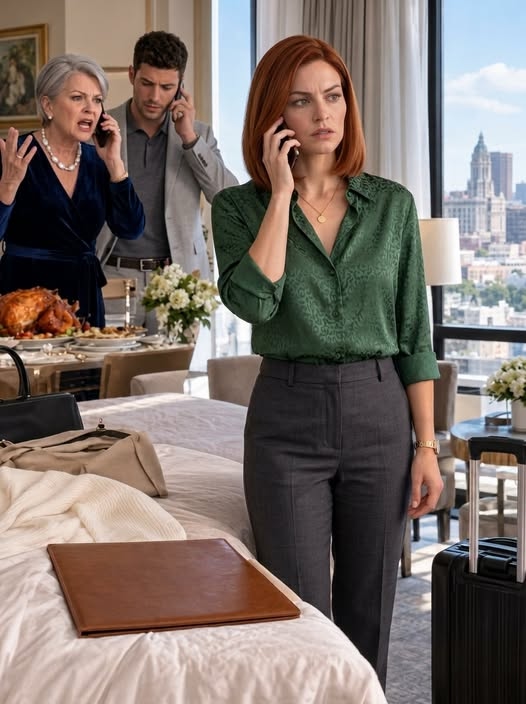
CHAPTER 1: THE GHOST OF THE MILLER ESTATE
At exactly five in the morning, one month after my divorce became official, the shrill sound of my cellphone shattered the silence of my bedroom.
For several confused, suffocating seconds, I wasn’t in my own bed. I was back inside the enormous, oppressive walls of the Miller estate. My body tightened from memory alone, expecting the shock of my bare feet touching the freezing basement kitchen floor. I could almost see Beatrice, my former mother-in-law, standing at the top of the stairs with a steaming cup of Earl Grey, reciting the endless list of impossible culinary tasks she expected me to complete before the wealthy, entitled members of her family had even opened their eyes.
Then I blinked, and the darkness disappeared.
Beige curtains. A small, modest apartment. The distant hum of traffic below. A quiet bedroom. No Brian snoring beside me, carrying the faint scent of expensive scotch and another woman’s perfume. No Beatrice waiting upstairs with her clipboard.
I was divorced.

I was free.
Apparently, Beatrice had forgotten. Or perhaps she simply refused to accept that something she considered her property had walked away.
I picked up the phone. Her name appeared on the caller ID. I answered and allowed the silence to remain.
“Samantha, finally,” her voice snapped through the speaker, sharp and impatient like a cracking whip. “I need you at the house by five-thirty. We are already behind.”
I stared at the ceiling, feeling that familiar hollow pain in my chest—the ghost of the woman who had spent ten years making herself smaller to fit into their world.
“Excuse me,” I said, my voice barely louder than a whisper. “Who is this?”
The silence afterward was almost beautiful. It was the sound of a matriarch’s mind failing to process what she had just heard.
“What do you mean, who is this? It’s Beatrice! Stop playing games.”
I sat upright and pulled the covers around my shoulders. “I thought you had the wrong number. I’m not your daughter-in-law anymore, Beatrice.”
She gave a dry, rattling laugh. It wasn’t because anything was amusing. She genuinely believed my divorce was nothing more than a temporary fit of anger.
“Stop being ridiculous,” she ordered. “Almost thirty people are coming for Charles’s seventieth birthday tonight. You are making the herb-crusted crown roast, the wild rice pilaf, the braised beef parcels, the heirloom garden salad, and that walnut cake Charles likes. And I want the silver polished this time. Last Thanksgiving, it was dull.”
She kept giving instructions as though the previous month—the attorneys, the signed documents, my quiet departure—had never happened. For ten years, this had been my assigned role. Thanksgivings. Birthdays. Baptisms. Corporate dinners. While everyone else wore Armani and drank vintage wine, I was confined to the kitchen, sweating over commercial stoves.
Cooking had once been my profession. Before Brian, I had been a promising culinary consultant. I created menus for boutique hospitality groups. I loved my work. But Brian had convinced me that having a wife who “performed for strangers” was beneath him. He told me his upscale restaurant, The Hearth, would become our shared empire. So I disappeared into the background. I created his menus, handled his supply chains, solved his staffing emergencies, and quietly rescued his finances.
And Brian became the “visionary.”
I became the domestic help.
“No,” I said quietly.
Her instructions stopped instantly. “What?”
“I’m not coming. Ever again.”
“You have nothing else to do, Samantha! You’re living in some tiny, pathetic apartment. If you behave properly today and cook this dinner, perhaps I can convince Brian to take you back.”
Before I could answer, I heard movement on the line, and Brian’s arrogant, lazy drawl replaced his mother’s voice.
“Sam, stop embarrassing yourself. Get over here.”
“I have to go, Brian. I’m working today.”
Brian laughed, the same cruel, dismissive sound that used to twist my stomach. “Working? Where? Flipping burgers at a diner? You won’t last a month without my name protecting you. Go help Mom and stop pretending you have a career.”
I looked toward the armchair in the corner of my bedroom. A perfectly tailored ivory Prada suit hung over its back. Beside it was a leather presentation folder embossed deeply with the gold crest of the Grand Plaza Hotel Group.
“I actually have a board meeting this morning,” I said, my voice becoming steadier, finding its steel.
“Sure you do,” Brian mocked. “And I’m the King of England.”
I ended the call. I didn’t block the number. I wanted them to experience the silence.
At 5:20 a.m., my private car arrived. It wasn’t heading toward the Miller estate. It was taking me to the Grand Plaza Hotel in downtown Baltimore, where, in a few hours, I would be introduced as the new Culinary Director and equity partner in a three-hundred-million-dollar international hospitality project.
As the car merged onto the highway, my phone buzzed on the leather seat.
A text from Beatrice.
If you are not at this house in twenty minutes, Brian is going to your father’s workshop. We’ll see how your arrogant little attitude holds up when he teaches that old blacksmith a lesson about respect.
My blood turned cold.
The phone slipped from my fingers. CHAPTER 2: THE STEEL AND THE SNAKES
My father, Thomas Reyes, owned a custom knife forge in a rough industrial part of Annapolis. Reyes Forge was a place of fire, sweat, and uncompromising perfection. Beatrice dismissed it as a “dirty blacksmith shop.” Brian saw it as an embarrassment. Neither had ever taken the time to learn that Reyes Forge had a five-year waiting list, or that Michelin-starred chefs traveled across the world just to hold my father’s steel.
I called my father’s apprentice, Sam, my hands trembling. He answered on the first ring with the video already activated.
“Sam, is my dad there? Is Brian there?” I demanded, watching the shaky footage of the brick courtyard outside the forge.
Popular Posts
→- 1
- 2
- 3
- 4




Recently Viewed
Stories you read recently will appear here.





