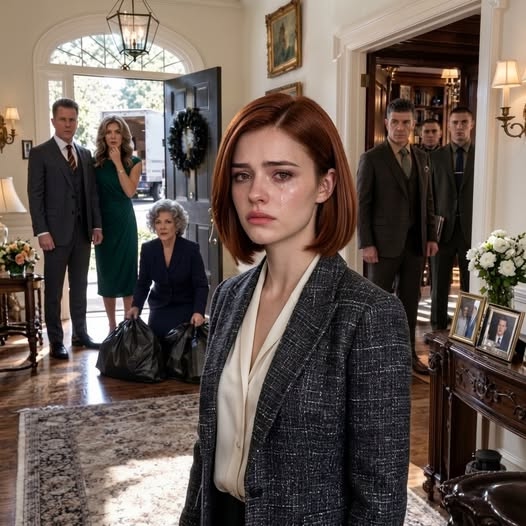
The morning after Grandpa’s funeral, my parents returned to the house they had abandoned me in seventeen years earlier.
And they brought a moving truck.
My sister stepped out behind them wearing designer sunglasses, glanced past the black wreath still hanging on the front door, and said,
“I’m taking the master bedroom.”
I was standing on the porch in Grandpa’s old flannel shirt, holding a cup of coffee I hadn’t touched.
The house still smelled faintly of lilies, rain, and the pipe tobacco Grandpa had stopped smoking years earlier but somehow always kept tucked inside his coat pocket.
Mom climbed the steps like she still had a claim to every board beneath her feet.
“You look terrible, Emily,” she said, as if grief were some kind of fashion mistake.
Dad didn’t hug me.
He didn’t say he was sorry.
He looked toward the truck and told the movers,
“Start with the furniture upstairs.”
Then Brianna brushed past me into the foyer.
“God, it smells like an old man in here.”
Something inside me went completely still.
I was five when my parents left me with Grandpa “for the weekend.”
They never came back.
No birthday calls.
No Christmas cards.
No explanation.
Grandpa raised me on pension checks, garden tomatoes, and bedtime stories about people who kept their promises.
Yesterday, I buried him.
Today, my family had come back for his house.
Mom snapped her fingers in front of me and shoved two black garbage bags into my arms.
“Pack whatever little things belong to you,” she said. “Clothes. Toothbrush. That ugly quilt. You were his responsibility, Emily. The house is ours now.”
Brianna appeared at the top of the stairs.
“Mom, can I paint the master bedroom white? This wood paneling is depressing.”
Dad finally looked at me.
“Don’t make this difficult. Your grandfather always intended the property to stay in the family.”
I almost laughed.
Instead, I placed the garbage bags neatly on the floor.
Because Grandpa had already told me exactly what to do.
In the hospital, he had taken my hand and whispered,
“When they come, don’t argue at the door. Let them inside. Let them talk. Let them show everyone exactly who they are.”
Then he added,
“After that, open my study.”
So I said nothing.
I let Mom walk through the house like she owned it.
I let Brianna plan renovations.
I let Dad order the movers around.
Then the locked study door at the end of the hallway clicked.
And slowly swung open.
Mom’s face changed so fast she dropped one of the garbage bags.
The study door opened wide.
Inside stood Mr. Harlan, Grandpa’s attorney.
Beside him were two uniformed deputies, a woman holding a camera, and Mrs. Alvarez from next door—the woman who had brought casseroles almost every night during Grandpa’s final month.
Mom took one step backward.
“What is this?”
Mr. Harlan adjusted his glasses.
“Good morning, Linda. Robert. Brianna. Emily.”
Dad’s jaw tightened.
“Harlan, you had no right to enter this house.”
“I had every right,” Mr. Harlan said calmly. “Your father gave me a key, written authorization, and very specific instructions.”
Brianna rushed down the stairs.
“Wait. Is this about the will?”
Mom recovered quickly.
Too quickly.
She gave Mr. Harlan the same polished smile she used with hotel staff and bank managers.
“This is a family matter. Emily is emotional right now. She doesn’t understand property law.”
Mr. Harlan looked at me.
“Emily understands more than enough.”
Dad laughed sharply.
“She’s a kid.”
“I’m twenty-two,” I said quietly.
Brianna rolled her eyes.
“A twenty-two-year-old who still lives in Grandpa’s house.”
I let her say it.
I let Mom smirk.
I let Dad stand there with his arms folded like he was waiting for a judge to agree with him.
Then Mr. Harlan tapped the tablet in his hand.
Grandpa’s voice filled the hallway.
“If you’re hearing this, then my daughter finally came home for what she could take.”
Mom went pale.
On the screen, Grandpa sat behind his desk.
He looked thinner than I remembered.
But his eyes were sharp.
“Linda, you left your child on my porch with one backpack and a stuffed rabbit. You said you needed one weekend.”
He paused.
“You took seventeen years.”
“Turn it off,” Mom whispered.
Mr. Harlan didn’t move.
Grandpa continued.
“Robert, you signed away guardianship because you didn’t want the financial responsibility. Brianna, you knew Emily existed, and you still told people you were an only child.”
Brianna’s mouth fell open.
“That’s private.”
“No,” Mr. Harlan said.
“That is evidence.”
Dad’s eyes flicked toward the camera.
“Evidence of what?”
I finally stepped forward.
“Of abandonment. Financial fraud. Attempting to claim property you don’t own. And, as of ten minutes ago, threatening to remove me from my legal residence.”
Mom gave a brittle laugh.
“Legal residence? Sweetheart, you don’t even have money for an attorney.”
Mr. Harlan opened another folder.
“Emily doesn’t need to hire me.”
He looked directly at Mom.
“Your father retained my firm to represent her.”
The hallway went silent except for the rain tapping against the windows.
Dad’s expression hardened.
“And the house?”
Mr. Harlan answered without hesitation.
“The house was transferred into an irrevocable trust six months ago.”
He turned toward me.
“Emily is the sole beneficiary, trustee, and resident owner.”
Brianna grabbed the banister.
“No.”
Mr. Harlan continued.
“The farmland, bank accounts, investment portfolio, vehicles, and business shares were assigned to her as well.”
Brianna stared at me.
“Grandpa wouldn’t give everything to her.”
Then Grandpa’s voice came from the tablet again.
“I gave everything to the only person who never left.”
Mom moved toward the study.
“That old man was sick. He didn’t know what he was signing.”
The deputies stepped forward before she reached the desk.
Mr. Harlan remained calm.
“He passed two separate competency evaluations. Both were documented. He also anticipated that you might make this exact accusation.”
He placed another document on the table.
Dad looked at it.
Then his expression changed completely.
Popular Posts
→- 1
- 2
- 3
- 4




Recently Viewed
Stories you read recently will appear here.





