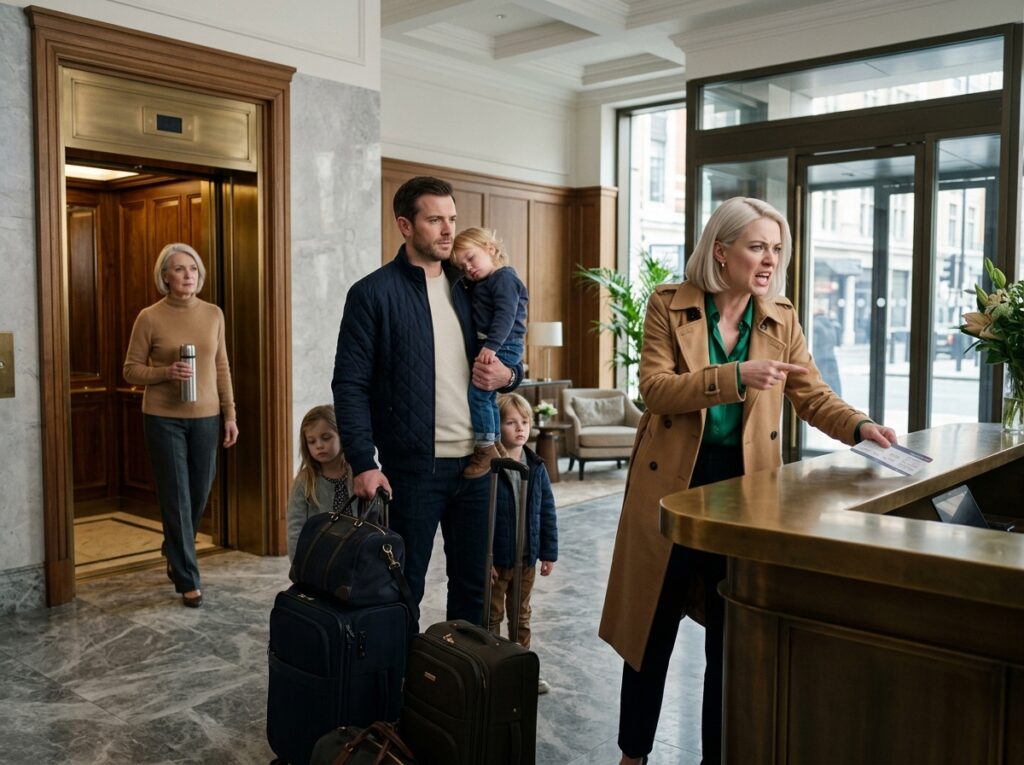
At midnight, my daughter-in-law texted, “Your apartment is closer to the airport…
The Spare Key That Stopped Working
At midnight, my daughter-in-law texted, “Your apartment is closer to the airport, so I’m dropping off my three kids.” She assumed the spare key meant I had no choice—but by morning, that key no longer opened my door.
My name is Chelsea Powell, and I was sixty-four when I finally learned that giving someone access to your home is not the same thing as giving them authority over your life.
The message came while I was already in bed.
My apartment was completely quiet except for the hum of the furnace and the occasional sound of tires passing four floors below on the wet downtown street. I had spent the evening reading, drinking peppermint tea, and enjoying the sort of peaceful night I had once found unbearable after my husband died.
Five years earlier, silence had felt like absence.
Now it had begun to feel like mine.
At exactly midnight, my phone lit the nightstand.
SARAH.
My daughter-in-law rarely contacted me that late unless something had already been decided.
I opened the message.
Your apartment is closer to the airport, so I’m dropping off my three kids.
I read it twice.
No question.
No “Are you awake?”
No “Our sitter canceled.”
Not even “Could you possibly help?”
Just an instruction.
I sat up and placed my feet on the hardwood floor.
The cold under my heels cleared whatever sleep remained.
I typed carefully.
I’m not available.
Three dots appeared almost instantly.
Then:
David has your spare key. He’s letting us in.
I stared at the screen.
The key.
My son had carried it for three years.
After my husband, Richard, died, David had insisted.
“Mom, you live alone.”
“I’m aware.”
“What if you fall?”
“I own a phone.”
“What if there’s a leak?”
“The building has maintenance.”
“What if something happens and nobody can get in?”
That question had reached the frightened part of me that still woke some mornings expecting Richard to be beside me.
So I had given my son a spare.
“For emergencies,” I said.
“Obviously.”
At the time, that word meant exactly what both of us thought it meant.
A medical problem.
A burst pipe.
A locked-out mother.
Then boundaries softened one small favor at a time.
Sarah used the key to drop off winter coats because their closets were full.
Then a folded stroller.
Then boxes of toys the kids had “temporarily outgrown.”
Then she let herself in one afternoon while I was at the grocery store because she needed somewhere downtown to wait between appointments.
I came home and found her sitting on my couch drinking one of my sparkling waters.
“You weren’t here,” she said cheerfully.
I should have taken the key back then.
Instead, I said, “Next time, text me.”
She did.
For a while.
Then the requests became announcements.
Can you keep the kids after school?
David will bring them at four.
We’ll pick them up after dinner.
Soccer got moved, so Noah’s staying with you tonight.
At first, I told myself this was what grandmothers did.
I loved Emma, Noah, and little Miles more than I could explain.
Being with them was rarely the problem.
The assumption was.
But I had spent most of my life solving problems before other people had to feel inconvenienced by them.
That habit did not disappear when Richard died.
If anything, widowhood made it stronger.
Being useful filled hours.
Being needed softened loneliness.
For a long time, I had not asked myself whether those two things were becoming confused.
At midnight, holding Sarah’s message, I finally did.
I did not argue.
I did not call David.
Arguing with Sarah always turned into a debate about whether my feelings were proportionate to her intentions, and somehow I would end up defending the fact that I had feelings at all.
Instead, I called the twenty-four-hour front desk downstairs.
Arthur answered.
“Front desk.”
“Arthur, it’s Chelsea Powell in 4B.”
“Good evening, Mrs. Powell.”
“I need to make a change to my access instructions.”
His voice sharpened slightly.
“Everything okay?”
“Yes.”
I looked at Sarah’s message again.
“I want the lock on my unit changed first thing in the morning.”
A pause.
“Lost key?”
“No.”
I kept my voice steady.
“A key is being used beyond the purpose I gave it for.”
Arthur did not ask for the family story.
That was one reason I liked him.
“I can have maintenance there at seven.”
“Perfect.”
“And until then?”
“No one comes upstairs without my direct verbal permission.”
“Understood.”
“Not even my son.”
Another brief pause.
“Understood, Mrs. Powell.”
I thanked him and ended the call.
Then I turned my phone facedown.
My heart was beating faster than it should have been.
Still, something inside me felt surprisingly settled.
The decision had been made.
I lay back down.
For years, I had believed difficult boundaries required dramatic speeches.
Apparently some of them required only a phone call and a work order.
By seven the next morning, a maintenance technician named Luis stood in my entryway with a small metal case.
He removed the old cylinder, installed a new deadbolt, tested it twice, and handed me two keys.
“Want extra copies?”
I looked at the new brass key lying in my palm.
“No.”
He smiled faintly.
“Easy enough.”
I signed the clipboard.
When the door closed behind him, I turned the new deadbolt.
The metallic click echoed through the apartment.
It was a tiny sound.
It felt enormous.
I made coffee.
At 7:42, my phone buzzed.
David.
Mom, we’re ten minutes away. Please tell me you’re actually home.
I carried my mug to the window.
Four floors below, delivery trucks moved along the avenue. Across the street, the bakery was opening. A woman in a red coat walked a small white dog past the parking meters.
Normal morning.
Normal city.
Nothing in the world required me to rearrange my life because two adults had bought airline tickets before securing childcare.
Popular Posts
→- 1
- 2
- 3
- 4




Recently Viewed
Stories you read recently will appear here.





