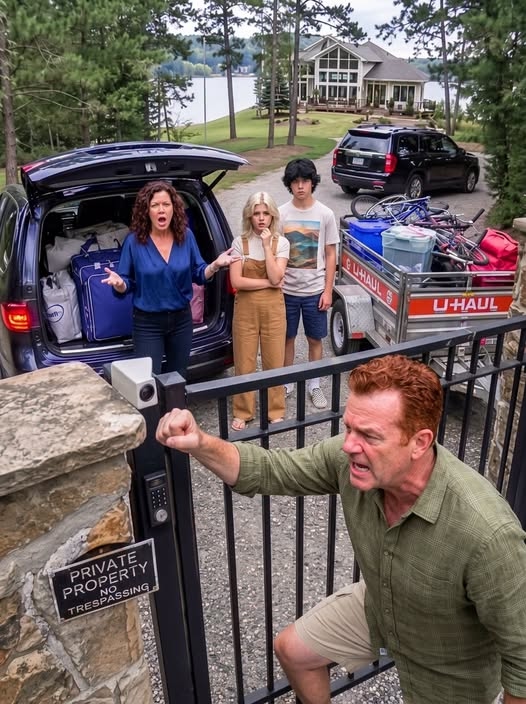
The Coded Gate
The first warning appeared on my phone at 7:12 on a Thursday morning.
The tile floor of my kitchen was cold under my bare feet, and the coffee in my hand smelled far better than it tasted, and I was standing there in that soft ordinary quiet before a workday begins when my father’s message arrived and set in motion the reckoning that had been building in my family for my entire adult life.
His text did not sound like a request. It sounded like a confirmation for a reservation he’d already booked.
Your lake house will be perfect for the family reunion. We’re coming next month.
No question mark. No hello. Not even a meaningless would that work for you. Just the flat announcement of a decision that had been made about my property without my involvement, delivered with the total confidence of a man who had never once, in forty years, imagined that I might say no.
Before I could even begin to compose a response, my mother called.
I knew, the instant I saw her name, exactly what her voice would sound like, because I’d heard it a thousand times. The bright, cheerful, managing voice she always put on after she’d decided how my time or my money or my things were going to be used. The voice that dressed up a taking as a favor.
“And Melissa’s boys can probably stay there for most of the summer,” she said, before I’d fully said hello, before we’d exchanged a single normal word. “You hardly use the place anyway.”
I stood at my kitchen window, looking out at my empty driveway, and the coffee went bitter in my mouth, and I was quiet for a long moment.
Let me tell you about the lake house, because everything hinges on what it was, and on what it was not.
It was not an old family cabin. It was not a place inherited from grandparents, hung with childhood photographs, with three generations’ worth of names on the deed and everyone’s dusty summer memories baked into the walls. It was not, in any sense, ours.
It was mine. Entirely, legally, completely mine. I had bought it nine months earlier, for six hundred and eighty thousand dollars, with money I had earned over twelve years in medical device sales. And I want you to sit with that number, and with those twelve years, because my family never did.
Twelve years of airport food eaten alone at gates. Twelve years of brutal quarterly sales targets, of the constant low-grade terror of the number, of weekends missed and holidays cut short and relationships that withered because I was always, always on a plane or on a call or in a hospital supply closet demonstrating a device to a skeptical purchasing committee. Two promotions I’d clawed my way to. And underneath all of it, a kind of financial discipline that my family had mocked for years, the saving, the investing, the not spending, the careful patient building of something, right up until the moment that something became large enough that they wanted a piece of it.
The house sat on Lake Norman, about forty minutes north of the city. It had a private dock, and a coded security gate, and a stillness so complete that after dark I could hear the water lapping gently against the wooden pilings. I had bought it for one reason, one simple reason that my mother, on the phone that Thursday morning, was in the process of demonstrating the necessity of.
I needed one thing in my life that no one else could gradually claim.
Because that was the pattern. That had always been the pattern. In my family, ownership was a stable, respected, inviolable concept, right up until the owner was me. My first apartment out of college had become my parents’ free hotel whenever they came to the city, and my mother had rearranged my kitchen to her liking and left passive comments about my housekeeping. My sister Melissa had borrowed my car when her transmission failed and kept it for over a month, returning it with an empty tank and a parking ticket in the glovebox and no apology, because we’re family. My mother had once filled my guest room with boxes of her craft supplies, unasked, because I lived alone and had, in her words, plenty of unused space.
Over and over, my whole adult life, my things became the family’s things, my space became available space, my money became the collective emergency fund, and it was always framed not as taking but as sharing, as family, as what people who love each other do. And it was always, specifically, my things. Melissa’s possessions were her own. My parents’ home was sacrosanct. But I was single, no husband, no children, and in the strange arithmetic of my family that meant that everything I had was surplus, unspoken-for, flexible, shared. My life had no legitimate claims on it, in their eyes, because it wasn’t organized around the people they recognized as real dependents. I was just a woman with a good income and no one to spend it on, which made everything I’d built fair game.
So when my mother paused, that Thursday morning, and waited for me to object, when she braced for the resistance she always got and always steamrolled, I did something I had never done before.
I gave her the opposite.
“Sure,” I said.
The silence on the line lasted just a beat too long. She’d expected a fight. She’d geared up for one, had her counterarguments loaded, was ready to call me selfish and difficult and remind me how much the family had done for me. And instead I’d simply agreed, and it wrong-footed her so completely that she almost sounded disappointed.
“See?” she called out, away from the phone, to my father. “I told you she’d be reasonable.”
Reasonable.
Popular Posts
→- 1
- 2
- 3
- 4




Recently Viewed
Stories you read recently will appear here.





