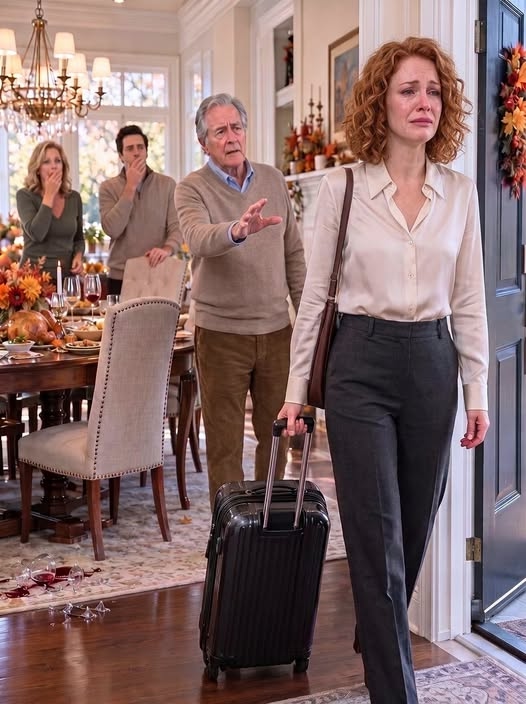
At Thanksgiving dinner, my father raised his glass, looked straight at me, and said the one thing I never expected to hear from the man whose home I had spent years saving.
“The best Thanksgiving gift you could give this family,” he announced, “would be to disappear from it.”
For a second, nobody moved.
Twelve people sat around the long dining table.
My younger brother, Trevor, sat across from me with his wife, Melissa.
My aunt Susan suddenly found the mashed potatoes fascinating.
My cousin Aaron lowered his eyes.
Dad’s wife, Linda, lifted her wineglass and hid a smile behind it.
Then Trevor laughed.
Not nervously.
Not because he thought Dad was joking.
He laughed because he agreed.
I stood at the head of the table holding a serving spoon.
The smell of sage, butter, and roasted turkey filled the dining room.
Candles flickered beneath the chandelier.
Outside, snow dusted the bare branches of the maple tree my mother had planted when Trevor and I were children.
Everything looked warm.
Everything looked like family.
And yet I had never felt more like a stranger.
I slowly placed the serving spoon beside the casserole dish.
“Disappear?”
Dad leaned back in his chair.
“You know what I mean, Rachel.”
“No,” I said. “I actually don’t.”
Linda sighed loudly.
“Please don’t turn this into one of your scenes.”
One of my scenes.
I almost laughed.
I had paid for the turkey.
I had ordered the pies.
I had paid the property taxes on the room in which she was accusing me of causing trouble.
Five years earlier, my father had called me at 1:17 in the morning.
I still remembered staring at the glowing numbers on my bedside clock.
Dad never called that late.
When I answered, he was crying.
I had heard my father cry only twice before.
Once when my mother died.
Once when his older brother passed away.
“Rachel,” he whispered, “we’re going to lose the house.”
I sat upright.
“What?”
“The bank.”
His voice cracked.
“They’re starting foreclosure proceedings.”
I was thirty-four then.
I lived in a modest apartment forty minutes away and worked as a financial consultant.
I had spent six years saving for a home of my own.
Not a mansion.
Just something small.
Something that belonged to me.
Dad explained that he had fallen behind on the mortgage.
There were back taxes.
Credit card bills.
Medical bills from Linda’s surgery.
And Trevor had borrowed money for his latest business idea.
He had convinced Dad to guarantee part of the loan.
The business failed.
The debts didn’t.
“I don’t know who else to ask,” Dad said.
I remember closing my eyes.
“How much?”
Silence.
“Dad?”
He finally gave me the number.
It was almost everything I had saved.
I should have said no.
I know that now.
But grief changes families in strange ways.
My mother had been gone four years at that point.
That house was where she had raised us.
The pencil marks showing our heights were still inside the pantry doorway.
Her rose bushes still bloomed along the eastern fence.
Her Christmas dishes were still stored in the dining room cabinet.
I couldn’t bear the thought of strangers buying it at foreclosure.
So I used my savings.
I cleared the remaining mortgage.
I paid the delinquent property taxes.
I covered the legal fees.
Because my father’s finances were a disaster, the property was legally transferred into my name.
The deed was mine.
The insurance was mine.
The taxes were mine.
The responsibility was mine.
Dad hugged me outside the attorney’s office afterward.
“I’ll never forget this.”
Then he put both hands on my shoulders.
“This will always be your home too.”
For the first two years, I believed him.
Dad stayed there rent-free.
Linda stayed there rent-free.
Trevor moved into the upstairs bedroom after his divorce.
He stayed for almost eighteen months.
He never paid rent either.
Whenever I suggested that everyone contribute something small toward utilities or maintenance, Linda acted offended.
“Families don’t charge each other rent.”
So I stopped asking.
Then the furnace died during the coldest week of January.
I paid for a new one.
The roof started leaking over the upstairs hallway.
I paid nearly eighteen thousand dollars to replace it.
A pipe burst beneath the downstairs bathroom.
I paid for that.
The electrical panel had to be upgraded.
I covered it.
The old kitchen cabinets began separating from the walls, so Dad asked if we could renovate.
I paid for most of that too.
Nobody complained when I signed the checks.
Nobody accused me of “keeping score” when they wanted new appliances.
But somewhere along the way, the story changed.
The house stopped being the home I had saved.
In their minds, it became Dad’s house again.
And I became the interfering daughter who happened to pay for everything.
That Thanksgiving evening, Trevor leaned back in his chair.
“You make everyone uncomfortable.”
I looked at him.
“How?”
“You walk around here like you own the place.”
That almost made me smile.
Because I did.
Melissa nodded.
“You’re always mentioning money.”
“When?”
She opened her mouth.
Nothing came out.
I waited.
Linda came to her rescue.
“It’s not what you say. It’s the attitude.”
“What attitude?”
“The way you look at things.”
I actually laughed then.
“The way I look at things?”
Dad slapped his palm lightly against the table.
“Rachel, stop.”
I turned toward him.
“You started this conversation.”
“I’m trying to make you understand something.”
“Then help me understand.”
His jaw tightened.
He hated when I remained calm.
Anger he could fight.
Calm made him feel exposed.
“You’ve never really fit with us,” Linda said.
The table became quiet again.
That one hurt more than I wanted it to.
My mother had been the center of our family when she was alive.
After she died, Linda appeared eleven months later.
She had worked with Dad years earlier.
Within a year, they were married.
I tried to welcome her.
Popular Posts
→- 1
- 2
- 3
- 4




Recently Viewed
Stories you read recently will appear here.





