“We’re Coming Anyway—What Are You Going to Do?” My Daughter-in-Law Packed Five Suitcases for My Beach House — When She Reached the Gate, the Old Code No Longer Worked
“We’re Coming Anyway—What Are You Going to Do?” My Daughter-in-Law Claimed My Beach House for Spring Break — Then She Arrived With Five Suitcases and No Invitation
The Message Without a Question
Most people know the peculiar discomfort of receiving a family message that is written like a decision already made, and I felt it settle beneath my ribs when my daughter-in-law, Vanessa, texted me that she, her two children, and her mother were spending spring break at my beach house and that I needed to stock the refrigerator by Thursday.
There was no question mark, no request, and no hint that she remembered the weathered blue-gray cottage on Oak Island belonged to me, the woman who had spent twenty-two years paying for it one careful month at a time beside my late husband, David.
I read the message twice while the kitchen smelled of coffee and toast, then typed a single word.
“No,” I replied.
Three laughing emojis appeared almost immediately.
Then Vanessa wrote, “We’re coming anyway. What are you going to do?”
The House Behind the Sea Oats
The beach house was not luxurious, and that was precisely why I loved it, with its chipped yellow kitchen tile, sticking windows, creaking floorboards, narrow outdoor shower, and screened porch where David and I had once listened to the ocean after our children fell asleep upstairs.
It was where our son Ethan learned to fish, where our daughter Lily arranged shells by mood, and where David had said, on our first walk-through, “Clara, it has good bones,” as though the cottage were an aging person he intended to protect.
After his death, the house became the one place where Lily could sleep through the night, because the ocean softened the silence that had followed her father everywhere, and because no one there expected her to compete with louder people for room, attention, or permission to exist.
Vanessa knew that, or at least she knew the downstairs bedroom was Lily’s quiet place, yet she had already mentioned that her mother would take it because the room was easier on her knees.
The Cars on the Driveway
Before sunrise, I drove to Oak Island with a thermos of coffee, the deed folder, my medication, and a decision that felt calmer than anger because it had already passed through years of being postponed.
I changed the gate code, changed the lockbox code, removed the spare key from beneath the ceramic turtle, and called Ron, a retired sheriff’s deputy who now worked for a local security company.
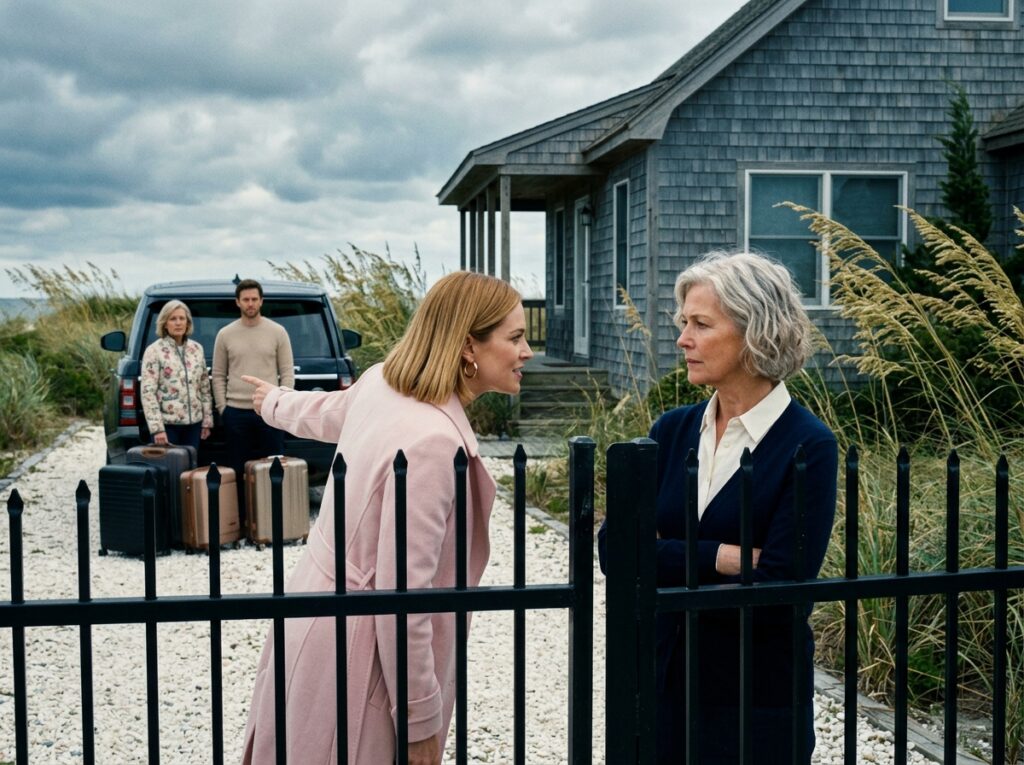
By noon, two cars were moving toward the cottage, Vanessa’s SUV carrying Ethan, Mason, and Ava, while Diane followed behind with a beach umbrella protruding between the seats and five packed suitcases visible through the rear window.
I stood on the other side of the gate as Vanessa punched in the old code.
The keypad flashed red.
She tried again, then turned toward me as the ocean hissed beyond the dunes and the hot cars ticked in the coastal air.
“Mom, is something wrong?” she asked.
I looked at the locked gate, then at the people she had brought after I said no, and understood that the answer waiting for them was no longer something I could soften with an explanation.
The Code That No Longer Opened the Gate
The old code flashed red beneath Vanessa’s fingers, and for one suspended moment the only sound was the soft ticking of the keypad, the restless hiss of wind moving through the sea oats, and the ocean breathing somewhere beyond the dunes beneath a pale afternoon sky.
She tried it again, more slowly this time, as though the gate had misunderstood her rather than obeyed a decision I had made before sunrise, while behind her Ethan sat rigidly in the passenger seat and Mason and Ava shifted among their headphones, snack bags, and the bright expectations of children who had been promised several days in a house that did not belong to the person who had made the promise.
Vanessa turned toward me with a smile that had already begun to lose its shape.
“Mom, is something wrong?” she asked brightly, lowering the window as the smell of salt, hot pavement, and sunscreen drifted through the damp air.
“The code was changed,” I said.
Her eyes moved from the keypad to the gate and then to me, as if the three of us had suddenly become pieces of a puzzle she had not expected to solve herself.
“Why would you do that?”
“Because I told you the house was not available.”
Where Assumptions Met Steel
She opened the driver’s door and stepped onto the gravel, her sandals making small, deliberate sounds against the stones, while Diane climbed out of the second car behind them and looked toward the house with the irritated expression of someone who had been promised comfort and had instead been handed inconvenience.
Vanessa folded her arms.
“You cannot seriously expect us to turn around after driving all this way.”
“I expected you not to come after I said no.”
“The children were excited.”
“They should have been told the truth before they were put in a car.”
Mason had removed one headphone. Ava pressed her face near the rear window, watching us with the fixed attention children give to adult conversations they are not supposed to understand. I could hear the low churning of the sea beyond the house, the clicking of a wind chime on the porch, and the dry rasp of dune grass bending under the coastal breeze.
Vanessa looked toward Ethan.
“Are you really going to let her do this?” she asked, her voice dropping into the tone she used when she wanted him to feel that silence would be a betrayal.
Popular Posts
→- 1
- 2
- 3
- 4




Recently Viewed
Stories you read recently will appear here.





