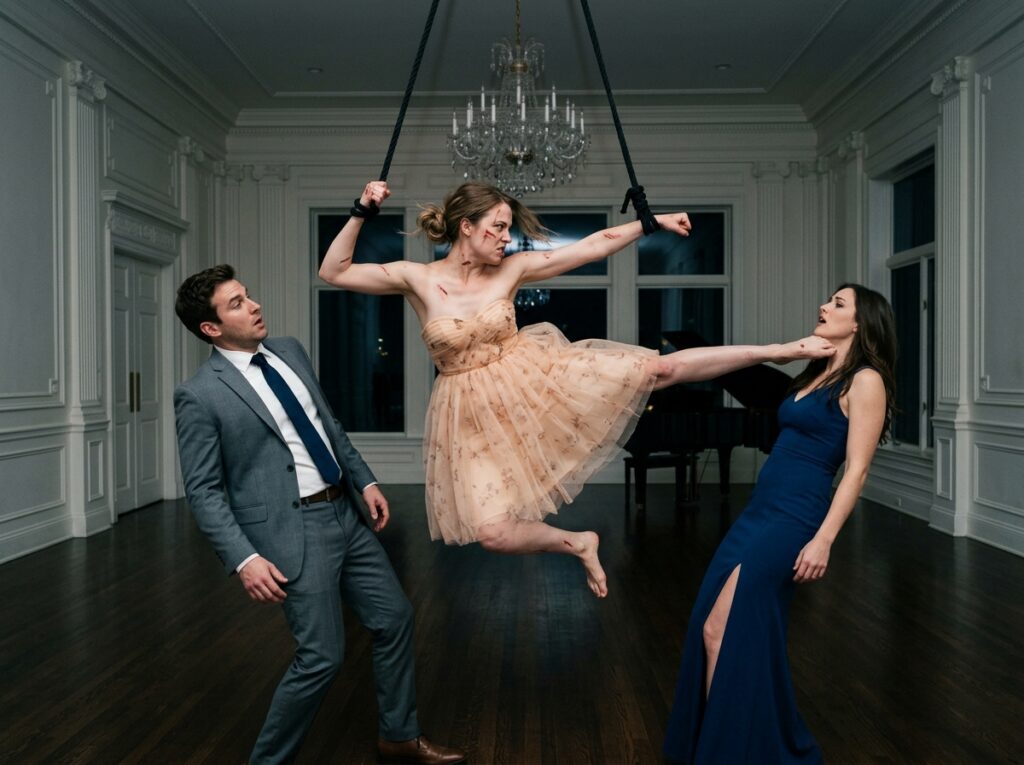
At a glittering gala, a woman in an evening gown is found bound beneath the chandelier, bruised and barely conscious. When a man in a tuxedo sees her, the horror on his face hints that this was never just an attack.
The ballroom at Beaumont House had been designed to make ordinary people feel small. Crystal chandeliers burned above polished oak, a black grand piano reflected the candlelight like still water, and three hundred guests in tuxedos and silk moved beneath the painted ceiling with the careful laughter of people who had learned never to look surprised. Yet at eleven forty-seven on Friday night, every voice in the room began to die. It did not happen because the orchestra stopped. It happened because someone finally looked up. Suspended from a thick black rope beneath the central chandelier was a young woman in a pale rose gown, her wrists bound above her head, her bare shoulders streaked with blood and dust. Her name was Evelyn Hart, and half the people in that room had come to celebrate her family’s foundation.
For several terrible seconds, the crowd did nothing. The gala had been advertised as an evening of experimental performance and modern theater, and some guests assumed the bruises painted across Evelyn’s face were part of a show. A few lifted phones. Others whispered that the Hart Foundation had always liked dramatic statements. Then Evelyn turned slowly in the air, the skirt of her dress drifting around her legs, and the nearest guests saw the truth in the tremor of her arms. Her left cheek was cut. A bruise darkened her ribs beneath the torn edge of her gown. Her breathing came fast and shallow, not because she was acting, but because the rope around her wrists had been carrying most of her weight for nearly twenty minutes. When she tried to speak, only a rough sound escaped her throat.
Julian Cross stood near the piano with a champagne glass in his hand. He was handsome in the polished, forgettable way of men whose money taught rooms to forgive them. As trustee of the Hart Foundation, he had welcomed donors at the door, praised Evelyn’s courage from the stage, and introduced the evening’s “surprise installation” with a smile so smooth no one questioned why he had ordered the security staff to keep the east corridor closed. Now he watched Evelyn with the same smile. To anyone who did not know him, he looked amused. To Evelyn, who had spent the previous six hours learning exactly how far he was willing to go, the smile was a threat. He wanted her to understand that the room belonged to him. The guests, the cameras, the guards, the music—everything had been arranged so her humiliation would look deliberate.
Then the ballroom doors opened hard enough to strike the wall. Adrian Mercer appeared beneath the carved archway, rain shining across the shoulders of his black tuxedo. He had left a private aviation summit in Boston, ignored three calls from his board, and driven the final forty miles through a storm after receiving a message containing only six words: COME BEFORE THEY MAKE HER DISAPPEAR. He had expected a confrontation, perhaps an argument about money, perhaps another anonymous accusation against Evelyn. He had not expected to see the woman he loved hanging beneath a chandelier while strangers stared. The expression on his face changed so completely that people nearest the doors moved aside without being asked.
“Cut her down,” Adrian said. His voice was not loud, but it crossed the room with more force than a shout. A security guard stepped forward and hesitated. Julian lifted one hand, smiling as if the interruption were inconvenient but harmless. “Mr. Mercer,” he began, “you’ve misunderstood the performance.” Adrian did not even look at him. His eyes were fixed on Evelyn. She stared back through swollen lids, and for one second the terror in her face broke through every wall she had built around it. Then something else appeared. Recognition. Relief. And, strangely, the smallest possible smile. It was not joy. It was the smile of someone who had been waiting for exactly one witness to arrive.
Adrian crossed the room. Julian’s men moved too late. One reached for Adrian’s arm and found himself driven backward into a cocktail table. Another blocked the rope pulley, but a gray-haired guest—retired Judge Eleanor Shaw, one of the foundation’s oldest donors—snatched a carving knife from a nearby service tray and held it out. Adrian took it without a word. Two members of the hotel staff climbed onto the low stage and caught Evelyn’s legs while Adrian sawed through the rope. She dropped less than two feet, but the cry that escaped her silenced even the people still pretending not to understand. Adrian caught her against his chest. Her body shook violently. When he lowered her to the floor, he saw red marks around both wrists and a fresh wound along her collarbone.
Julian finally stopped smiling. “This is private property,” he said, turning toward the security team. “Remove him.” No one moved. The donors were no longer watching Evelyn as entertainment; they were looking at Julian. Phones were still raised, but now they were recording him. Evelyn curled one hand around Adrian’s lapel, forcing him closer. Her lips barely moved. “The piano,” she whispered. He thought he had misheard. “What?” Her eyes flicked toward the black grand piano behind Julian. “Middle pedal. Under the brass plate.” Then she closed her eyes, but not before Adrian saw the stubborn intelligence that had always frightened her enemies more than anger ever could.
Popular Posts
→- 1
- 2
- 3
- 4




Recently Viewed
Stories you read recently will appear here.





