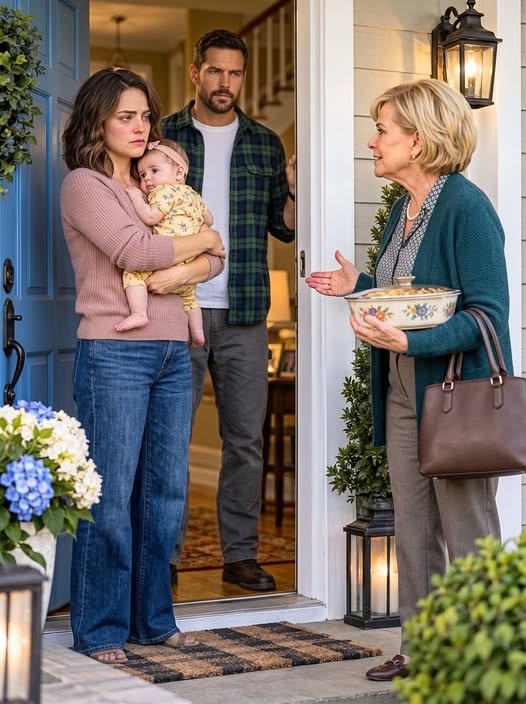
My mother appeared on my porch for the first time in 15 years, smiling as though she hadn’t stood by while my father threw me out into the rain at 19. She opened her arms toward the baby I was holding and said, “We’re ready to forgive you.” For a second, I nearly laughed. Forgive me?
She hadn’t apologized, admitted they were wrong, or even asked how I had survived 15 years without them.
She had simply shown up with a casserole, reached for my daughter, and acted as though I was the one who needed forgiveness. Then her eyes finally landed on the name written on my mailbox, and her smile slowly disappeared.
PART 1: THE FAMILY THAT CAME BACK TOO LATE
My mother appeared on my porch for the first time in fifteen years carrying a casserole and smiling as though the silence between us had been nothing more than a misunderstanding. My four-week-old daughter, Ren, was sleeping against my chest when Mom opened her arms toward her and spoke as if she were arriving to settle a minor family dispute.
“We’re ready to forgive you.”
For a moment, I genuinely thought I had misheard her. She had not apologized, admitted that she and Dad had been wrong, or asked how I had survived after they cut me out of their lives.
“Forgive me?”
Her smile faltered slightly.
“You know what I mean, Colleen. We’ve all made mistakes.”
Those words dragged me back to the night I was nineteen, standing in my parents’ foyer while rain hammered against the windows. Dad had discovered that I intended to marry Silas Callahan, a twenty-one-year-old man from a working-class family, and reacted as though I had announced my intention to disgrace the Whitfield name.
“No daughter of mine marries trash.”
Silas drove an old pickup, came from a family that repaired things instead of replacing them, and had never pretended to be anything he was not. None of that mattered to Dad because, in his world, poverty made Silas unworthy before he had even been given a chance.
“You want to be a Callahan? Go be one.”
Dad threw my suitcase onto the wet lawn along with a box of nursing-school textbooks. Mom stood halfway up the stairs in her robe and watched the entire thing without saying a word, while I kept waiting for her to come outside and stop him.
She never did.
Silas found me about twenty minutes later, soaked through and trying to save textbooks whose pages had already warped in the rain. He wrapped his jacket around my shoulders, loaded everything into his truck, and never once asked me to choose between him and my family.
“We’ll figure it out.”
And somehow, we did.
For eight months, we slept on the foldout couch in his father’s duplex while I worked diner shifts and finished nursing school. Silas stretched every dollar we had, sometimes eating peanut-butter sandwiches for dinner so we could cover rent and tuition without falling behind.
Over the years, the life my parents predicted would collapse became solid. I became a NICU nurse, Silas joined the fire department and eventually rose to captain, and together we bought a modest white-sided house with a blue front door that we paid off ahead of schedule.
After years of hoping and one miscarriage I mostly grieved in private, Ren was born. Holding her for the first time taught me something that hurt in a completely different way because I finally understood that love for your child was not supposed to depend on whether they obeyed you.
There was nothing Ren could become that would make me erase her from my life for fifteen years. That realization made Mom’s appearance on my porch feel even stranger, because she seemed determined to treat the past as though we had simply disagreed about something small.
Mom reached toward Ren, and I stepped back before she could touch her. The offense that crossed her face came so quickly that I understood she had expected immediate access simply because she was biologically connected to my daughter.
“She’s my granddaughter.”
“You’ve known she existed for four weeks.”
“That doesn’t change what she is.”
Then Mom looked past me and noticed the brass nameplates Silas had installed beside the blue front door. His name was above mine, and the surname she had spent fifteen years refusing to accept was impossible to miss.
SILAS CALLAHAN.
COLLEEN CALLAHAN.
Her mouth tightened, and I knew instantly that nothing fundamental had changed. Fifteen years later, the name still bothered her.
Eventually, she told me Dad had recently suffered a serious heart problem and collapsed at home. He was recovering now, but according to Mom, nearly dying had caused him to think about family.
“He’s been thinking about you.”
“He had fifteen years.”
She left a card beneath the casserole and told me to call when I was ready. I thought that would be the end of it, but within days relatives and people from my childhood church began contacting me with messages about reconciliation, forgiveness, and honoring my parents.
Mom had clearly reached them first.
According to her version, Dad’s only wish was to hold his granddaughter, while I was refusing because I was still angry about “something that happened when I was nineteen.” The years of silence, the rain-soaked suitcase, the missed graduation, wedding, promotions, pregnancy, and every birthday in between had apparently been reduced to a vague family disagreement.
Then Mom came to my hospital while I was carrying Ren through the corridor after introducing her to several coworkers. She approached us with another casserole, reached for my daughter in front of everyone, and immediately began crumbling emotionally when I stepped back.
“You won’t even let your own mother hold her grandchild?”
That was the moment I understood what she was really doing. This was not reconciliation built on accountability; it was pressure, and she believed making the conflict public would embarrass me into giving her what guilt had failed to obtain.
Popular Posts
→- 1
- 2
- 3
- 4




Recently Viewed
Stories you read recently will appear here.





