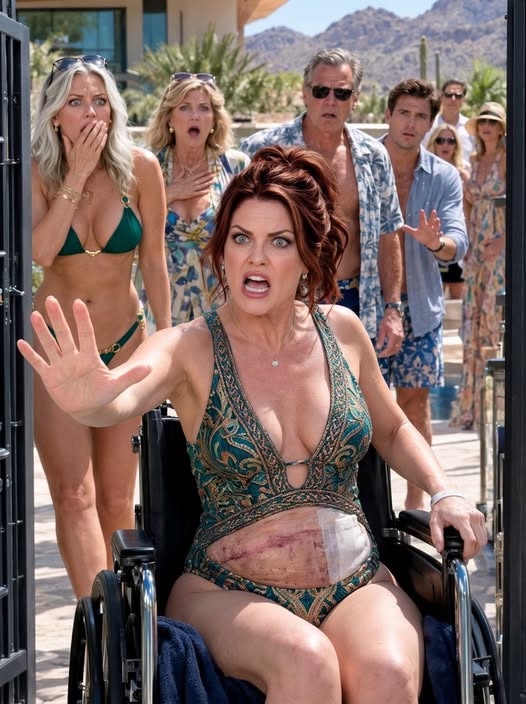
Part 2/5: When twelve guests arrive with luggage and a sign crediting my father as builder, the locked gate forces them to confront what I already told them.
Friday’s temperature was already above one hundred degrees when the first SUV appeared on my gate camera.
Mom was driving. Dad sat beside her, one arm resting out the window. A wooden sign was strapped to the roof, its dark letters reading: Built by Vernon Mercer.
Blythe’s car followed, then Bennett’s parents in another vehicle. By the time everyone stepped out and reached for bags, twelve people were standing in the gravel, expecting nine days under my roof.
Mom went straight to the keypad. The light flashed red. Dad tried his fob, then tried it again, holding it closer as though the gate simply needed patience.
Blythe took her turn. When her fob failed, she struck the post with the heel of her hand.
From the kitchen, I watched them look past the bars. The photographer’s box truck stood in my driveway, and crew members were setting up lights near the palo verde tree. The pool was covered; the patio chairs had been stacked.
Mom saw them first. Her scream came through the camera speaker so sharply that I lowered the volume.
Dad marched toward the gate and shouted that the crew was trespassing on his property. The producer walked over and showed him the signed location agreement, with my name on it as the person granting access.
Celeste took the notice from the sleeve and read it. She asked whether the agreement was current. When the producer said it was paid and active, she turned to look at Dad.
I waited until Mom called, then answered through the gate speaker. “The house is unavailable,” I said.
“We drove four hours,” she snapped.
“I told you not to.”
Dad leaned close to the camera. “Open it, Talia.”
“No.” I could see the wooden sign above his head. “The codes changed because you planned to come after I refused.”
Mom turned toward him. “Why is she talking about your access?”
Rather than argue through a speaker, I sent three images to the group chat: Blythe’s instruction to use the old fob, Dad’s email claiming to be the builder, and the page of the deed identifying me as owner.
Phones came out along the driveway. For several seconds, no one spoke.
“You said she agreed,” Mom told Blythe.
“She always does eventually,” Blythe replied.
Simon was standing by a rear hatch. “That isn’t an agreement.”
Blythe told him to stay out of it, but Celeste was still reading. Her husband, Graham, looked from the deed page to the sign on the SUV roof.
Aubrey, Blythe’s friend, asked why she had been invited if this was supposed to be a family visit. Blythe brushed the question aside. Aubrey went back to the car without picking up her suitcase.
Dad asked where twelve people were supposed to sleep. I told him they would have to arrange lodging with the people who had assured them the house was available.
Mom searched hotels on her phone. A festival had filled much of the area, and the rooms she found required a two-night minimum.
Dad suggested that everyone split the cost. Mom stared at him.
“You told us the lodging was handled,” she said. “You told Celeste you built this place. You deal with the hotel.”
The producer politely asked them to clear the driveway entrance so his crew could work. Dad began loading suitcases with quick, angry movements. He stared into the camera as he lifted the last bag.
“Think you proved something?” he asked.
“I think you showed them what you told me to ignore,” I said.
Four hotel rooms went on his card. The cars backed out one at a time, awkwardly maneuvering around the sign he had left beside the gate.
After they disappeared, I sat down on the kitchen floor. My hands shook, and I hated how much effort it had taken to say less than a dozen words. I drank water, took my medication, and watched the crew return to its work.
The next morning, thirty-one notifications waited on my phone. Blythe wanted me to tell Celeste there had been a misunderstanding. Mom wanted me to explain that Dad had meant well. Dad had called so many times his name filled the screen.
Blythe’s next message was more direct: if Celeste believed I had truly refused access, Bennett might postpone their wedding plans. She suggested I blame my decision on confusion after the hospital.
“I will not tell her that,” I wrote.
She responded that she had never claimed to own my house; she had only called it a family house. I put down the phone before I could start writing a paragraph she would refuse to read.
Simon called from a stairwell at the hotel. He said Blythe had told Celeste I was not thinking clearly after my hospital stay and that the locked gate should not be treated as a real decision.
I asked him to send me the message. Seeing it on my screen hurt more than I expected. I had been careful with my recovery because I wanted to trust my own judgment again, and my sister was using that recovery to discredit it.
An hour later, the hotel called. Dad had listed my number for charges on the four rooms, including parking and incidentals. I told the front desk I had not made the reservation and would not pay any part of it. The employee recorded my refusal.
The bill had passed $4,800. Dad called almost at once and accused me of embarrassing him at the desk.
“You gave them my number,” I said. “I answered their question.”
“You’ve made your point.”
“I’m still at home, following the schedule the hospital gave me. I haven’t asked anyone there to do anything.”
Popular Posts
→- 1
- 2
- 3
- 4




Recently Viewed
Stories you read recently will appear here.





