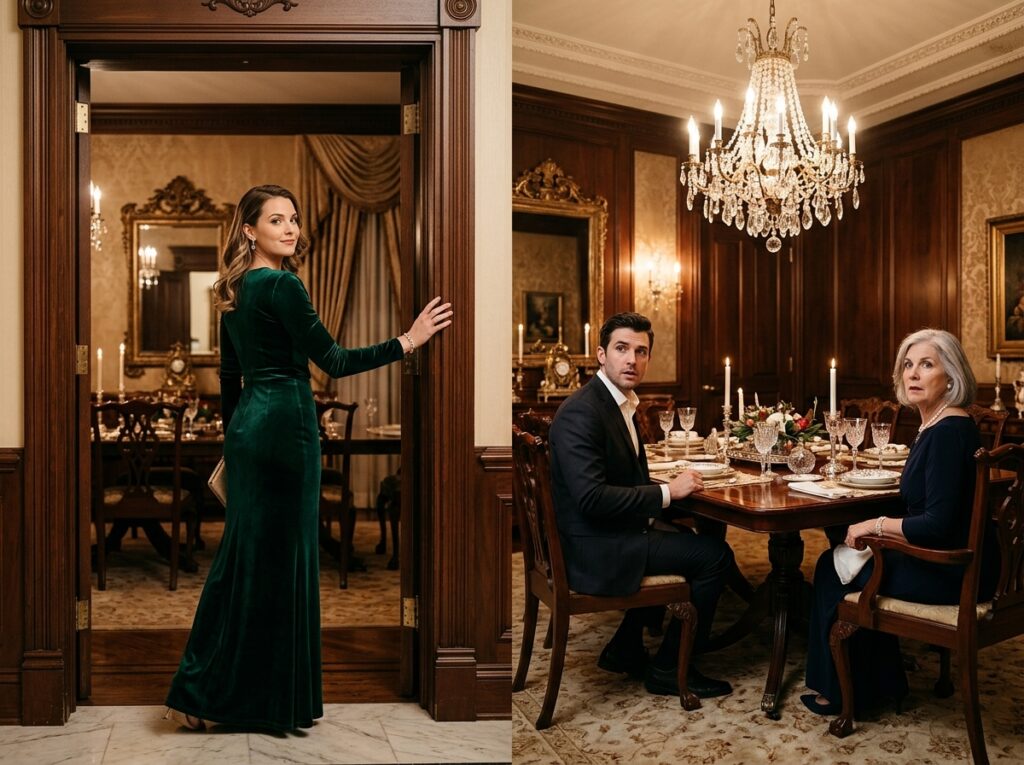
The morning after our wedding, my husband humiliated me in front of his entire family because his mother didn’t like the breakfast I made.
His entire family watched.
No one defended me.
His mother actually looked satisfied.
I didn’t cry.
I didn’t beg.
I didn’t ask him why the man who had promised to stand beside me for the rest of my life was suddenly treating me like an employee who had failed an inspection.
I simply removed my wedding ring, placed it beside his mother’s plate, picked up my purse, and walked out.
Grant thought I was humiliated.
The Whitmores thought I had finally learned what it meant to “know my place.”
They had no idea that before the day was over, the company they had spent thirty years building would be facing questions they had worked very hard to keep buried.
It happened at 7:42 that morning inside the Whitmore family’s twelve-million-dollar estate in Westchester County.
I had slept barely two hours after our wedding reception.
Still, Grant’s mother, Meredith, knocked on our bedroom door before seven and informed me that “a new Mrs. Whitmore should understand how to take care of her family.”
They had two housekeepers.
They had a private chef.
But Meredith wanted me in the kitchen.
It wasn’t about breakfast.
It was about obedience.
So I cooked.
Then I sat beside my new husband at the massive oak table while his father read financial news, his sister Paige watched me like entertainment, and Meredith inspected everything I had made.
She took one bite of the eggs.
“Overcooked.”
Then the potatoes.
“Too much rosemary.”
Paige laughed.
Grant stared into his coffee.
I finally said, “Then don’t eat it.”
The entire table went quiet.
Meredith’s expression hardened.
“This family has standards.”
I looked directly at her.
“So did my father. He just included basic decency among them.”
Grant pushed his chair backward.
“Elena, apologize to my mother.”
“No.”
His face changed instantly.
The charming man who had sent flowers to my office, flown across the country when I was sick, and promised I would never have to face life alone disappeared.
“You do not embarrass my family in their own house,” he said.
“Your mother insulted my father.”
“She was making a point.”
“So am I.”
Grant leaned closer and lowered his voice.
“You became a Whitmore yesterday. Start acting like one.”
That sentence changed something in me.
Meredith leaned back in her chair.
His father looked away.
Paige folded her arms.
And in that moment, I finally understood.
This wasn’t one uncomfortable breakfast.
This wasn’t an argument caused by exhaustion after a wedding.
This was how the entire family worked.
What none of them understood was that I had already spent months quietly investigating why Grant had pursued me so aggressively.
They thought I was simply Elena Vale, the daughter of a late public-school teacher from Ohio who had somehow married into one of New York’s wealthiest medical families.
They didn’t know my father had left me shares in a logistics company controlling refrigerated distribution routes their business desperately needed.
They didn’t know Grant’s father had discussed those shares before Grant ever proposed.
They didn’t know I had uncovered altered safety reports, suspicious overseas payments, buried employee warnings, and charitable money flowing toward companies connected to Paige’s social circle.
And they definitely didn’t know my attorney had inserted one very specific clause into the prenup Grant barely bothered to read.
Any documented attempt to pressure me into transferring, surrendering, or signing away my inherited business interests would trigger immediate legal review of every agreement between my assets and the Whitmore companies.
I slowly removed my ring.
Grant frowned.
“What are you doing?”
I placed it beside Meredith’s breakfast plate.
Then I stood.
“Where do you think you’re going?” she demanded.
I picked up my purse.
“To work.”
Grant laughed.
He still thought I was bluffing.
Less than ninety minutes later, I stepped into the Manhattan headquarters of Whitmore Medical Systems with my attorney beside me and three black cases filled with documents.
And at exactly 10:00 a.m., while Grant begged me not to “overreact,” my finger hovered over one button.
He had no idea who was about to receive what I was holding.
Or why the breakfast he considered a victory was about to become the moment his family wished they could undo.
The rest of the story is in the first comment.
I didn’t press the button immediately.
That was the part Grant never understood about me.
He had mistaken patience for weakness from the day we met.
I had spent nearly a year listening while his family spoke freely around me because they assumed I didn’t understand the language of mergers, supply contracts, compliance reviews, distribution leverage, and corporate control.
My father had been a public-school teacher, yes.
What the Whitmores never bothered to learn was that before he became a teacher, he had helped his older brother build a regional refrigerated logistics company from three trucks into a network serving hospitals, laboratories, pharmacies, and medical suppliers across several states.
When my uncle died, my father inherited a significant portion of the company.
When my father passed away, those shares came to me.
I had never talked about them publicly.
I had no interest in being introduced as an heiress.
My father had taught me that money was useful, but character was revealing.
Grant seemed to admire that about me.
At least that was what I had believed.
Then, three months before the wedding, I overheard a conversation that changed everything.
Grant and his father were in the library at the estate.
I had returned early because I had forgotten my laptop charger.
Neither of them knew I was standing in the hallway.
His father said, “Once she’s family, the distribution issue becomes much easier.”
Grant answered, “She trusts me.”
His father lowered his voice.
“Trust is useful. Ownership is better.”
I left before they discovered me.
I didn’t confront Grant.
Popular Posts
→- 1
- 2
- 3
- 4




Recently Viewed
Stories you read recently will appear here.





