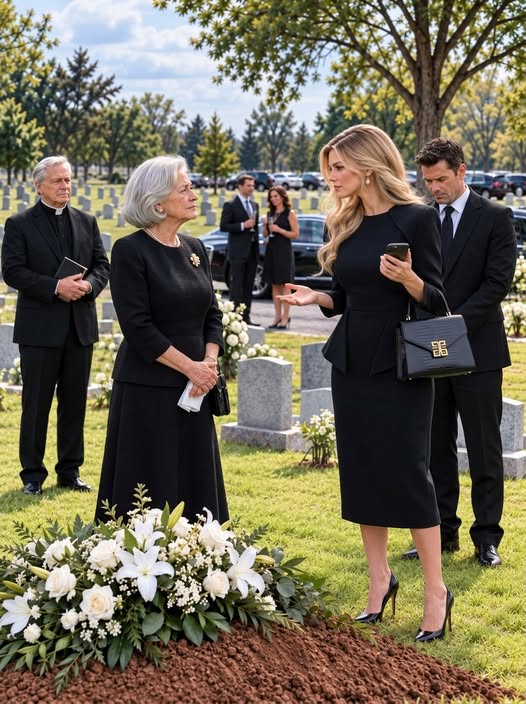
My husband had been buried for barely five minutes when my daughter-in-law asked when she could receive his money.
Behind us, champagne glasses chimed in the cemetery parking lot.
Someone was playing music through an open car window.
A steady bass rhythm floated between the headstones while the pastor wiped damp earth from his fingers.
I stared at the mound above Harold’s coffin.
Thirty-eight years of marriage, and I couldn’t remember if I had kissed him goodbye that final morning.
“Stop being so dramatic, Shirley.”
Addison’s designer heels sank slightly into the grass beside me.
She seemed irritated by that, too.
“The lawyer is waiting.”
“Can’t this wait?
I just buried my husband.”
She glanced at her watch.
“Harold is gone.
We have important matters to discuss.”
Behind her, my oldest son, Michael, stared at his shoes.
David stood beside his wife, Sarah, near the pathway.
My grandchildren gathered farther away, their attention fixed on their phones.
“What could possibly be so urgent?”
Addison gave me the patient smile people use with someone they consider difficult.
“Eight million dollars.”
I waited for Michael to protest.
I had cared for that boy through illnesses and heartbreaks.
Once, at seven, he had brought an injured sparrow home inside his winter hat because he couldn’t bear leaving it alone.
Now he wouldn’t even meet my eyes.
David eventually stepped forward.
“Dad showed us the will last year.
Everything gets divided among the family.”
“I haven’t seen it.”
An uneasy silence followed.
Apparently, I was the only person Harold hadn’t shown.
The pastor gently touched my elbow.
“Take all the time you need, Mrs.
Patterson.”
Addison exhaled.
From the parking lot came another burst of laughter.
Earlier, I had overheard her discussing a European vacation she hoped to take next month.
I bent down and laid a white rose on the soil.
“Goodbye, sweetheart,” I whispered.
But for the first time in thirty-eight years, I wondered who I had truly been married to.
At home, Addison began estimating the value of my belongings before I had even removed my funeral shoes.
“The china should be appraised,” she said, running one manicured finger across the dining table.
“And those paintings.”
Michael carried around a notebook.
David paused inside every doorway, studying the rooms.
Twenty-three years earlier, Harold and I had painted the kitchen yellow because I wanted sunshine even during winter.
Under the hallway wallpaper were pencil marks documenting our sons’ heights.
Now they moved through everything like potential buyers.
My phone buzzed.
Addison stood only ten feet away.
Stop being dramatic about everything.
This is important business.
The lawyer expects you tomorrow at 9:00 sharp.
Don’t make this more difficult than necessary.
I lifted my eyes from the message.
She was inspecting the silver candlesticks my mother had given me.
That night, I pressed Harold’s pillow against my chest and listened to the refrigerator humming downstairs.
During his last weeks, he had held my hand with unexpected strength.
“Don’t worry, Shirley.
I’ve made sure you’ll be looked after.
They can’t hurt you.”
I had assumed he was reassuring me.
Now I wondered why his voice had sounded frightened.
Mr.
Henderson’s office smelled like polished furniture and aging paper.
Addison opened a leather portfolio before everyone else had even sat down.
Michael checked his phone.
David leaned forward, resting his elbows on the mahogany table.
“The will you’re referring to was prepared last year,” Henderson began.
“However, there have been several developments.”
Addison’s pen froze.
“What developments?”
“Harold made adjustments to his estate planning during his final weeks.”
Michael’s head lifted sharply.
“What kind of adjustments?”
“We’ll review the documents at our meeting next week, after everything has been gathered and verified.”
“Dad was heavily medicated,” David said.
Henderson took off his glasses.
“Your father was very clear regarding his instructions.”
I saw Michael and David exchange a glance.
It lasted less than a second.
It was enough.
Back at home, they continued cataloging possessions.
“This is my house,” I said.
“And Harold’s gone,” Addison replied.
“We need to be practical.”
That evening, she announced that she and Michael would sleep in the guest room.
She didn’t ask permission.
Later, I heard their voices drifting through the heating vent.
“She’s too emotional,” Addison said.
David replied, “Grief can affect judgment.”
“What are you suggesting?”
Michael asked.
“Someone should help her with important decisions.”
I sat upright, clutching the blanket.
Their voices became quieter after that.
I remained awake until sunrise, afraid to sleep inside a house where my own children were discussing my future without me.
At breakfast, Addison set coffee in front of me.
“We’ve worked out a reasonable arrangement.”
I left the cup untouched.
“We manage the estate.
Michael has his MBA.
David understands the business.
I’ve handled estate paperwork.
You keep the house and receive a comfortable allowance.”
“An allowance?”
“Harold always shielded you from financial stress.”
I stared at her across the table.
When Harold launched his company, I had managed payroll after putting the boys to sleep.
I had answered calls, followed up on overdue invoices, and delivered sandwiches to muddy construction sites.
Somewhere over the years, everyone had forgotten that.
Including, perhaps, me.
“I’ll wait until the meeting.”
Her smile tightened.
“Think about what’s best for everyone.”
That afternoon, they left for “estate errands.”
I entered Harold’s study.
His reading glasses remained beside a magazine.
His coffee mug still had a brown crescent along the bottom.
Seeing those everyday objects nearly brought me to my knees.
Then I spotted a white corner beneath the desk blotter.
A business card.
Rebecca Morrison, Attorney at Law.
On the back, written in Harold’s handwriting:
For Shirley only.
Tell no one.
I lowered myself into his chair.
Harold had another attorney.
That evening, Michael mentioned condominiums that would be “more manageable.”
Yesterday, I could remain in my house.
Today, they were already discussing moving me elsewhere.
The card remained inside my pocket.
The following morning, once their car disappeared down the street, I locked the study door and called.
Popular Posts
→- 1
- 2
- 3
- 4




Recently Viewed
Stories you read recently will appear here.