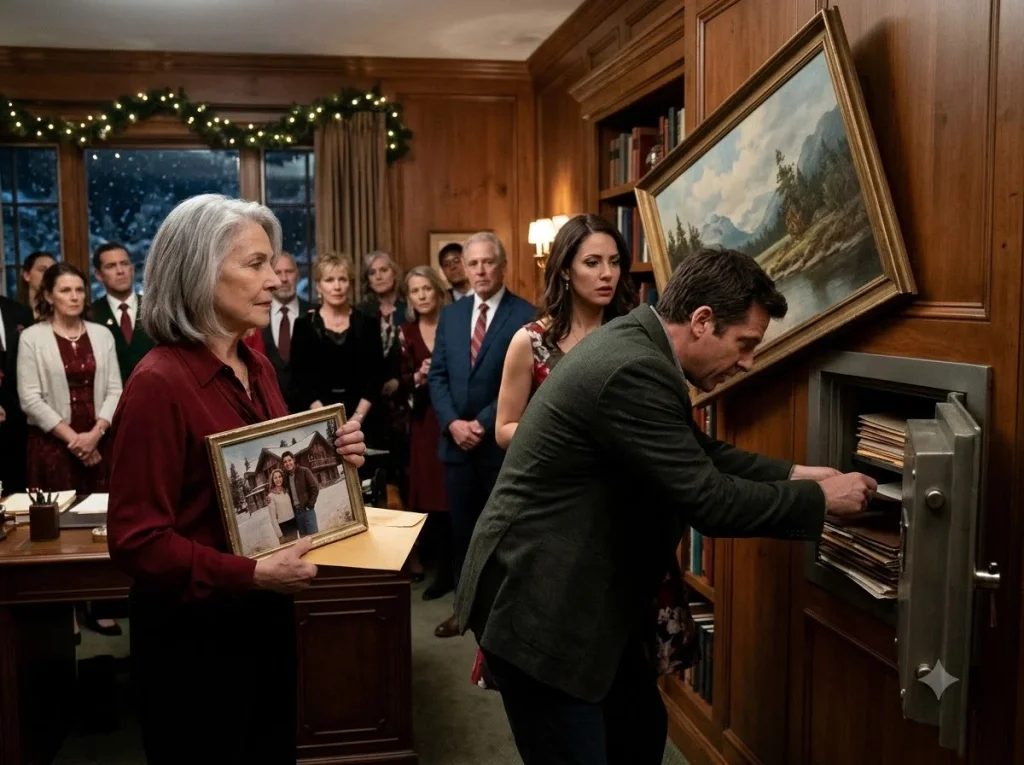
The tray hit the floor before I understood that my son had thrown it.
Roast beef slid across the polished hardwood.
A porcelain bowl shattered near the fireplace.
Someone screamed.
And for one strange second, all I could hear was Bing Crosby singing softly through the speakers about a white Christmas while red wine crawled across the floor like blood.
Then my son grabbed me by the collar.
“Get out, you worthless old woman!”
Daniel’s face was inches from mine.
His cheeks were flushed from whiskey and rage, and the tiny veins beside his nose stood out the way they always had when he lost control of himself.
Behind him, thirty people had gone completely silent.
Employees.
Friends.
Neighbors.
People who had known our family for years.
People who had eaten at my table, worked at my resort, attended my husband’s funeral, and told me how lucky I was to have a son willing to “take care of everything” after my husband died.
Daniel tightened his fist in the front of my blouse.
“We’re done paying for your pathetic life.”
I looked at him.
Not because I was frightened.
Because I wanted to remember his face.
There are moments in a mother’s life when she sees two people at once.
The child she raised.
And the adult he chose to become.
For one heartbeat, I saw both.
I saw the little boy who used to run into my office with snow in his hair, begging me to close the resort early so we could build a snowman.
I saw the teenager who cried when his first girlfriend left him.
I saw the young man who stood beside his father on the overlook above the ski runs and swore that one day he would protect everything we had built.
Then I saw the man holding a seventy-year-old woman by the collar in front of a Christmas tree.
And I understood that the boy I remembered had been gone for a very long time.
“Daniel,” I said quietly, “take your hand off me.”
His wife laughed.
Vanessa stood near the banquet table in a silver dress that probably cost more than some of our seasonal employees earned in a month.
Her champagne glass was still in her hand.
“Oh, please,” she said.
“Don’t start with the dramatic voice.”
A few people glanced at each other.
Nobody moved.
That hurt more than I expected.
Not because I needed rescuing.
I didn’t.
But because silence is a dangerous thing inside a family.
Silence gives cruelty permission to believe it is normal.
Daniel jerked me forward.
My chair tipped behind me.
My hip struck the edge of the table.
Pain flashed through my side.
“Get out,” he repeated.
Then he shoved me.
My shoulder slammed into the wooden cabinet beside the fireplace.
The impact rattled the framed photographs sitting on top.
One of them fell face down.
It was a picture of my husband, Robert, standing beside me in front of the original lodge forty-one years earlier.
We had both been poor then.
Exhausted.
Terrified.
Happy.
The resort behind us had only twenty-two rooms and a roof that leaked every spring.
Now that same property was worth eighteen million dollars.
And my son believed it belonged to him.
Vanessa walked toward me.
She was smiling.
Not nervously.
Not awkwardly.
Smiling the way people smile when something they have been waiting for is finally happening.
She picked up a stack of envelopes from the sideboard.
Electric bills.
Insurance statements.
Medical invoices.
Property expenses.
Most of them were mine.
Most of them had already been paid.
She slapped them against my chest.
The papers scattered around my feet.
“There,” she said.
“Look at all of it.
Do you know how much you cost us?”
I stared at her.
She had rehearsed this.
I realized that immediately.
Maybe not every word.
But the humiliation.
The performance.
The story they wanted everyone in that room to believe.
Poor Daniel and Vanessa.
Burdened by his elderly mother.
Supporting her.
Housing her.
Paying her bills.
Keeping the resort alive while she sat around like dead weight.
It was a good story.
If no one asked whose name was on the bank accounts.
Whose name was on the deed.
Whose money had been paying whom.
Vanessa reached past me and snatched my handbag from the chair.
“Here.”
She threw it toward the front door.
It landed near the entry rug.
My keys spilled out.
So did my reading glasses and a small wrapped peppermint I had taken from the reception desk that afternoon.
“You can take that,” she said.
“And whatever clothes you packed.
The rest can be sent later.”
Someone near the tree whispered, “My God.”
Daniel turned toward the room.
“What?” he snapped.
“You all know what this has been like.”
Popular Posts
→- 1
- 2
- 3
- 4




Recently Viewed
Stories you read recently will appear here.





