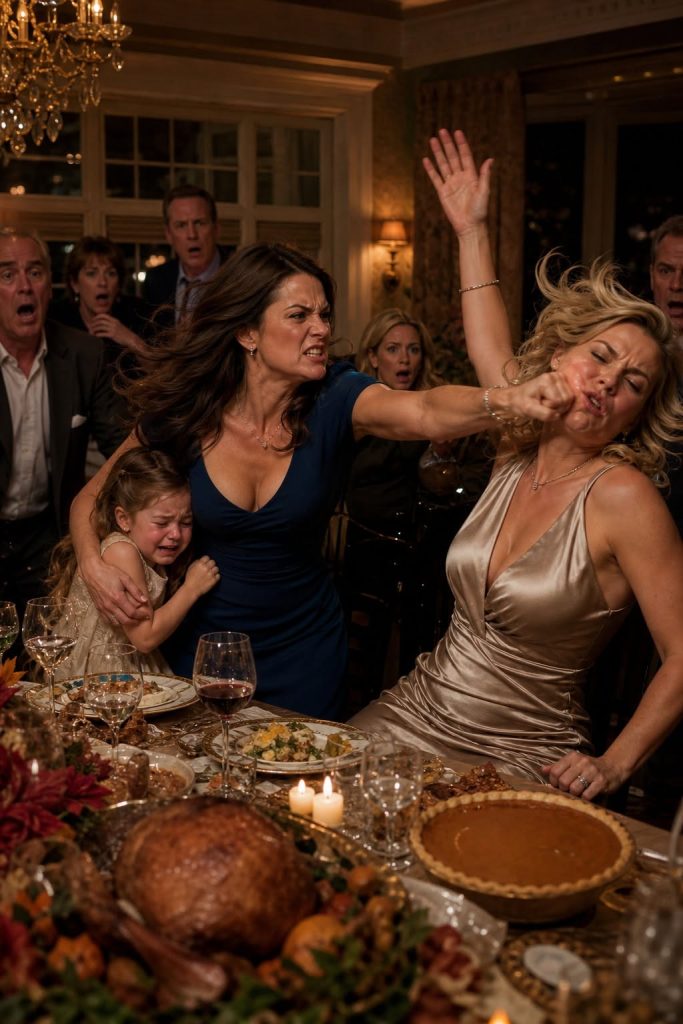
The slap cracked through the room so sharply during Thanksgiving dinner that every fork stopped halfway to someone’s mouth.
One second earlier, the Peterson dining room had been loud with polite laughter, clinking glasses, and the smug, well-fed comfort of a family that believed its privilege insulated them from the ugly realities of the world. The next, my five-year-old daughter, Lily, stumbled backward so hard her knees bumped the edge of the heavy mahogany chair, sending it screeching across the wide-plank oak floor.
Her small hand flew instantly to her cheek.
A bright red mark bloomed across her pale skin, stark against her freckles.
For one frozen, terrible beat of my heart, nobody moved.
Not my husband, Mark, who was midway through cutting a slice of roasted turkey. Not my father-in-law, Frank, whose fork remained poised over his plate. Not my mother-in-law, Carol, who had been mid-sentence about her recent charity committee meeting. Not the four adults seated around the long mahogany table covered in crystal goblets, silver serving spoons, and a carefully orchestrated Thanksgiving perfection enough to make a magazine editor weep.
The only one still moving was my sister-in-law, Megan, because she hadn’t yet finished pointing her rigid finger at my child.
“You rude little brat!” Megan snapped, her voice dripping with venom. “If your mother won’t teach you manners, I will.”
My ears started ringing. A low, metallic hum filled my head, drowning out the sound of the wind outside.
Lily’s lips trembled, her lower lip catching between her teeth, but she didn’t cry. That hurt me more than the slap itself. My child had learned too early—in the subtle ways adults signal disapproval—that crying in front of the Petersons only invited more judgment, more cold stares, and more quiet lectures about emotional resilience.
I stood up so fast my chair tipped backward, hitting the floor with a dull thud.
“What the hell did you just do?”
Megan turned toward me, her perfectly highlighted blonde hair framing a face twisted with righteous indignation. She didn’t look remorseful. She looked annoyed, as if a stray dog had dared bark on her manicured lawn.
“Oh, don’t start, Chloe,” Megan said, rolling her eyes. “She was being disrespectful.”
Carol slowly lifted her wineglass, taking a delicate sip as if she were presiding over a homeowner association committee meeting instead of an unprovoked assault on her own granddaughter.
“Lily rejected the turkey I served her,” Carol said smoothly, her voice ice-cold. “Right at the table. After all the hours I spent preparing this meal, after all the trouble I went to accommodate everyone’s schedules.”
Lily looked at me with huge, swimming, wounded eyes. “Mommy,” she whispered, her voice shaking. “I said thank you. I just asked if I could have the other piece because this one had too much pepper.”
“She did,” I said, my voice shaking so hard the words barely formed. “She asked politely.”
“Oh, please,” Megan scoffed, picking up her water goblet with a dismissive flick of her wrist. “Kids need discipline these days. You baby her, Chloe. You let her run wild. That’s why she acts like such a spoiled brat.”
I looked across the table. “Mark.”
My husband swallowed hard. He looked at Lily’s red cheek. He looked at his sister. Then he did what he had done in a hundred smaller, cowardly moments over our seven years of marriage.
He chose the path of least resistance.
“Chloe,” he murmured, his voice barely loud enough for me to hear over the hum of the refrigerator in the butler’s pantry. “Just let it go. Not tonight.”
I stared at him.
Not tonight.
As if there would ever be a right night for his sister to hit our five-year-old daughter. As if my child being slapped across the face at a Thanksgiving dinner was an awkward misunderstanding instead of a violent line that no human being had the right to cross.
“You want me to let it go?” I asked, my voice rising.
Mark stood up slowly, holding his palms out in a placating gesture—the way people approach a wounded animal or a bomb they’re hoping not to set off. “I’m saying don’t make a scene. Let’s not ruin the holiday.”
“Megan just hit your daughter.”
“She was correcting her tone,” Mark said, digging himself deeper into a ditch of spineless excuses.
I turned fully toward him then, and something inside me—something quiet, patient, and endlessly accommodating that I had maintained for seven years for the sake of his family—cracked open, letting in a cold, rushing draft of pure, unadulterated fury.
“Correcting?” I repeated, my voice dropping into a dangerous, icy register. “You call that correcting?”
Frank finally spoke from the head of the table, his voice booming like an aging judge who had grown tired of a messy courtroom. “Everybody calm down. It’s a family disagreement. Let’s finish our dinner before the turkey gets cold.”
Popular Posts
→- 1
- 2
- 3
- 4




Recently Viewed
Stories you read recently will appear here.





