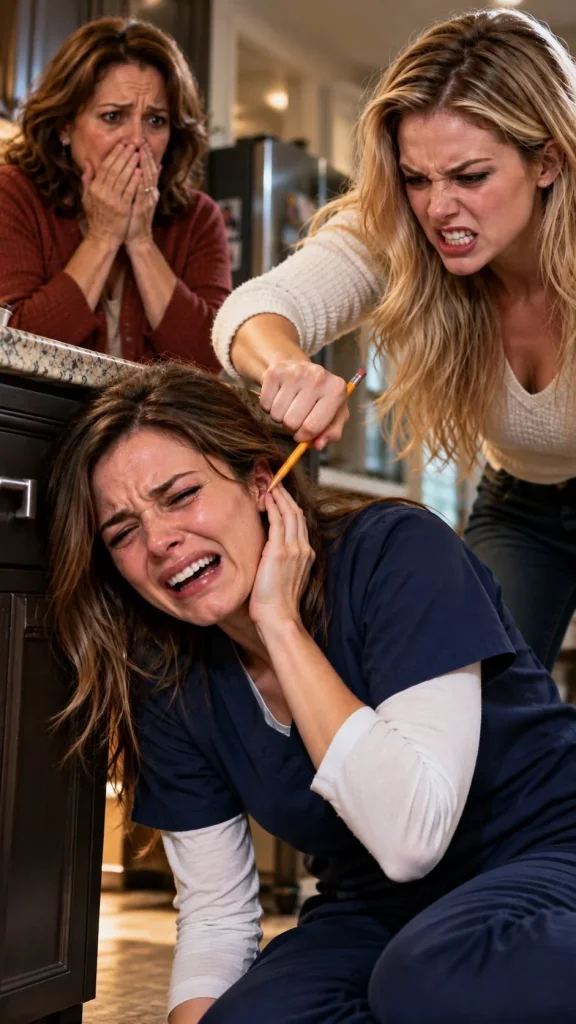
My sister drove a pencil into my ear, but somehow I was the one arrested. Mom claimed I attacked first, and my sister walked away smiling. “You’ll never get out,” she whispered. They thought their story was perfect, until my lawyer noticed one detail Mom couldn’t explain.
Chap 1
The world inside the holding cell did not operate on time; it operated on sound, and for Emily Vance, sound had become an instrument of torture.
Every breath she drew scraped against the back of her throat like coarse sand, but it was her left ear that anchored her to the nightmare. The pain was not a dull ache. It was an incandescent, white-hot spike that seemed to pulse in direct synchronization with the artery throbbing in her neck. With every heartbeat,
a wet, viscous warmth trickled past the tragus, tracing a familiar path down her jawline before cooling against the rough fabric of her scrub top. The county jail paper gown they had forced her into hours later was stiff and smelled of chemical lye, but beneath its neckline, her collar remained stiffened with dried hemoglobin.
She sat on the edge of the steel bench, her knees pressed tightly together, fingers clamped between her thighs to stop their violent tremor.
Whenever the heavy iron latch at the end of the corridor clanged shut, the sound hit her left ear not as a metallic strike, but as a blown-out, distorted blast of static—like a speaker cone torn to ribbons by excessive wattage. Then came the high-pitched hum. A constant, piercing tone hovering somewhere around eight thousand hertz.
It never dipped. It never wavered. It was the biological siren of a ruptured tympanic membrane, a physical reminder that her own sister had tried to pierce her brain with six inches of graphite and cedarwood.
*“Enjoy prison. You’ll never get out.”*
The words had not faded. They were burned into the ringing.
Thirty-two years of life. Six years as a trauma nurse at OhioHealth Grant Medical Center. Hundreds of shifts spent stabilizing gunshot victims, coding cardiac patients, holding the hands of strangers as their vitals flattened into horizontal lines. She had spent her adult life as the competent one. The rock. The daughter who took the extra night shifts on holidays so she could fund her mother’s supplemental Medicare premiums, who drove across town with groceries Eleanor pretended she couldn’t afford,
who quietly fixed the broken plumbing and paid off the delinquent utility notices.
And across from her had always stood Vanessa.
Vanessa, who was twenty-nine and moved through the world like an open flame, consuming oxygen, leaving ash, and demanding applause for the warmth she provided. Vanessa, whose failed boutique businesses had been funded by three separate second mortgages on their mother’s house. Vanessa, who had wept so convincingly at their father’s funeral nine years ago that the mourners had ignored Emily—the daughter who had actually held his hand while the ventilator was disconnected—to console the younger sister who couldn’t stand the sight of hospital beds.
The heavy steel door at the front of the intake block buzzed, the sound vibrating through the concrete floor into Emily’s bare soles.
“Vance,” a corrections officer barked. His face was round, gray-stubbled, and completely indifferent to the human misery cataloged within the logbooks on his desk. “Counsel is here. Visitation room three. Stand up, hands behind your back.”
Emily rose too quickly. A sudden wave of inner-ear vertigo tilted the room thirty degrees to the left. The cinderblock walls smeared into a gray blur. She reached out blindly, her right palm slapping against the cold, damp paint to keep from collapsing.
“I said hands behind your back,” the guard repeated, his voice sharpening.
“I’m dizzy,” she whispered. Her own voice sounded foreign to her, muffled on the left, boomy and cavernous on the right. “My ear… I was told the doctor would see me again after intake.”
“Doctor’s gone for the night. You’re on the infirmary roster for tomorrow morning. Turn around.”
She swallowed the bile rising in her throat, obeyed, and felt the bite of the nickel-plated steel ratcheting over her wrists. The cuffs were cold. Every motion sent a jolt of agony radiating through her cervical spine into the wound. She shuffled forward in the slip-on canvas shoes they had given her, keeping her eyes fixed on the scuffed linoleum of the corridor to fight the spinning room.
Visitation Room Three was tiny, smelling faintly of stale coffee and industrial lemon bleach. A single acrylic partition divided the room, though there was no glass—just an open steel table with two bolt-down stools and a low divider.
Sitting on the far side was a man Emily had never met in person, though she knew his reputation.
Popular Posts
→- 1
- 2
- 3
- 4




Recently Viewed
Stories you read recently will appear here.





