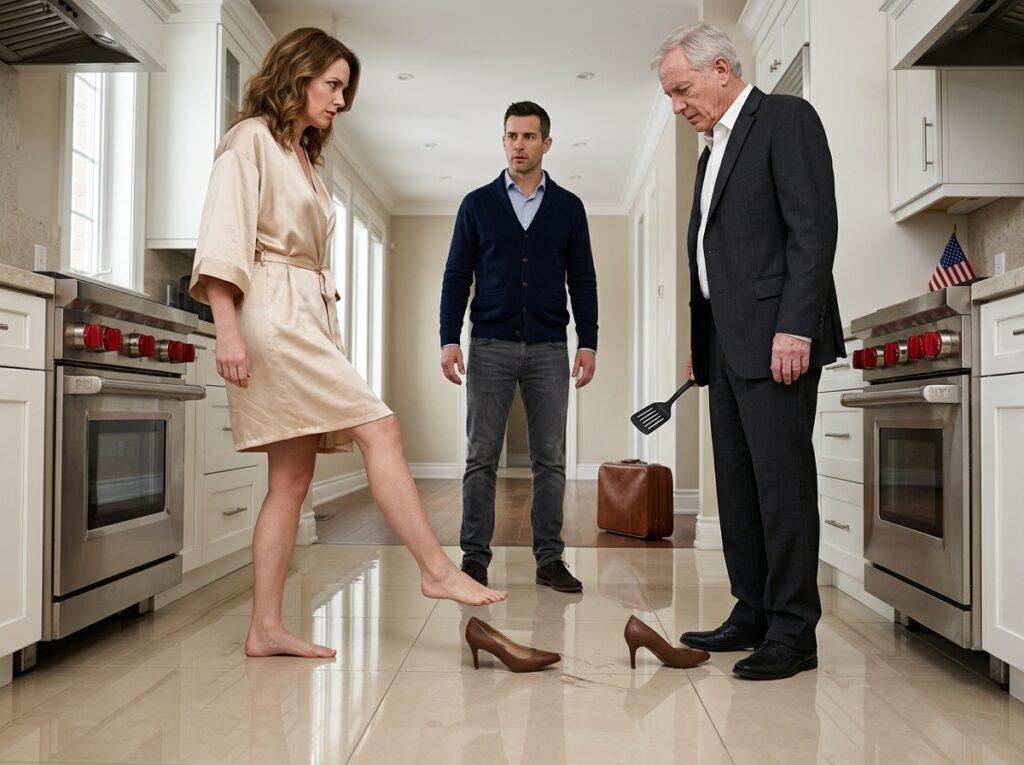
In the morning, my daughter-in-law threw her muddy shoes, demanding I kneel and clean them. I refused. My son walked in, snapping, “Either serve and apologize to my wife, or get out!” I smiled, grabbed my suitcase, and left. A week later, 30 missed calls.
At 8:07 on a freezing October morning, my daughter-in-law kicked off her mudcovered heels in my kitchen and shoved them toward me.
“Clean them before we leave,” she said without even looking at my face.
I stood there in silence until my son walked in. He glanced at the shoes, then looked me straight in the eyes.
“Dad, you’re going to apologize to my wife right now, or pack your suitcase and get out.”
I smiled.
I picked up the suitcase I had packed 5 days earlier, and I quietly walked out the front door.
One week later, my phone showed 30 missed calls.
This story contains fictional elements crafted for entertainment, but every lesson inside it is worth carrying with you.
My name is Arthur Bennett. I’m 72 years old.
That morning, the kitchen smelled like burnt toast and old resentment. I’d been at the counter since 6:00, cracking eggs into the cast iron pan my late wife Margaret bought at a yard sale back in 1987.
Sunlight came through the bay window in long gold stripes across the floor. I’d refinished myself back when this house still felt like a home.
Then Clare walked in.
Silk robe, phone already in her hand, moving through the kitchen like I was furniture.
She poured juice I’d freshly squeezed. Took one sip, wrinkled her nose, set it down without a word.
Then I heard heels on marble.
She came back and dropped both shoes at my feet.
Souls caked with mud.
“The souls are filthy. Get to it before I leave.”
Something moved through my chest.
Not anger exactly, something older, something that had been building for 2 years and 11 months in a life that no longer resembled anything I’d built.
I set the spatula down and said nothing.
That’s when Daniel came downstairs.
42 years old, three months between jobs, still carrying himself like a man at the top of the world.
He looked at the shoes, then at me, and something calculating moved behind his eyes.
“Dad, Clare asked you something. It’s just shoes. You’re home all day. The least you can do is help around the house.”
I repeated the words slowly.
“Help around the house. Is that what this is?”
His jaw tightened.
He stepped closer, and I could see it.
My refusal had made him feel small in front of his wife, and Daniel could not tolerate feeling small.
“I’m going to say this once. Either you get on your knees and apologize to Clare, or you get out of my house.”
I had buried a wife, built a company from a single mechanic’s bay into a real estate trust worth more than Daniel could count.
And now my own son was asking me to kneel in my own kitchen.
“Your house?” I said.
“That’s right.”
I looked at him, not with hatred, with grief.
“All right, Daniel,” I said. “All right.”
I walked past both of them down the hall to the smallest room in the house, the one they’d given me, facing the alley instead of the garden.
In the closet, behind a spare blanket, sat a leather suitcase I’d packed 5 days before, methodically, not impulsively.
Three suits, Margaret’s photograph, her wedding bible, a folder of documents.
I’d known this moment was coming.
I’d only been waiting to see how it would arrive.
I walked back through the hallway, past photographs where my face appeared in almost none of them.
I’d always been the one behind the camera.
Clare was filming something in the living room.
Daniel stood at the bottom of the stairs, arms crossed, watching the way a man watches someone he expects to back down.
I did not back down.
I put on my coat.
“You asked me to leave,” I said. “I’m leaving.”
For a fraction of a second, something flickered in Daniel’s eyes.
Not regret.
Not yet.
Just the ghost of something.
The October air hit my face outside, cool and clean.
The door closed behind me.
I didn’t look back.
Thomas, my driver of 11 years, was already waiting with the car door open.
He always knew what the suitcase meant.
“The Liberty?” he asked.
I confirmed.
As we pulled away, I watched the house shrink in the mirror, then disappear around a corner.
I took out my phone, one name in my contacts.
Wallace.
My lawyer picked up on the second ring.
“Michael,” I said, “is it time?”
A beat of quiet, then understanding.
“Start,” I said.
What Thomas didn’t know, what almost nobody knew, was that this single word had just set 12 legal and financial instructions in motion.
Michael Wallace wasn’t merely my lawyer.
He was the architect of a structure I’d spent 30 years quietly building, designed for exactly one purpose: to make sure nothing I’d built could ever be taken, wasted, or stolen, not even by the people who shared my name.
By close of business, every account Daniel and Clare touched through the Bennett family trust would be frozen.
The BMW he leased through a Bennett LLC would be flagged for repossession.
The utilities on the mansion would move to a holding account requiring my personal authorization.
I hadn’t done this out of anger.
I done it the way a surgeon does what must be done, precisely without cruelty, but without hesitation.
2 days later, Wallace called with the first result.
Daniel had taken Clare to an expensive restaurant in Cambridge.
Card declined.
Second card declined.
Third declined.
He’d had to call in a personal debit card over the phone while the whole restaurant went quiet around him.
Clare had leaned across the table and hissed.
“What is happening with our accounts, Daniel? This is humiliating.”
Popular Posts
→- 1
- 2
- 3
- 4




Recently Viewed
Stories you read recently will appear here.





