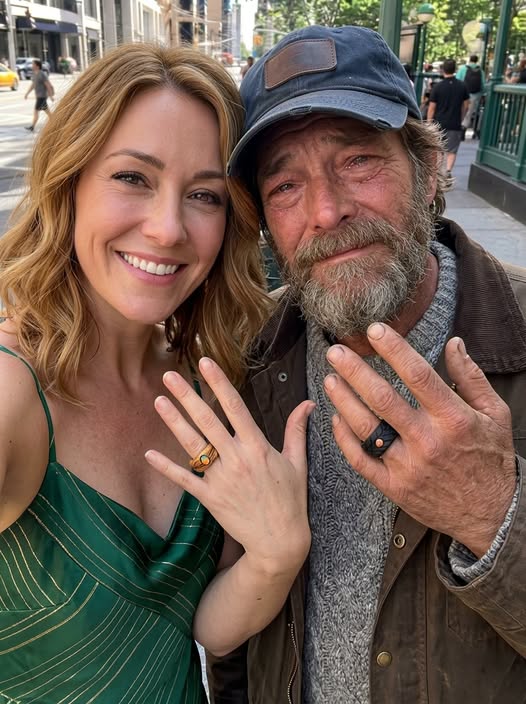
Larry always drank his coffee black outside the subway station where I passed every morning. For nearly two years, we had exchanged small conversations, jokes, and quiet moments. Then one Tuesday, I noticed how badly he was shaking. A cardboard sign beside him explained everything: the doctors believed his liver was failing, and he might have only a month left. When Larry asked me to marry him, I thought he simply wanted someone legally responsible for his final arrangements. He told me he was terrified of dying without anyone who could say he belonged somewhere. I was single, he was dying, and I had always been the person who solved difficult problems instead of walking away from them. Two days later, we went to the courthouse. Larry wore a borrowed blue shirt, and I wore my work dress. Eleven minutes later, we were husband and wife.
Three weeks after our wedding, I sat beside Larry in hospice and held his hand until his breathing stopped. Six days after his funeral, a letter arrived in his unmistakable, trembling handwriting. I expected a goodbye. Instead, the first sentence made my stomach tighten: “Sarah, I need to apologize before I thank you.” Then came the words that changed everything. Larry admitted his illness had been real, but the reason he had asked me to marry him was not what he had told me. He said his burial arrangements were already handled and that he never needed me to save him from becoming a nameless body. He had simply known I would respond to a problem I could solve. Then he instructed me to return to the courthouse where we had married and ask for a woman named Margaret. He promised that she would explain something he had never told me. I grabbed my coat and headed straight back there.
Margaret recognized Larry’s name immediately. She was an older courthouse employee who had known him for decades. When I told her I was his widow, she hugged me and then revealed something I could barely believe: Larry had worked inside that courthouse for twenty-eight years. He had lost his savings after medical problems forced him to retire, eventually losing his apartment as well. But his history there was stranger than his homelessness. Margaret took me into an old ceremony room and opened a cabinet filled with marriage records. Page after page contained different couples, different years, and the same familiar signature. Larry had repeatedly served as a witness for people who arrived at their weddings without anyone to stand beside them. He could not bear the idea of someone entering a marriage alone. Then Margaret showed me our certificate. For the first time in his life, his name was not followed by “witness.” It said “spouse.”
Margaret explained that Larry had visited her before our wedding. He had sat beneath the same wooden arch where we later exchanged vows and admitted he was nervous. She asked why. Larry had only smiled and said that the next day he would finally be standing on the other side of the desk. I remembered how carefully he had handled the marriage paperwork and how nervous he seemed that morning. I had assumed it was because he was dying. Now I understood there had been another reason. Larry had spent decades watching other people find someone who chose them. He had spent years signing as a witness while remaining alone himself. My marriage to him had not been about rescuing a homeless man from an administrative problem. It had been about giving a lonely man the one title he had spent his life watching other people receive.
I returned to the subway station where Larry had spent so many mornings. The coffee vendor recognized me and automatically prepared two cups—mine with cream, his black. I sat in his usual place and continued reading his letter. Larry confessed that he had known I might have married him anyway if he had simply asked me to choose him. But he had been afraid that loneliness would sound like an insufficient reason. So he had turned his wish into a practical problem, knowing I would understand paperwork, responsibility, and something that needed fixing. Then he wrote the sentence that finally broke me: I had spent so much time trying to save him that I had forgotten to simply sit beside him. He remembered every time I arrived carrying food, blankets, chargers, and supplies, but what he had wanted most was my company.
The final lines told me not to turn him into another person I believed I had failed to save. I had been his wife for only three weeks, but Larry said those three weeks mattered to him more than I could understand. I folded the letter beside our marriage certificate and watched commuters disappear into the station. A man with a worn backpack approached and asked whether the empty seat beside me was taken. My first instinct was to offer help, but I stopped myself. Larry had taught me something in his final letter: helping someone was not the same as deciding what they needed. I introduced myself instead. His name was Jeremy. We sat quietly together for a while. Then I returned to the coffee kiosk, added cream to Larry’s untouched black coffee, and carried it back to the bench. For once, I wasn’t trying to fix anybody. I was simply sitting, remembering a man who had finally gotten to call someone his wife.
Popular Posts
→- 1
- 2
- 3
- 4




Recently Viewed
Stories you read recently will appear here.





